Alex Lee
Mrs. Straub
AP Economics
18 December 2019
The Failure of Amtrak
Trains are an essential element of America’s surface transportation system, both historically after the landmark building of the Transcontinental Railroad, and with the current day presence of an intense, well-funded, and robust freight rail system. However, one area where America has failed to keep up with the rest of the world in on-the-track-excellence is its passenger rail system Amtrak, and its failure to exceed or even meet the standard of passenger rail set in many other developed nations such as France and the United Kingdom.
On the surface, Amtrak looks like an effective transportation option, as it serves more than 500 destinations in 46 states, connecting the country together now just as it did in the 1800s. Passenger rail services are extremely important to a connected nation, as they support economic development, connect rural communities to the nation, and help reduce roadway congestion in major metropolitan regions. In addition, Amtrak facilities and services are vital to commuter rail agencies, allowing 840,000 commuters to reach their destinations every weekday.
However, in its current state, Amtrak is not the answer to a failing American passenger rail system. According to the Center of American Progress, in the fiscal year of 2012, Amtrak earned $2.877 billion in revenue and incurred $4.036 billion in expenses, incurring losses of over $1.1 billion, forcing substantial subsidies of around 30-35% to be given to our nation’s most popular rail service.
There are a variety of reasons why Amtrak fails to live up to the expectation of other country’s passenger rail services, such as France’s SNCF (state-owned) or the UK’s many profitable private-owned rail services. In my eyes, the easiest way to attack this is to put it in the government’s hands and increase funding for our NATIONAL rail system (as defined by Congress in 1971).
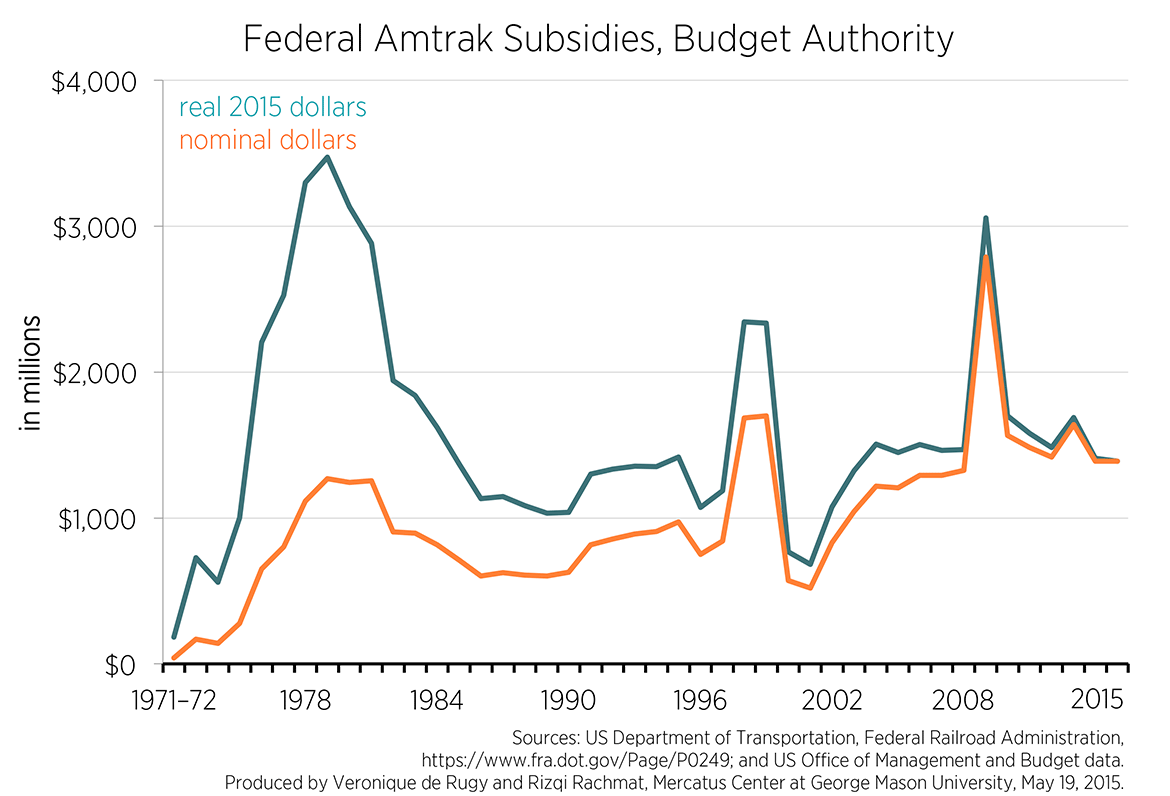
Since beginning operations in 1971, Amtrak has received, in inflation-adjusted terms, only $70 billion in total federal funding. Although that seems like a lot, from 2008-2014, Congress has backfilled the Highway Trust Fund with $65 billion in general fund revenues to avoid insolvency and promote improvements in infrastructure and safety. In just seven years, Congress provided nearly the same amount of general fund support for highways as Amtrak had received in its 45 years of existence. Moreover, when revenues rise as a result of robust ticket sales, such as recently when Amtrak unfolded their new “see this beautiful country” advertising campaign, Congress often uses this as a justification to cut federal support further, taking away momentum gained from an excited and captivated U.S. transportation audience and further burying Amtrak in the mud both economically and in reputation.
Inadequate funding also makes it difficult for Amtrak to comply with necessary safety requirements, such as the installation of positive train control, or PTC, technologies. Positive train control is a communication-based technology that relies on transmitting information using radio signals to provide real-time data on the location, speed, and direction of trains (DeGood). This system is capable of preventing derailments from excess speed, train collisions, and incursions into work zones, among other benefits. When Congress mandated the adoption of PTC in 2008, it did not provide any additional funding or set aside the radio spectrum for Amtrak and other transportation agencies to communicated. As a result, Amtrak and other providers have had to lease spectrum at market rates from spectrum holders, further driving up expenses and launching Amtrak into a tough economic hole, as well as forcing Amtrak to choose between basic rail maintenance and PTC installation.
Funding is not the only challenge, as the system of passenger rail in the United States is set up in a very flawed manner. Unlike passenger rail providers in many other countries, Amtrak operates most of its service on tracks owned by private freight railroads, states, and other public authorities, such as Union Pacific or the Kansas City Southern Railway. In fact, Amtrak owns only 28 percent of the 21,300 route miles it covers. This means that Amtrak has little to no control over its on-time performance, as scheduling and track maintenance decisions remain within private companies, who have no incentive to schedule their trains behind to allow Amtrak trains to pass by and arrive at stations on time. This is especially punishing to Amtrak, as their reputation relies a lot on their ability to get consumers to their locations on time and efficiently, which is not able to happen in the current setup of our national rail system.
So, what is there to do about this? Amtrak is a national asset that will not be able to continue to provide reliable service or expand to meet future population growth and travel demand without additional investment. This is especially true in the Northeast, where approximately one out of every three jobs in the region is within 5 miles of a passenger rail station. Over the next four decades, the region is expected to grow by more than 30 percent, adding approximately 15 million new residents. Without improved passenger and commuter rail service, this growth will lead to crippling congestion that hampers U.S. economic performance not only internationally, but domestically as well. In my eyes, the only logical way to solve this problem in the current, privately owned railroad industry that we live in, is to increase federal funding to include enhanced safety measures, create newer, more efficient infrastructure, and then, maybe one day, Amtrak will be able to become profitable.
Graphs show 1) the drop in Amtrak subsidy despite an increase in ridership 2) increase in ridership 3) loss vs. ridership

Works Cited
DeGood, Kevin. "Understanding Amtrak and the Importance of Passenger Rail in the United States." Center for American Progress. 2019 Center for American Progress, 4 June 2015. Web.
K, Harvey. "How to Fix Amtrak." Trains Magazine. Kalmbach Media, 1 Feb. 2009. Web.
Singer, M.E. "Fix Amtrak? Fix Its Board First." Railway Age. 2018 Simmons-Boardman Publishing Inc., 17 Jan. 2019. Web.