Monday, October 7, 2019

So You Want a Cat?

Grace Zimmermann
Personal Finance, A4

So you want a cat. Sure. At least forty seven million US households feel the same way. But taking care of a living being is a huge financial responsibility. Of course, costs will depend on the age, size, and general health condition of the cat you adopt but all possible costs should be considered before one signs the adoption papers. Here’s how you own a cat on a budget:


Costs only included in the first year are represented in blue. Annual costs are in red/yellow.
Adoption fee: This fee varies on age where young kittens are more expensive than the adults. For the sake of generalizing, a young adult American shorthair would cost about $75-$150. A kitten would cost from $200 to $300, so if you’re a cat lover on a budget, you should consider adopting an older cat.

Spaying/neutering: Most likely, an adult cat from an adoption agency is already spayed/neutered so you wouldn’t have to pay this. However, if you adopt from a breeder or adopt a young kitten, the surgery can cost up to $200 depending on the cat’s size, age, and health. With that in mind, the cheapest option would be adopting from an agency.

Medical fees: An initial medical exam will cost about $130 but will be a one time thing. In order to keep you cat healthy, they’ll have to undergo annual routine checkups which can be divided into four sections: office calls, vaccines, fecal exam, and heartworm test.

The office call, which is a regular examination, will cost about $50.
Vaccine boosters will typically be done two to four times a year and will cost you $20 each.
The annual fecal exam will cost about $35
The annual heartworm test, which tests for heartworm disease, will cost $45

In general, the annual medical cost of a healthy cat will be $190. These are the typical procedures for any cat but if your cat has a disease and needs to undergo surgery, these costs can very easily go into the thousands.

Food: Wet food cans range from $0.56 to $1.50 depending on the brand. Dry food bags will cost about $20 (but ranges from $7 to $38 at petsmart). It’s healthy for a cat to receive both dry and wet food. Dry bags will last around two and a half months, meaning that you’ll go through about 5 bags a year. That’s $100. As for wet food, a can will last four days. That’s $91 a year. In total, food will cost $196 a year but can differ based on the cat’s needs.

Pet Insurance: This may not be mandatory but is important to consider. A decent coverage plan will cost $360-$600 a year. By taking this option, you’ll be covered if your cat has a medical emergency, which could save you thousands.

Equipment: Cat collars will be about $8 and ID tags fall at around $8 as well. I’d suggest getting your cat an ID tag so that they’re able to be identified if they run away. As for toys, you don’t have to spend anything. Sure, you can purchase a $9 string toy but cats typically enjoy a simple shoe lace or twig much better anyway. Scratchers are good for their claws and can cost $35. If you’re on a budget, just glue rope to a wooden pole. Cheap brushes will be $3.40 but it is suggested that you purchase a Furminator, which costs $30. While more expensive, it collects hair much better, which avoids matts and visits to the professional groomer (which can cost $50). Litter boxes will be $10 and scoops $5. In total, equipment will only cost $61 initially.

Standard cat litter will cost about $10 a box and needs to be changed monthly. A box will likely get you through three months, adding up to $40 annually.


In total, it will cost $876 annually and $1,167 the first year. With this in mind, it’s important to note that if you can not afford to pay these costs, you should not adopt a cat. Some may think they’ve found a loophole by adopting a free farm/stray cat. However stray cats typically have a lot of medical issues which will cost a fortune to overcome (I should know! I adopted a farm cat who now requires medicine everyday. I also own a stray who has appetite problems. While it’s good to give care to a cat that needs it, it’s financially safer to go with the healthy agency cat!)

Therefore, those wanting to adopt should wait until after college to take another life into their care. Throughout college, you can set aside savings for pet ownership to prepare. Many of us want to own an animal but it would be wiser to wait until we are financially stable before signing that adoption contract.

Works Cited
Allen., Meredith, et al. “The Annual Vet Visit Cost: What to Expect.” PetCareRx, Published by: PetCareRx, 13 Aug. 2013, www.petcarerx.com/article/the-annual-vet-visit-cost-what-to-expect/1276.

“American Shorthair Kittens for Sale.” Adopt a Dog or Cat Today! Search for Local Pets in Need of a Home., www.adoptapet.com/s/adopt-an-american-shorthair.

“Cat & Kitten Health Care Costs: Check Ups, Vet Visits, And Care Expenses.” Catological, 26 Apr. 2019, www.catological.com/much-cat-healthcare-cost/.

“Facts   Statistics: Pet Statistics.” III, www.iii.org/fact-statistic/facts-statistics-pet-statistics.

How to Save For Retirement

How to Save For Retirement
Written by: Sylecia Weisman-Ramey

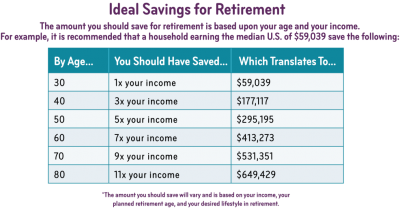
If you’re like most Americans, you most likely don’t know how much money you need to live comfortably when you’re older. 61% of Americans don’t know how much money they need to save for retirement, according to Bankrate Survey from 2018. “As much as you can” is the standard advice. The most logical answer is at least 10-15% of your income will begin to make up your retirement fund, starting as soon as your early 20’s. Of course, that’s just a general guide. Here’s an example of what a big difference starting young can make.

As you can see in the graph above, the earlier you save, the better off you are in the future when you are no longer able to work. Many might ask well, where should I save my retirement funds at? There’s 2 main accounts that come to mind.The best places to keep your retirement funds are IRA’s and 401(k)’s. As you approach the age for retirement, most experts say that people should gradually start increasing the amount of money they put in their retirement fund as they get older. When planning for retirement, the common truth is that the earlier you start saving and investing, the better off you will be. They say to start saving as much as you can in the moment, but at our age that may not be the case. Extra money? Don’t spend it, put it in your retirement fund and make sure to set goals for yourself. Overall, It’s never too early or never too late to save for retirement.


Works Cited
Dayana, and Forbes. “How to Save for Retirement.” NerdWallet, NerdWallet, 8 Apr. 2019, www.nerdwallet.com/article/investing/how-to-save-for-retirement.

Pant, Paula. “How Much Money Should You Put into Your 401(k)?” The Balance, The Balance, 10 Sept. 2019, www.thebalance.com/how-much-should-i-put-in-my-401k-453991

Tepper, Taylor. “How To Save For Retirement.” Bankrate, Bankrate.com, 4 July 2019, www.bankrate.com/retirement/how-to-save-for-retirement/.

Thursday, October 3, 2019

Making Power Moves

Making Power Moves
Written By: Agastya Asthana

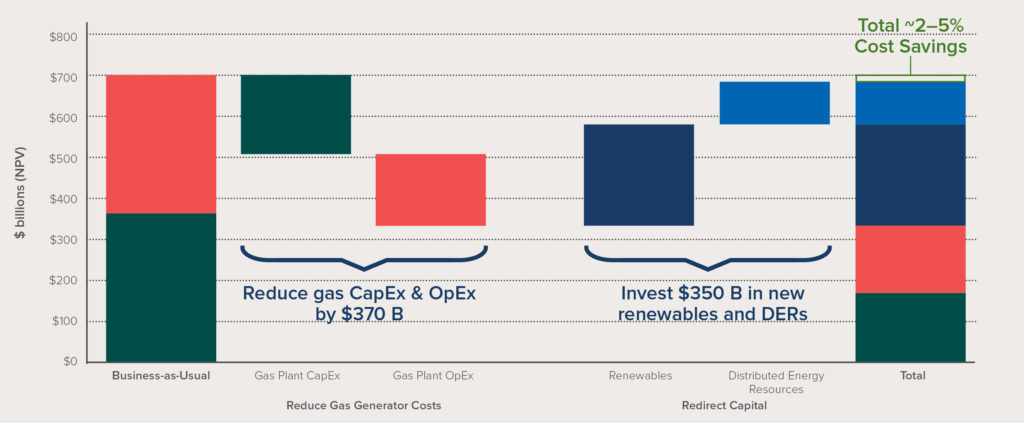
Clean energy is question understood by most but addressed by the few. 90% of the people claim that global warming and climate change are problems that should be addressed, yet only 5% of those 90% have taken action by buying electric cars or installing solar panels. The only reason demand is so low for clean energy generating devices is that clean energy is a want, not a need. People have grown complacent of their sources of energy for their daily use and consider switching to cleaner methods as a menial and lengthy task. What people are not realizing is that increased CO2 levels will prove themselves to extremely noxious for humans to the point where clean energy generating devices will be a communal need.


-courtesy of Rocky Mountain Institute

Industrially, there are not many solutions that exist out there, which will be able to meet the rising demand of clean energy. Most products are either hard for people to get their hands on, too expensive, require daily maintenance, or simply don’t produce enough energy to light up a single home. The normal coal and gas powered energy producers are enticing their customers in future investment of upwards of $1 trillion. Companies like PaveGen are in the development of producing such devices but unfortunately they are currently focusing on a single method of electricity generation. As a result, I have taken it upon myself to deal with this situation. For my Engineering Design & Development class, I have embarked on the idea of creating a single company that would be able to provide cutting edge technology on creating energy generating devices. Some of the prototypes are as follows: Tiles that generate energy as people step on them - courtesy of PaveGen, door knobs that harness the rotational energy that humans exert on them, and doors that harness the pushing energy exerted onto them. Having all of these products one supplier will increase demand in the same fashion Apple devices are so popular worldwide. When buying an IOS device or a Mac, you simply have to look at different options that Apple offers, whereas buying a windows or an Android device requires you to research over 1000 different companies that produce them.


-PaveGen proto tile
If such products achieve a high status in the market, then I fail to see why humanity's future won’t be bright.

Works Cited
Brueck, Hilary. “In Washington, DC, People Are Using Their Feet To Turn On The Lights.” Forbes, Forbes Magazine, 18 Nov. 2016, www.forbes.com/sites/hilarybrueck/2016/11/18/pavegen-energy-generating-sidewalk/#5018bb9c78da.

Litwhiler, Dale H, and Thomas H Gavigan . “A Door Motion Energy Harvesting System for Powering an Electronic Door Lock .” A Door Motion Energy Harvesting System for Powering an Electronic Door Lock , cd14.ijme.us/papers/013__Dale%20H.%20Litwhiler%2C%20Thomas%20H.%20Gavigan.pdf.

“The Economics of Clean Energy Portfolios.” Rocky Mountain Institute, rmi.org/insight/the-economics-of-clean-energy-portfolios/.

The Out-of-State Premium

Sydney Reehm
Reuter, Economics B2
The Out-of-State Premium

Wisconsin colleges are fine, right? But what if I want to attend school somewhere else instead? I will have to pay almost triple the price as everyone else, that’s what.

The National Bureau of Economic Research states that “roughly 75 percent of students nationwide attend in-state institutions.” That still leaves tens of thousands of already-poor college students struggling to pay out of state tuition costs, assuming they’re not on scholarship.

Out-of-state tuition is more expensive than in-state-tuition because non-residents of that state are not paying the taxes that fund that school. However, they are paying taxes that fund a different school. For example, if I would want to attend the University of Georgia (Athens, Georgia) I would, as a Wisconsin resident, pay $31,120 instead of residents’ $12,080 [Afford]. And that’s just tuition, not to mention the extra $700 estimated in books and supplies. This is because I don’t pay taxes to the state of georgia and fund that school like the residents there do. This also means, though, as a wisconsin resident, I pay taxes on UW-Madison (Madison, Wisconsin) even though I do not attend that school. I am still paying my money to the government, just not to the same state in which I would be attending college.

The idea is that you are getting the best use out of the taxes you pay, but if I’m not going to a Wisconsin school, I’m not utilizing that resource anyway. Perhaps Georgia doesn’t want me taking the spot of a taxpayer, but if I am a more qualified applicant, then I should get the seat anyway (but this interferes with college attainment numbers and in-state percentages, which is a conversation for another time). Should I still have to pay the extra $19,040 dollars to attend the school? Technically, it would be full circle, because there are Georgia residents paying for UGA that are attending a different state’s school, or a private school instead. UGA would still be getting money, just not from me, specifically. Is it then my responsibility as a student to give them even extra? The state government officials setting the gap say yes.
Image result for in state vs out of state tuition
This also encourages students to attend institutions that may be a lesser fit for them. Say I live in Vermont or Rhode Island, am from a financially struggling family, and I would like to earn a degree in aerospace engineering. If I stay in-state, I save money and can afford the tuition, but am going to a school that less suits my needs because no colleges in my state offer a graduate degree in my field. If I go to Purdue in Indiana, I am going to a college that much better fits my needs as a student, but I am now in crippling debt, putting stress on my family and myself, and cannot afford to go. I choose an in-state school, am not happy, and not receiving my degree. Perhaps I’m so anxious and burdened by an extra job that I’ve now dropped out. Without a large out-of-state tuition gap, I could’ve had the career of my dreams. Instead, I have settled, because that’s what I was monetarily forced to do.

Therefore, I believe that in-state and out-of-state tuition should be the same, or at least more similar in value than they currently are, for the same quality of education.


Works Cited
“2018-19 Tuition and Fees at Public Four-Year Institutions by State and Five-Year Percentage Change in In-State Tuition and Fees - Trends in Higher Education - The College Board.” Research, 3 Sept. 2019, research.collegeboard.org/trends/college-pricing/figures-tables/published-state-tuition-and-fees-public-four-year-institutions-state.

“Afford.” UGA Undergraduate Admissions, www.admissions.uga.edu/afford/.
Chandler, Ryan. “Everything You Need to Know About Out-of-State Tuition.” CollegeXpress, www.collegexpress.com/interests/public-colleges-and-universities/articles/financial-aid-public-colleges/everything-you-need-know-about-out-state-tuition/.

G, Brian, et al. “The Out-of-State Tuition Distortion.” NBER, 29 Dec. 2016, www.nber.org/papers/w22996.

Molly. “Residency: Its Impact on Tuition Price and College Financial Aid.” Peterson's, Peterson\'s, 28 June 2018, www.petersons.com/blog/residency-its-impact-on-tuition-price-and-college-financial-aid/.

Nelson, Ryan. “In-State vs. Out-of-State Tuition: What Students Need to Know.” GradLime, 29 May 2018, gradlime.com/in-state-vs-out-of-state-tuition/.

Chick-fil-a Blog

JC Terrian

What’s your go-to order at Chick-fil-A? Is it a classic chicken sandwich with Chick-fil-A sauce, with a nice cold Coke, and some salty waffle fries on the side? What about some chicken nuggets with some barbeque sauce and a silky smooth milkshake to wash it down? Whatever you choose to get you can’t go wrong. Chick-fil-A has been a rising fan favorite in the past few years while climbing the lucrative ladder. With the Chick-fil-A tucking in a competitive Pewaukee fast-food market, how has it affected the community and businesses around it?


During the exams of 2016-17 students would rush down capitol in their 45-minute window to get some Chick-fil-A, then proceed to roll into a parking lot 2 minutes before their Chemistry exams drowns them head to toe in molecular garbage. Why? You could’ve just grabbed a chicken sandwich at McDonald's for 1$, why Chick-fil-A? I asked a few of my friends what they would do in the same scenario; Ashton Janowski stated, “I would rather pay 2 dollars more to get a higher quality meal than to cough up a dollar for something that may make me throw-up.” This was the same response given by 75% of the people I asked. While the other 25% say, "Their service is uncomparable, most of the time I go to Taco-Bell the employes are grumpy and doing something shady in the back.” Noah O’Neal summed up the general opinion of these responses. This specific location on Capitol Drive in Pewaukee recognized the demand and capitalized on it.
Image result for chick fil a
According to QSR magazine, an average Chick-fil-A produces 4.1m in annual sales. This is an average unit sales over many sites, QSR just fell the closest to the average unit sales. If you would have gone to Chick-fil-A on the opening week it would’ve taken 20-30 minutes to receive your food, but now you order and receive your food before you sit down. What does this show? Well, Chick-fil-A not only has marvelous service, but they haven’t had an overwhelming demand since March. This will probably push their annual sales for this year over 5m, but then fall next year close to the average 4.1m. Obviously 4.1 million in sales is still crazy, to have this integrated into Pewaukee will enable Capitol Drive’s economy to thrive. To put this into perspective Taco Bell has an average of 1.5M in annual sales, Panera’s has 2.6M in annual sales, and Buffalo Wild Wings rakes in about 2.34M annually.

Capitol drive was at one point a dusty two-way road. Through the development of Capitol Drive, there have been businesses that have been in an out of the restaurant scene. It has felt like Applebee’s has been there forever with Buffalo Wild Wings right next to them. Chick-fil-A, Jersey Mike’s, and Mod Pizza have come in and sparked the next transition for Capitol Drive. Chick-fil-A has added a lot of fuel to the fire when it comes to economic growth, which means we all can be excited about what’s to come.

Works Cited
Rachel. “America's 25 Most Lucrative Fast-Food Chains.” QSR Magazine, 30 Oct. 2018, www.qsrmagazine.com/content/americas-25-most-lucrative-fast-food-chains.

Taylor, Kate. “Chick-fil-A Is the Fast-Food Chain of the Year, and Things Are Only Getting Better.” Business Insider, Business Insider, 28 Dec. 2018, www.businessinsider.com/Chick-fil-A-is-the-fast-food-chain-of-2018-2018-12.

A Different Kind of War

A Different Kind of War
Gavin Schultz


The United States and China are recognized as having the world’s two largest economies.

And they’ve engaged in a trade war.

This could potentially leave one or both countries’ trade prowess in ruins. It is undoubtedly true that the United States relies on China for many things - almost everything we own contains the words “Made In China” on it somewhere. However, the future could hold devastating consequences for China as well, as China also relies on America as a steady trading partner. So with so much to lose on the line for both countries, what’s the motive behind this bold conflict?

In case you are unsure what a trade war is, a trade war is a conflict between two countries that is initiated when one country imposes trade barriers or tariffs on another country. The second country then does the responds by erecting more trade barriers or tariffs on the country that did it first. The motive for doing so is thought to be for economic security and autarkic (self-sufficient) positioning.

The Trump Administration believes it has the upper hand in the ongoing trade war. Ryan Woo and Kevin Yao of Yahoo Finance, in their 2019 article, wrote, “The Trump administration is considering radical new financial pressure tactics on Beijing, including the possibility of delisting Chinese companies from U.S. stock exchanges” (Woo and Yao 2019). Additionally, the United States looks to further damage China’s economy by moving some companies away from the communist nation. CNBC’s Jake Novak reports in his September 7th article,

Just five days after that trade war flare up, the Nikkei business daily reported on Aug. 28 that Google is shifting its Pixel smartphone production to Vietnam from China starting this year and that the company is also looking to shift some of its smart home speaker assembly to Thailand...It’s not that Google is the first U.S.-based company to announce some shift away from China; more than 50 other big names have moved out or scaled back (Novak 2019).

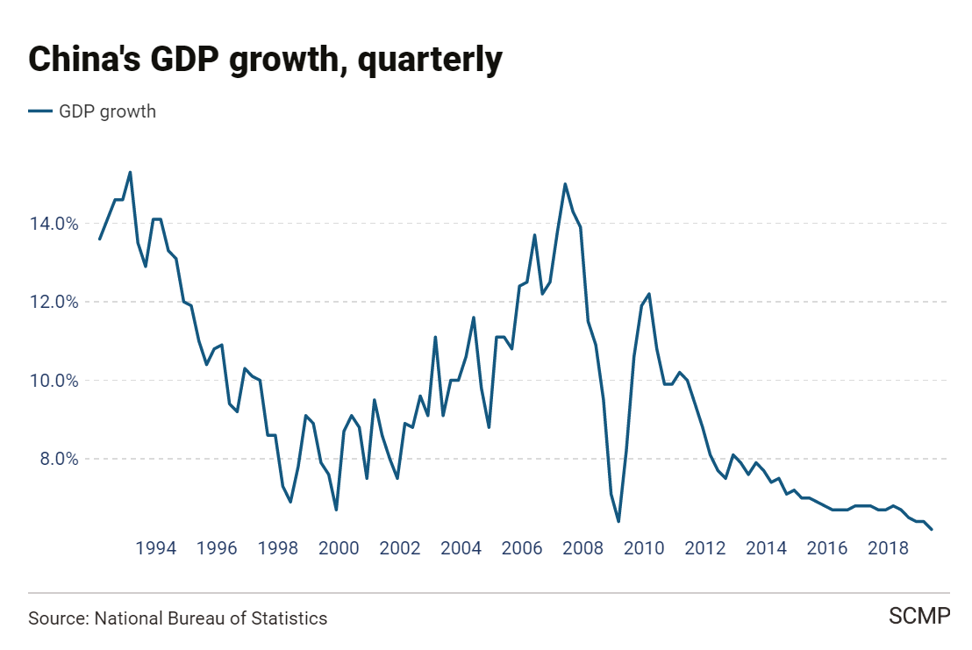
This is a big, bold move by Trump. The message he is sending to China is one of hostility and self-interest. By shifting technology production elsewhere, Trump is effectively saying “forget you” to China. And it seems to be working. The figure (below), taken from a 2019 South China Morning Post article, shows China’s GDP growth, which is at an all-time low.
China’s economic growth slowed to a record low of 6.2 per cent in the second quarter.


It’s not just China feeling the pain in this war. Wars affect both sides, and this trade war is no exception. Numerous business owners are feeling the weight of the heavy tariffs. Virginia Harris, a BBC News writer, reported on some small business owners in her August 2019 article. Sherrill Mosee, one of the interviewed business owners, told Harris, “‘As a small business my finances were already a little tight. I had to figure out how I was going to get the money to operate the business. We're all paying for this, not [only] China,"’ (Harris 2019). Additionally, Harris reported on Litgear, a travel bag company, who has felt the full blow of the trade war. Harris writes, “When tariffs on some of those goods were hiked by 10% last December, chief executive Magi Raible had a feeling the matter might drag on for some time. She acted quickly to shift some production out of China to Cambodia. Later those tariffs were increased by another 15%” (Harris 2019).

Clearly, both sides are harming and being harmed in the process of trying to create economic reforms. While China may be trying to satisfy economic demands of their own or are simply responding to aggressive tariffs from the United States, it is unknown.

With talks set to begin in mid October, the world holds its breath. It is safe to say that everyone, even the countries not directly involved in the trade war, hopes for a positive, friendly outcome. Because when the two largest economies on the planet crash head-to-head, who knows what will come next?


Works Cited
“China Urges 'Calm and Rational' Resolution to U.S.-Sino Trade War.” Yahoo! Finance, Yahoo!, 29 Sept. 2019, finance.yahoo.com/news/china-says-companies-facing-many-094644914.html.

Harrison, Virginia. “US-China Trade War: 'We're All Paying for This'.” BBC News, BBC, 1 Aug. 2019, www.bbc.com/news/business-49122849.

Jakejakeny. “Tariffs Are No Longer China's Biggest Problem in the Trade War.” CNBC, CNBC, 7 Sept. 2019, www.cnbc.com/2019/09/06/tariffs-are-no-longer-chinas-biggest-problem-in-the-trade-war.html.

“Trade War Is Harming US Economy More than China's, Beijing Official Claims.” South China Morning Post, 18 July 2019, www.scmp.com/news/china/diplomacy/article/3019071/trade-war-harming-american-economy-more-chinas-claims-official.


Wednesday, October 2, 2019

The Effect of Technology on the Job Market


The Effect of Technology on the Job Market 

By: Ava Landmeyer

It used to be that the not getting the job usually meant that there was simply a better applicant than yourself. Maybe they were more qualified, professional, or had a better interview than yourself. However, it is becoming more and more common that the more qualified “applicant” who was chosen over you for that position you were hoping for may have not even been a person, but rather, a computer. 


“The robots are taking our jobs”. This phrase is commonly heard in relation to the debate on the effect of technology on our job market. However, as shown in the graph above, there are two sides to this argument. As technology and artificial intelligence continue to advance, many jobs are facing a declining demand. Much of the fear that surrounds the idea of technological advancements taking over the workplace has came about due to the crippling debt, unemployment, and the cost of education that many are already facing. Technological advances have reduced the need for jobs that are centered around routine, mechanized work, such as data entry keyers, typists, and similar jobs shown to be declining in the graph above. In fact, an Oxford study predicted job losses of up to 47% within 50 years. Similarly, the McKinsey Global Institute reported that an estimated 375 million jobs will be eliminated due to technological advancements by 2030.  Even in the current times, 25% of jobs in the U.S. are being threatened by automation. According to a similar study as shown in the graph, the jobs most at risk for being replaced by artificial intelligence are telemarketers, computer support specialists, receptionists, and similar occupations. Advancements in technology have not yet revealed the effect that they are going to have on our economy, although many of these statistics point to the idea that many will be at risk for becoming unemployed. Unfortunately, those with the lowest incomes will be most affected by this shift, as the majority of the jobs with the ability to be replaced by technology will be those with the lowest.
 wages. 
However, there is another valid side to this argument: what about all the jobs being created by the new and exciting advancements in technology? As shown in the graph above, the occupations with the most estimated growth are jobs related to fields requiring high-skilled technical, analytical, and personal work. This shift is job growth is due to the fact that, while technology is proving to be advancing at an impressive rate, it has not yet reached the point of being able to replace jobs that involve emotional and personal aspects, such as home health aides, or highly-skilled analytical jobs, such as nurse practitioners or software developers. Additionally, the advancements of technology itself are posing the idea of many brand new jobs being made available. In fact, an estimate made by the World Economic Forum stated that while 75 million jobs may be lost in the next four years due to a shift towards more automation in the workplace, 133 million new jobs will also emerge as a result of this shift. 

So, what’s the correct answer? Is technology going to hurt or harm the job marker of the American citizen? Unfortunately, we haven’t quite reached that answer yet. Technology will without a doubt eliminate many of the jobs that offer employment during the current age, such as receptionists, data analysts, telemarketers, etc. However, technological advancements will certainly also provide for some brand new occupations and opportunities within the field of technology. Therefore, we cannot say with certainty that technological advancements and reliance on automation and artificial intelligence can either harm or help the economy or job market. However, the statistics and predictions for how this shift will impact our economy and the future of the job market allows us to make educated decisions as to how we employ ourselves and the future generation, as well as the value of a live, breathing employee over a generic computer. 


Works Cited
Bernazzani, Sophia. “10 Jobs Artificial Intelligence Will Replace (and 10 That Are Safe).” HubSpot Blog, blog.hubspot.com/marketing/jobs-artificial-intelligence-will-replace.
Brown, Steven, and Pamela J. Loprest. “How Is Technological Advancement Changing the Labor Market?” Urban Institute, 21 June 2019, www.urban.org/urban-wire/how-technological-advancement-changing-labor-market.
Shaban, Hamza. “Machines Will Create 58 Million More Jobs than They Displace by 2022, World Economic

Forum Says.” The Washington Post, WP Company, 18 Sept. 2018,

www.washingtonpost.com/technology/2018/09/18/machines-will-create-million-more-jobs-than-they-

displace-by-world-economic-forum-says/.
Related Posts Plugin for WordPress, Blogger...