Thursday, March 20, 2014

High Demand for Flappy Bird

Written by: Carter Allen 
High Demand for Flappy Bird

All it took was a few weeks for the mobile game ‘Flappy Bird’ to take over the app stores on almost all devices. This free and addictive game involves a bird that the player controls and makes fly through metal pipes that serve as difficult obstacles. The frustrating and everlasting game took over the app market place in what seemed over night. The rapid rise in popularity caused a global bandwagon effect and the demand for the game skyrocketed. However, the rapid rise was accompanied by an equally unanticipated fall when the creator, Dong Nguyen, took the game down in early February of this year.
Nguyen shut the game down simply due to its addictive nature along with the stress he was experiencing; but was the opportunity cost of deleting the app to save stress worth losing all the money made each day from advertising? Nguyen believes it was, as he announced to the public, “it is an addictive product. I think it has become a problem. The game is gone forever” (Shoichet). What was a shock to many were the negative externalities the difficulty the game caused. From time lost to fights with family and friends even to “marriages ended” (Shoichet) there were endless amounts of complaints. Perhaps the deletion of this game has brought these people peace, but many are outraged as they can no longer participate in the latest fad. The app store does still provide many available substitutes, but in most cases consumer preference was too high for this game to be replaced.

With Flappy Bird being removed from the market, the market responded with an even greater demand for this private good. The consumers who had already downloaded the game before its removal were able to keep it on their mobile devices, but as of now the game is not downloadable. In turn, this has increased the value of smartphones and other devices with Flappy Bird installed on their hard drive. As you can see in the visual below, in some cases on eBay the value of a phone with the game installed has more than tripled its value. Select Samsung Galaxy 4 and iPod devices have reached the one thousand dollar mark.

Some believed that Nguyen should continue the game, but set in a dollar fee to it. At its best, I believe this game was rather inelastic; it was so exceptionally popular and addicting that the dollar fee would have had little influence on the number of downloads. In a particular two-week time span Flappy Bird was downloaded over fifty million times (“Game Over”). The amount of revenue Nguyen could have made off this would have been substantial along with the money made off of advertisements.
At its peak, Flappy Bird was making Nguyen over $50,000 simply in advertisements each day. For a game he created in “two to three days” (Shoichet) this marginal benefit of money made off advertising far outweighs the marginal cost of making it. This game was a great achievement and asset of Nguyen’s and there has even been talk of him releasing it back to the public. Overall, his sudden stop of supply stunned the market and it will be interesting to watch if the global phenomenon makes a second appearance in app stores everywhere.


This YouTube video serves as a great overview of the economics of Flappy Bird:

Works Cited
“Game Over.” The Economist. The Economist Newspaper Limited, 2014. Web. 17 March. 2014.
Norman, Alex. “The Curious Case of Disappearing Flappy Birds.” Medill Reports Chicago. Medill Reports – Chicago, Northwestern University, 2001-2014. Web. 17 March. 2014.
Phillips, Jack. “Flappy Bird: Developer Dong Nguyen Mulling Bringing Addicting Game Back.” The Epoch Times. Epoch Times, 2000-2014. Web. 17 March. 2014.
Shoichet, Catherine E. “Developer yanks ‘Flappy Bird’ after game soars to success.” CNN. Cable News Network, 2014. Web. 17 March. 2014.
“28 Days of Fame: The Strange, True Story of ‘Flappy Bird’.” Mashable. Mashable, 2014. Web. 17 March. 2014.

Wednesday, March 19, 2014

March Madness, is it Good or Bad?

March Madness, is it Good or Bad?
Brady Callen

March Madness. When most people hear those two words, they instantly think basketball, but what a lot of people don't think about, is how much of a distraction the games are. Everywhere, from  high  schools  to  the  workplace,  people  will  be  watching  basketball  games  on  TVs, smartphones, and tablets. As for  schools that may just be something else to distract kids that already  aren’t  paying  attention, and might  not have the big of an effect. But in the workplace, March Madness creates a huge negative externality.

All over the country Americans will be watching in place of working, which is bad right? Maybe not.  Although  lost  wages  are  estimated  to  be around $1.2 billion for each unproductive hour, according to the consultant firm Challenger, Gray, & Christmas, there are positive outcomes of the  games.  March  Madness  can  increase  morale  among  workers,  as  their teams do  better. Seeing your team prevail, or even just watching them play whether they win or not in the end can inspire  you  to work more, and better.  It can also  be a way for employees to bond. Assuming workers in one business cheer for the same team, they find similarities and work better together after the games. Going through the three weeks knowing that someone  else is hoping for the same team to win allows you to connect with that person, which will then let you work better with them later. So after the inevitable decrease in productivity, there can perhaps be an increase that surpasses what it was in February for example. This positive externality is a nice counter to the negative one more commonly thought of.

Then  there’s  also  things  like  sportswear  sales,  tournament  ticket  sales, hotels, and possibly even increased sales of TV’s to watch the games.
(graph)http://www.statista.com/statistics/219655/ncaa­basketball­tournament­games­ticket­sale
s/

As you can see, not only do  ticket  sales  create a  lot of revenue, but the amount is also rising every year. Television revenue from the games is also rising from about $400 million ten years ago to about $684 million last year. If the increase stays relatively constant, in another ten years that  number  could  be  close  to $1.2 dollars.  The revenue generated from just  television could equal lost wages of companies.

As  the  games  begin,  so  does  the  distraction  from  work  and  school,  and  so  does  the  team bonding between workers. Who will you be cheering on?

Bibliography:
● "Is March Madness Really Good for the Economy?." SmallBusiness. N.p., n.d. Web. 18
Mar. 2014.
<http://smallbusiness.aol.com/2011/03/15/is­march­madness­actually­good­for­the­econ
omy/>.● "March Madness Could Cost Employers $1.2B." Challenger, Gray & Christmas, Inc..
N.p., n.d. Web. 18 Mar. 2014.
<http://www.challengergray.com/press/press­releases/march­madness­could­cost­empl
oyers­12b>
● "NCAA college basketball tournament TV/television revenue 2013." Statista. N.p., n.d.
Web. 18 Mar. 2014.
<http://www.statista.com/statistics/287522/ncaa­basketball­tournament­television­revenu
e/>.
● "NCAA college basketball tournament revenue from ticket sales 2013." Statista. N.p., n.d.
Web. 18 Mar. 2014.
<http://www.statista.com/statistics/219655/ncaa­basketball­tournament­games­ticket­sal
es/>.
● "The New Republic." New Republic. N.p., n.d. Web. 18 Mar. 2014.
<http://www.newrepublic.com/article/117045/economic­costs­and­benefits­college­bask
etball­ncaa­tournament>.

Next Generation Consoles: Their Economic Impact

Next Generation Consoles: Their Economic Impact
Austin Baylor

We’ve entered the eighth round of counsels in video gaming with the introduction of the Play Station 4, Xbox 1, and Wii U; developed by Sony, Microsoft, and Nintendo respectively. We may not all own of play on them, but we’ve heard of them, but have we heard the economics behind the competitive market video gaming it?
The PS4, Play Station 4, and Xbox 1 have a combined total sale of over 10 million systems and they have only been in the market for 4 months. The PS4 currently pushes ahead over the Xbox 1 due to the price difference. The PS4 opened at 399$ while the Xbox was 499$. To those who don’t have favorites, it’s clear what your first choice would be. Both systems also rocket over 1 million sales within the first 24 hours of their release dates in about the exact same time, so price was initially not an issue in the choice of the consumers.
Bill of materials cost comparison of TechInsights.

Cost and Profit Comparison Chart.


Now to the actual amounts these companies make. With the chart above, it shows that Microsoft makes almost 3x as much money from a sale of an Xbox 1 compared to a sale of a PS4 on Sony’s part. If we round the sale figures to the nearest million, Sony sold 6 million and Microsoft sold 4 million systems. With sony making an estimated 40$ per system, they’ve profited 240 million dollars in profit so far from the system sales alone. On the other hand, Microsoft has sold 4 million at around 110$ of profit a piece. That accounts for 440 million dollars of profit from systems alone for Microsoft. This is almost twice the profit Sony has made.

New systems are not released often and the last generation of systems came out almost a decade ago. It’s up to these companies to produce the best they can to make the most they can. It’s also a huge war to try to get others to be part of their brand and not the other.

Most people own an Xbox or PS4. Not many own both, and as systems get more expensive, the number of people owning both shrinks, so it is important to the companies to get people to buy their product and not the other.  As of now the Play Station Systems are more popular, but mostly because of cost and not loyalty. Xbox owners tend to be more loyal to the Xbox knowing the extra costs needed to own one.

These companies push millions of dollars into the market each year with video games alone. Usually these come from the annual release of games that sprinkle money into their pockets, but every decade or so they unveil a brand new system. One reason is to stay ahead of the crowd and the other is to give a boost to their companies. It’s only been 4 months since the release of these systems, the companies and the economy are still seeing a lot of money circulating because of 2013’s huge gaming system release.

Sources

How War Affects the Economy

Tanner Hollrith
Mr. Reuter
Economics
17 March 2014
How War Affects Economy.
World War I and II are the greatest and the worst wars that ever happened. The U.S. was involved in both and the economy changed drastically. Wars should never happen, but when they do the economy changes in both directions.
            During the First World War, the United States was neutral for most of the war. They didn’t start fighting until 1917 but they were selling U.S. good to the European allied countries. This was good for the U.S. because selling their product makes the country grow in money. In 1917 the U.S. joined and that meant more jobs were made. The unemployment rate declined from 7.9 percent to 1.4 percent in the time period. During the Second World War the United States didn’t enter until 1941 when Pearl Harbor was attacked. All of the men went to war and this is the time period when women took over. Women took the jobs that men had. This was the solution for the unemployment rate because women finally got jobs instead of staying home. This graph below shows the unemployment rate during the two world wars. The big drop in unemployment rate is caused from World War 2.
Also when it comes to war, the goods people need to survive become scarce. During war time, the supply and demand curve changes. The supply decreases and the demand increases. During World War 2 rationing and price control impacted the civilians that made most families have trouble providing food for their family. Rationing and price control was invented to not have the same problem that occurred during World War 1.  Rationing is this U.S. government making the distribution of goods fair for everyone because the resources are scarce. Some goods that are rationed are gasoline, tires, sugar, meat, silk, shoes, and nylon. Citizens get booklets and tokens so they can buy what they want for the ones that are rationed. Rationing is a way to decreases inflation that occurred in the First World War. The war had to be paid and inflation occurred. Prices increased and the value of money changed. Every war causes come inflation but not at an extreme as the one from World War 1. Below is a picture of what a ration booklet looked like.
            When war occurs, it just doesn’t affect the people the fight. The economy affects in a good way and a bad way. The great depression is the worst drop in the stock exchange in the history of United States.  The economy was hit so hard, that according to gwu.edu a glossary on The Great Depression “By spring of 1933, when FDR took the oath of office, unemployment had risen from 8 million to 15 million”. But one of the ways that the United States did to help the Great Depression to end is the start of World War 2.
            These two wars changed the way the economy is today. These are just two wars that the United States were a part of. Countries need money for wars and they will find ways to get it. Also supplies are needed and they will make more jobs or ration goods. Either way, wars impact differently. It could either be good or bad it depends on the country fighting.
           
Works Cited

"The Economics of World War I." National Bureau of Economic Research. N.p., n.d. Web. 16 Mar. 2014. <http://www.nber.org/digest/jan05/w10580

"The Great Depression (1929-1939). 17 Mar. 2014. <http://www.gwu.edu/~erpapers/teachinger/glossary/great-depression.cfm>.

Movie Sequels and their Financial Benefits

Movie Sequels and their Financial Benefits
Miranda Kozlik

It seems like all successful movies follow up with a sequel or maybe multiple sequels. Of course the directors of these movies want to keep their production alive, fans yearn for more of the movie, and the actors are usually willing to follow up the first production yet that isn’t the reason why they make another movie. If there is a spike in interest solely off of one movie, producers jump on that opportunity because of the money. Since the 20th century, the cinema of the United States—generally referred to as Hollywood—is known throughout the world. The American film industry has grossed more money every year than that of any other country and their good at it.  Because of this success, if one movie gets a rise out of the audience, the demand for a second, third, fourth, one is high and the profit is rewarding.

Everyone can relate to the hype of Harry Potter’s movies. Because of the book and the first movie, the producers were not hesitant on transferring the sequels of the books onto the big screen. The first movie, according to “The Numbers: Harry Potter Movies”, made a worldwide profit of almost one billion dollars when in theaters. Because of this hype and revenue in November 16, 2001, a year later the second installment was created. America’s profit skyrocketed exporting these productions that included 8 total. “Harry Potter and the Deathly Hallows: Part II” had the highest profit almost producing 1.5 billion, once again only in theaters. Altogether the installment of the whole Harry Potter movie series created a profit of $7 billion knocking down many old record holdings for the Box Office history. 

ox Office History for Harry Potter Movies

← See all franchises
Release DateMovieProduction
Budget
Domestic
Opening
Weekend
Domestic
Box Office
Worldwide
Box Office
Trailer
Nov 16, 2001Harry Potter and the Sorcerer's Stone$125,000,000$90,294,621$317,575,550$974,755,371
Nov 15, 2002Harry Potter and the Chamber of Secrets$100,000,000$88,357,488$261,987,880$878,979,634
Jun 4, 2004Harry Potter and the Prisoner of Azkaban$130,000,000$93,687,367$249,538,952$796,688,549
Nov 18, 2005Harry Potter and the Goblet of Fire$150,000,000$102,685,961$290,013,036$896,911,078
Jul 11, 2007Harry Potter and the Order of the Phoenix$150,000,000$77,108,414$292,004,738$942,943,935
Jul 15, 2009Harry Potter and the Half-Blood Prince$250,000,000$77,835,727$301,959,197$934,416,487Play
Nov 19, 2010Harry Potter and the Deathly Hallows: Part I$125,000,000$125,017,372$295,983,305$956,399,711Play
Jul 15, 2011Harry Potter and the Deathly Hallows: Part II$125,000,000$169,189,427$381,011,219$1,328,111,219Play
Totals$1,155,000,000$2,390,073,877$7,709,205,984
Averages$144,375,000$103,022,047$298,759,235$963,650,748
Because the books ended, the last Harry Potter movie in 2011 was the last big revenue to gain from the series. Now producers and writers are trying to find the next big thing. Some say that Marvel’s superhero series is going to be it.  Already, according to “Marvel Comics”,  because of the success of “Iron Man” in 2002, the idea of created a series of superhero movies was a go. Creating about 30 movies already, Marvel has gained around $5.8 billion and it’s only the beginning. Because of the response towards Iron Man, sequels (now 2) and ideas branching off of this movie have skyrocketed. In the past year (2013), five Marvel movies erupted the big screen and the demand for more because of the response is creating hype for the production of movies coming out up until 2015. Some of these movies include “Robocop”, “Captain America: The Winter Soldier”, “The Amazing Spider-Man 2”, “Avengers: Ager of Ultron”, and “Superman vs. Batman”. Estimating the profit of around $200 billion per movie, Marvel has a lot coming their way.

http://img2.wikia.nocookie.net/__cb20130627144006/ironman/images/5/5d/The-Avengers-2-poster.jpg
http://cdn.screenrant.com/wp-content/uploads/Captain-America-2-Winter-Soldier-Logo-1024x640.jpg
Why does this relate to economics some may ask? The CEO of Time Warner, Jeff Bewkes says sequels for movies make sense financially. Even though it takes a lot to produce these movies including money, sequels to movies are “more predictable” and “are more profitable and less risky than medium or small” budget films. The idea of sequels weren’t always big though but now, all studios are becoming skillful at creating these types of films. He explains how movies are franchises; businesses that need to keep growing because competition is growing in our capitalistic country. Bewkes also touches on that “even the grow overseas and via online distribution” is a big factor when it comes to the amount of profit made on the sequels of movies. Movie production has only just begun to be big. New ideas and new storylines are constantly going to be made based off the consumers trends and lucky for us, all we have to do is enjoy them.


Citations


Friday, March 14, 2014

The Battle for the Internet Overturning Net Neutrality

The Battle for the Internet

Overturning Net Neutrality
By: Joel Godden
                Although you might not be familiar with the term net neutrality, it plays a very large role in over everyday lives.  Net neutrality states that broadband network providers should be completely detached from the information that is sent over their networks. Basically what they are saying is that internet providers aren’t allowed to slow internet speeds from some web sites and raise them for others; however, the U.S. Supreme Court moved the American Economy closer free market side of our mixed economy, they did this by take a laissez faire approach and removing the government regulation from internet providers such as Comcast, Time warner Cable, and AT&T.

                This ruling works in favor of the already large internet providers and gives them too much power. The network providers want a “tiered internet” where people would have to pay more for a faster connection and those who cannot pay will be left behind with the slowest internet connection. Below is a picture of how the tiered system would work.

As you can see from the image, without net neutrality internet providers would be allowed to charge what they wanted for services such as, google, Netflix, and Skype. Although the abolishment of net neutrality moves us closer to a free market it is not a good thing. According to Adam Smith, the government plays a key role in making sure the economy remains balanced. Removing net neutrality has allowed the power to shift from the house holds to the firms. Companies that already make large sums of money will now be able to take more money out of the hands of spenders.

                Some may argue that a free market is the base of our country; however, the real base of our country is the constitution and bill of rights. And within the bill of rights we are guaranteed the right to free speech. The abolishment is a clear violation of that right. It limits what we can access and impedes on our fundamental rights. It allows the companies to block content and speech from the user. Whether it’s a website they don’t like or an app the directly competes with one of their own. Not only that but it also has many negative externalities for smaller websites or future startups. After all, how will smaller companies be able to compete with large companies on an internet where you have to pay for a faster connection? Another problem that will occur without net neutrality is “double dipping”. Companies are being paid for internet access and now they want to be paid for what you do while you’re on the internet.

                We are in an age where technology has become a part of our everyday lives. Computers are used almost, if not, every day. Now companies what to use this fact to make even more money. The loss of net neutrality will be felt in a lot of different places. The abolishment will also stifle advance and progress.   


http://www.savetheinternet.com/net-neutrality

Wednesday, March 12, 2014

The Profits of Airlines

By: Joe Porter 

In America, there are many opportunities to prove your knowledge and make yourself rich. Starting back in the early 1900’s with the big coal companies, steel companies, and oil companies rising to the top, there has been an outburst of wealth that these monopolies dictate through our country.  The one major monopoly that still is thriving in today’s down turn economy is the airline. There will always be an aggregated demand for flying in America, along with an aggregated supply that constantly stays in the long run equilibrium.
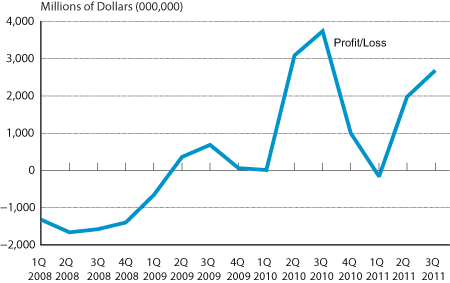
            The economic profits that airlines encounter are up with the profit of companies who make billions such as Exon or Mobil oil companies. According to the economist “The International Air Transport Association (IATA) said this month that it expects industry profits to hit a record high of $19.7 billion in 2014.” This increases 50% from 2013’s 11 billion made. No matter the price of gas going up the demand will still be at equilibrium and since the demand for both gas and airplanes, two complimentary goods, both will encounter an exceeding economic profit. As shown in the graph below, airlines have somehow come out of this economic down turn and are now on the uprising in profit.
           

This youtube video shows how airline profits were able to take off from 2010 to current projections. With the downturn in the economy the fiscal policy would be to cut taxes both state and federal and increase government spending. Thus, allowing airlines to increase ticket prices for flying which increased their revenue and with the unemployment rate rising this allowed for airlines to cut some loose ends and save even more. But the real economic question is, is what are they doing with all that resource?
            According to la times “airlines will invest in roomier seats, tastier food, and better entertainment systems….that would enable them to offer pricier seats.” This going along with what has been said before with aggregate demand being constant thus sticking with changes in price level shows the amount of control a monopoly like the airlines have.  According to Business and Money “Airline profits are expected to soar to a record high in 2014 as companies cut costs, fuel prices drop and passenger demand rises.” Airlines are also doing good to the economy, through their success they are raising the GDP, cutting out some of those lost taxes that the government has to endure from the recession, and overall controlling the market prices to make it less risky.
            America is largely in debt, we find ourselves in these major recessions trying to climb out of the holes we put ourselves. Therefore, I applaud these monopolies that still find a way to make a profit in a down turn economy that would make most people think is impossible. Airlines have found the key to success in such an economy and will keep making a profit as long as they stick to the game plan which included supply and demand.


Works Cited


Related Posts Plugin for WordPress, Blogger...