Wednesday, February 21, 2018

Trump's Major Impacts

Trump’s Major Impacts
Alex Kraussel

After winning the election in 2016, Donald Trump looked to “Make America Great Again”. But what has he really done? When looking at the statistics, he has had a yuuuuuge impact on the stock market. The S&P 500 was at a decrease right before Trump was elected, but after, it was at a major increase. It had increased around 550 points. Not only has the S&P 500 risen, but the whole stock market in general. The market has hit record highs ever since Trump was elected. Last month in January, the market had been thriving. Although, it has hit a bit of a wall. High interest rates and inflation are to blame. This has been a problem on notice for a little while now. But it is finally being realized that this problem is real and happening.

Not only did Trump help the stock market, but he has brought unemployment down to a record low too. It is current
ly at 4.1%. This is the lowest in recorded U.S. history. This is also a huge deal because this was one of the topics Trump had promised during his campaign. This has also lead to a tax break, saving many less wealthy families extra money that they can utilize for basic needs.


To close, I believe that people should put their grievances against trump aside and give him a chance. He may not be the best person personality wise (based on opinion), but he sure has done a lot for our economy and market. Personally, I believe that he has had more benefits on our country than drawbacks. I also think that he is a great leader for us. He is one of the first presidents who tells it how it is, and I really admire that about him.


Works Cited

 Chu Economics Editor, Ben. “What Has Donald Trump Achieved for the US Economy 12 Months after Winning the Presidency?” The Independent, Independent Digital News and Media, 8 Nov. 2017,

Shen, Lucinda. “Trump Loves Taking Credit for Stock Market. Other Presidents Did Better.”Fortune, 8 Nov. 2017, fortune.com/2017/11/08/donald-trump-record-stock-market-election/.

Friday, February 16, 2018

How Much We Spend For Love

 How Much We Spend For Love
Written by: Brooke Jende

February 14th is either an excitedly anticipated holiday or a highly dreaded one. Many couples and loved ones enjoy Valentines day and see it as a chance to celebrate love. On the other hand, many see it as a corporate ploy to get people to spend money on romantic gift items that they do not need. While I believe that the idea of Valentine's Day is sweet and romantic, the reality is that Valentine's Day has simply become a way for businesses and companies to get people to spend their money on overpriced goods. 

Just like for Birthdays and Christmas, Valentine's day revolves around gift giving. The significant difference when it comes to Valentines gifts are that they typically fall into the realm of chocolates, flowers, and other love related items. Because these are common valentines goods, stores take advantage of the holiday and the aggregate price level of Valentines goods are increased during this time. While we economists would typically see an increase in price level result in a decrease in amount demanded, the increased holiday demand for these products is what allows companies and businesses to rack up their prices and yet still get consumers to purchase the products. This year in particular, According to the National Retail Federations latest statistics, “Consumers will spend a near-record $19.6 billion on Valentine's Day.” The large profits and high prices both confirm my belief that Valentine’s day is becoming a holiday that's all about making more money. 

While I believe Valentine’s Day has become a commercialized way get people's money, there is a positive effect on the economy as a result of this holiday and it can be related to the multiplier effect. The multiplier effect states that given change in a particular input, such as Valentines Day goods, a larger change in an output will occur. In the case of Valentines Day, people are spending more of their money on Valentines items. Because of this the money they spend will directly benefit the companies, business selling the items and will then use that money and create a strong multiplier effect, which will in the end increase the Gross Domestic Product. 


Works Cited

“Explaining the Multiplier Effect | tutor2u Economics.” tutor2u, www.tutor2u.net/economics/reference/multiplier-effect.

Ngabirano, Anne-Marcelle. “On Valentines Day, heres how much were willing to spend for love.” USA Today, Gannett Satellite Information Network, 14 Feb. 2017, www.usatoday.com/story/money/2017/02/13/more-expensive-year-show-your-love/97766678/.

“Valentine's Day.” National Retail Federation, 13 Dec. 2016, nrf.com/resources/consumer-research-and-data/holiday-spending/valentines-day.

Thursday, February 15, 2018

Why Would you Host the Olympics?

Why Would You Host The Olympics?
Josh Geisel

The Olympic games are hosted every other year by the country who is willing to spend the most money on the games, this money is often seen as an investment and a small cost compared to the potential profit for the country. Usually, the budget of the games is well below the amount of money a country can afford and the predicted profit makes the games seem like a no-brainer when it comes to investments. With the games, comes a massive expectation to out-do the last host of the Olympics which in turn means more money needs to be spent. The budget can be quickly diminished before the games even start as the countries don’t take into account setbacks and problems while creating the games.


Almost every Games for the last few decades have gone over budget at least a little bit. In 2014, Sochi held the Olympic games and the final cost was 289% of their budget and 51 billion dollars. To put the 51 billion dollars in perspective, The Dallas Cowboys stadium is regarded as one of the best stadiums in the United States and that stadium costed 1.3 Billion dollars to build, which is only a tiny fraction of how much money was spent in Sochi. Although the budget of the Olympics includes: building infrastructure, travel costs, payroll of employees, and other expenses. This is still a lot of money and is more than any other by almost 10 billion dollars.

Isn’t the money spent on the Olympics only an investment for the huge profits that will come in the end? The profits, in the end, are anything but guaranteed. Over the years there have been many games that came out ahead such as The Vancouver Winter Olympics which raked in almost 2 billion dollars for the country and The Beijing Olympics which earned about a billion dollars. But these countries are outliers compared to other Olympics such as the Sydney Olympics which lost over 2 billion dollars and even the Athens Olympics which lost a whopping 14.5 billion dollars in their investments.

Why would a country host an Olympic Games if it is such a bad investment? The Olympic Games is unlike any other world event. 3.6 billion people are expected to watch the 2018 Olympics this year which is nearly half of the world’s population. The Host country is definitely put on the world’s stage during the weeks of the Olympics which can make or break how other people feel about the country for years to come. A good Olympics will boost tourism for years to come and in turn increase economic growth. But a bad showing of the Olympics can ruin the future of the country in terms of tourism, which is why countries are willing to spend so much money for the Olympics and lose money. The money lost in the Olympics can and will be made up in the end if the country spends the money to make the Olympics great which is why the investment in the Olympics isn’t as bad as it seems.
Works Cited

“Cost of the Olympic Games.” Wikipedia, Wikimedia Foundation, 11 Feb. 2018, en.wikipedia.org/wiki/Cost_of_the_Olympic_Games.

Goldblatt, David. “Cost of Hosting the Olympics: How It Got So Expensive.” Time, Time, 26 July 2016, time.com/4421865/olympics-cost-history/.

McCarthy, Niall. “The Massive Cost Of Hosting The Olympic Games [Infographic].”Forbes, Forbes Magazine, 4 Aug. 2016, www.forbes.com/sites/niallmccarthy/2016/08/04/the-massive-cost-of-hosting-the-olympic-games-infographic/#6b2b6f772e38.

Chinese Imports and Exports Set to Surge Forward

Chinese Imports and Exports Set to Surge Forward
By Christa Buth
As of right now, a large majority of any American’s belongings were made in China, this is because of the large capacity of exports China has, and it is only getting greater. As Mr. Reuter said in class, ”I will give $20 to anyone wearing only clothes produced in the U.S.”. China and other countries exports support a great deal of America’s products. Thus with China’s exports rising, Americans can expect quite a few more products with the infamous “Made in China” sticker.
As of January 2018, China reported a 36.9% rise in imports and an 11.1% rise in exports. Because China’s trade surplus for the month amounted to a whopping $20.34 billion, it beat expectations set by a poll produced by Reuters (a business and financial news source). To be exact the data exceeded the polls expectations by 27.1% gap in imports and a 1.5% gap in exports. Now festivals, such as the Long Lunar New Year, may alter trade data for the month. This is due to increased spending for the holiday festivities and buying gifts that may be shipped from outside countries. But thus far there has been healthy domestic trade in 2018. 
As a change from past years (see graphs) data collected for the month of December 2017 indicated imports had risen 4.5% from where they were a year ago. Most of China’s imports are raw materials from Central America and Africa. China’s commodity consumption has fueled a world-wide boom in mining and agriculture. Specifically coal imports reached their highest rates since January 2014, according to Reuters records. This is most likely caused by colder weather hitting China and raising the public need for coal. It is natural for economies to fluctuate through time and as of right now the numbers are showing an upward trend. This meaning that China will be taking in more materials from other countries. Data currently shows exports have decreased a little, but with the upward trend set in January it is optimistic to say the trend will continue to rise. Data collected from December of 2017 shows that exports had risen 10.9% from where they were in December 2016, a great feat. With a larger global need for China’s exports, this boosts need for laborers and bringing the unemployment rate further down. With more citizens employed there are more active consumers, therefore boosting China’s economy.
In total January alone produces a trade surplus of $20.34 billion dollars while polls produced by Reuters predicted a 54.1% trade surplus. 


As of right now, China is the world’s second largest economy and grew by 6.9% last year. This beat strong predictions made for strong global and domestic demand. According to Tan Huileng for CNBC, ”a favorable external environment will continue to support China's exports in 2018. However, domestic demand may face challenges if there is a "a more pronounced-than-expected impact of the planned financial tightening and slower real estate activity,". If all goes well, China is looking towards a prosperous future. 


Graphs
https://tradingeconomics.com/china/exports
https://tradingeconomics.com/china/imports

Sources
https://www.cnbc.com/2018/02/07/china-reports-january-exports-imports-trade-data.html
https://www.thebalance.com/china-economy-facts-effect-on-us-economy-3306345


Classics are back in Style

Classics are back in style
Shannon Huren

If I were to tell you that in 2018 one the most popular and profitable brands out right now would be Champion would you believe me?  Well Hanesbrands saw sales climb 2 percent in the third quarter ended Sept. 30, to $1.80 billion, returning to organic sales growth, for the first time in eight quarters. The rise was driven primarily by double-digit international segment growth. On the international front, net sales increased 16 percent and operating profit increased 25 percent for the International segment in the third quarter. Results were mainly driven by the high demand of Champion and brand growth in Europe and Asia (http://us.fashionnetwork.com).
Hanesbrands Inc. Stock


 Champion apparel was everywhere in the 90’s and was a very popular in sportswear. Champion produced uniforms for all the NBA teams during the 1990s, and some NFL teams during the 1980s and 1990s. It has also produced sportswear for many major colleges.Champion was also the kit manufacturer of the Olympic basketball team also known as the “Dream Team”  that competed at the 1992 Summer Olympics.  Even at the time when there was only a fraction of the number of clothing brands that there are now, there weren't many labels that had Champion's insane demographic reach. It was the uniform for jocks and preps, but also for skaters and hip-hop heads. Champion was all over the hardcore punk scene, but it was just as popular among jam band fans.

Then the hype died down drastically Champion went from being one of the hottest brands out to being a Walmart brand. During the early 2000’s to just recently Champion was known to most as an afterthought. A brand that was really only bought in stores like Walmart or Target something cheap and lacking in quality.  Champion was and still is being sold in Walmart or Target however, the newer Champion gear is completely separated from the Walmart lines.

One key element in the brand's comeback has been Champion’s way of capturing the eyes of the quote on quote “Hypebeasts” as well as the causal shopper. Champion has done that with a barrage of headline-grabbing  collections with a broad range of collaborators, from Supreme to Vetements even brands like A Bathing Ape,and Wood Wood. These major collabs not only kept Champion's name in everyone's mouth, but also highlighted the brand's versatility. 

Nowadays Champion is at the forefront of 90’s nostalgia within fashion.  In a quote from Manny Martinez (Champion’s global brand ambassador) he said, “I think we're in a golden hour. The brand doesn't actually need collabs right now. Not that we don't appreciate them, but now is when the brand can live on its own. When you see Kylie Jenner wearing the brand on her own, it's not because it's a collab. You see people wearing it because it's Champion. That's the beauty of it."

Champion is a brand that’s seen it’s fair share of highs and lows over the years. However, it’s hard to understate the phenomenal comeback of this brand. There comeback is something that brands looking to resurrect or emerge in the fashion scene need to look and model their approach after Champion. Don’t be surprised if you see Champion continue to succeed and prosper in the fashion industry.

https://www.youtube.com/watch?v=Gth1y6yuNLg
Watch the video :)
“THE BIGGEST UPCOMING HYPE BRAND! HOW CHAMPION IS GETTING HYPE!”

Works Cited
Jennifer,Braun. “Hanesbrands Revenue Hits $1.8bn, Global Champion Sales up 16%.” FashionNetwork.com, 1 Nov. 2017, us.fashionnetwork.com/news/Hanesbrands-revenue-hits-1-8bn-global-Champion-sales-up-16-,886698.html#.WoOW4oPwbZ6.
Raymer, Miles. “How Champion Became One of the Coolest Brands Around-Again.” Esquire, Esquire, 9 Oct. 2017, www.esquire.com/style/mens-fashion/news/a54070/champion-sweats-comeback/.

Tuesday, February 13, 2018

Spain’s Surprising Growth

Spain’s Surprising Growth

Written by: Payton Wolf

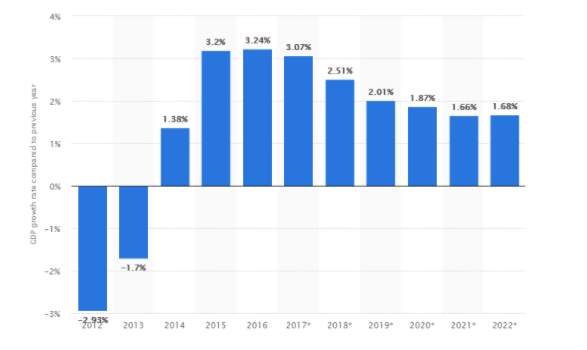
Spain was one of the countries that was most affected by the eurozone crisis, which brought it's economy to the brink of collapse. Unemployment rose as industrustries could not pay minimum wage for its employees during the recession. However, over the last couple of years, Spain has managed to increase its GDP and recover from this disaster. In 2014, it's economy grew 0.6% and 0.6% in the second and third quarters of the fiscal year, respectively. Why that may not seem like a large growth, in reality, this is an increase of several million dollars in some cases. Spain was able to recover because it focused on increasing the amount of goods it exported.

Exports are one of the factors that contributes to a country's Gross Domestic Product, along with consumer spending, investment spending, and government spending. Exports improve the GDP because Spain produces new goods within the borders of the country. The goods that are produced 2014 contributed in the economic growth recorded during that year. If the goods had been produced in a different country, for example France, they would not have been included in Spain’s GDP, so they focused on loyal, sometimes family run businesses to produce within the country. Specifically, Spain focused it's manufacturing efforts in pharmaceuticals, automobiles, capital goods, and more. These industustries are centered around exporting their goods to other countries, increasing Spain’s total GDP.

Producing exported goods within the country also increased the employment rate, and the number of people in the workforce. During a recession, it is common for people to give up looking for a job because there are simply no jobs out there. At this point, these disgruntled people are no longer considered unemployed, nor are they a part of the workforce. However, using local businesses and industries allows more local citizens to find jobs, increasing the employment rate. Increasing the amount of exports in a country is a very effective way to not only increase the GDP of a country, but also increase the amount of citizens who have jobs and are able to provide for their family. Spain is likely going to continue growing economically due to this decision, possibly surpassing other large European nations.


Works Cited
“Economic Forecast for Spain.” European Commission - European Commission, 7 Feb. 2018, ec.europa.eu/info/business-economy-euro/economic-performance-and-forecasts/economic-performance-country/spain/economic-forecast-spain_en.

Monaghan, Angela. “Spain's Economic Recovery Gathers Momentum.” The Guardian, Guardian News and Media, 30 Oct. 2014, www.theguardian.com/world/2014/oct/30/spain-economic-recovery-growth-quarter.

China’s Outrageous Economic Growth

China’s Outrageous Economic Growth

By Morgan Impola

China has been a long time player in the world economy, but China itself has been stagnant in its’ economy for hundreds of years, often failing to compete with global powers like the British, French, Russian, and Japanese Empires, which often abused the region to exploit resources or to exert domination of China. But over the past 60 years, The “People’s Republic” has grown to one of the largest powers in the world, dominating industries that factor into production whilst also having a bounty of natural resources to boot. This lucky combination of resources, labor, and domestic industry have allow China’s GDP to grow at insane rates, topping at 6.9% during the last quarter of 2017, in comparison, the GDP growth of the United States was around 4%.

With the increase of GDP growth means that the overall GDP will continue to grow if they expand their domestic production, leading to and increase in consumer spending, which further cycles into the Nominal GDP of China each year it continues to grow.

One of the less-known factors of China and their insane GDP growth is the fact that with overall GDP growth ties in GDP per capita: Many Chinese citizens are moving toward the middle class. The shift from rural farming, to urban development not only advances the society as whole, but also provides a bountiful land of opportunity for many newly endowed urban dwellers. This focus on urban development has created many issues socially. First and foremost is the issue of peasants who have been farming for a large chunk of their lives suddenly being thrusted into a society that revolves around skills that consider technical prowess- something that rice farming does not require in any manner. There also is the issue of housing, most of China’s coastal cities are larger than some countries, and this isn’t even considering if the inhabitants have proper housing; Take the city of Hong Kong for example. Hong Kong is a former protectorate the British Empire and is an economic gem for China, but regarding housing, many city dwellers are relegated to up 40 square feet apartments for multiple people! (To put this into perspective, an entire apartment could be the size of a king-sized bed for three people). This type of housing predicament seems odd considering Hong Kong is also home to some of the most luxurious and exclusive housing in the world.

While the economic gains of China are pretty significant, with the insa every nne GDP growth rate, there are a significant amount of underlying issues that are often hidden from the public eyes, mainly the plight of the lower classes. But what can be said is that China is no longer the laughingstock of the Orient, rather they are carving their own path in every nook and cranny across the world, even if you don’t know it yet.


Works Cited
Bradsher, Keith. “China's Economic Growth Looks Strong. Maybe Too Strong.” The New York Times, The New York Times, 18 Jan. 2018, www.nytimes.com/2018/01/18/business/china-gdp-economy-growth.html.

“Hong Kong's Shocking 40-Square-Foot Apartments Photographed by Chinese Human Rights Group.” Inhabitat Green Design Innovation Architecture Green Building, inhabitat.com/chinese-human-rights-group-releases-shocking-aerial-photos-of-hong-kongs-locker-sized-apartments/.
Related Posts Plugin for WordPress, Blogger...