Tuesday, February 25, 2020

The difference between homeowners insurance vs. renter’s insurance

The difference between homeowners insurance vs. renter’s insurance
By: Annie Edward

It’s not going to be a long until you rent out your own place and eventually buy a home. It’s important to protect your home when buying it, which is why most buy insurance. There are two insurances available when it involves protecting your home: homeowners and renters. Knowing the difference and similarities, in addition to what each insurance provider can help you in the long run and be beneficial in protecting your home.

RENTER’S INSURANCE (https://youtu.be/llXiZrgAQ_A )


Renter’s insurance is designed for people in rented spaces and is provided by the owner and purchased as part of the lease agreement. In order to understand renter’s insurance, let’s look over what it covers:

Privacy Property: This is 80% of the coverage provided by renters insurance (Bergen). Before giving you the lease, the owner will require you to estimate the cost of your valuable items and the price to replace them, which then becomes the coverage limit. The coverage limit comes in handy when there is any damage to your personal item-furniture, clothing, and other-within your coverage limit. However, the protection is only covered through certain risks or known as perils, such as a fire, and not provided in all situations (Allstate).

Personal Liability: This is the next major part of the renter’s insurance and protects you from any unwanted damage and lawsuits from the leaser.

According to the NAIC (National Association of Insurance Commissioners), renter’s insurance costs about 10-15 dollars per month. The low price of this insurance comes from the difference of how much coverage it provides.

HOMEOWNER’S INSURANCE
Homeowners insurance is a coverage program designed for those who have their own home (condo, home, anything you own). The homeowner’s insurance is usually required for those with mortgages and is common insurance for those within that database. In order to understand what homeowner’s insurance is, let’s look at what it covers:

Dwelling Coverage: This is the coverage of any actual damage on your property, which includes a broken roof, damaged fences, and so on. Like the privacy property policy in renter’s insurance, there is a peril, where the home insurance has a list of incidents of what it covers. For example, if your house roof was damaged because of a tornado, which is on the perils list, it would allow for the dwelling coverage.

Personal Property: This policy protects any belongings inside your home, such as a computer. Note that this is always included in the dwelling coverage, but again depends on where you are getting your insurance from.

Personal Liability: The same as concept policy as renter’s insurance, but for accidents that happen within your home, and not rented place.

The price for homeowner's insurance is relatively higher than renter’s insurance, around 300-1000 dollars, because of dwelling coverage. The dwelling coverage is the main difference between the two types of insurance because more coverage means a higher price tag.

THE RIGHT ONE
Obviously the correct insurance is dependent on your housing situation. If you are renting a place, then a renter’s insurance may become a mandatory action, however, if you have a mortgage, your lenders will require you to have a homeowner’s insurance (Bergen). However, there might be situations in which you debate between the two types of insurance, so it’s best if you know what each insurance has to offer in order to get the best deal.


Works Cited
Bergen, Amy, et al. “Homeowners Insurance Vs. Renters Insurance - Which One Is Right For You?” Money Under 30, www.moneyunder30.com/homeowners-insurance-vs-renters-insurance.
“NAIC News Release: NAIC Releases Homeowners Insurance Report.” National Association of Insurance Commissioners, www.naic.org/Releases/2019_docs/naic_releases_homeowners_insurance_report.htm.
“What Is Renter's Insurance .” AllState , Oct. 2019, www.allstate.com/tr/renters-insurance/what-does-renters-insurance-cover.aspx.

Economic Effect of NFL Stadiums

Economic Effect of NFL Stadiums
PJ Heimsch

I’m sure most people have heard of the new sports league surge that the XFL is making. The XFL offers a different range in entertainment, than its counterpart, the NFL. It allows you to watch the traditional game of football with the perks of listening to coaches and players reactions during live action via on field microphones. As well as allowing you to see some of your favorite college players that just didn’t make the cut for the NFL. I briefly watched the Tampa Bay Vipers game over the weekend and realized that they were playing in Raymond James Stadium (the Tampa Bay Buccaneers stadium). This exciting new surge of fans were wearing jerseys and other merchandise, which got me thinking, how does an NFL stadium affect the local economy? Especially with two different leagues utilizing it.

Obviously NFL stadiums are very expensive, does that money get paid off? Professional teams immersed in cities create an irreplaceable culture. The Atlantic says, “Strangers at a bar can commiserate about a loss, and a championship run can bring a city together… But these benefits are intangible.” These stadiums create a huge change in the community, but that change isn’t always economically beneficial. The problem with these stadiums is how they bring in money. Most purchases at NFL stadiums are made by local fans. These local fans would be spending that same money in the area with or without an NFL stadium. NFL stadiums are a new way of circulating money, the ticket and merchandise purchases don’t create that much of an economic change. Also, along with the upfront cost of stadiums, there are maintenance costs and renovation costs throughout the year.

There are situations where these stadiums are beneficial for a community. I’ve already talked about the huge cultural benefits, but there are also benefits in the jobs being created and the double utilization involved with an XFL and NFL team in the stadium. Although the jobs are slim they do make a difference. There are temporary construction jobs lasting a few years when the stadium is being made, and there are permanent jobs in the stadium created locally. Another benefit of these stadiums is the utilization by multiple leagues. NFL teams have only 8 home games a year, but once you involve another league such as the XFL, that’s when tickets and merchandise make a bigger impact in the local economy.

Overall, the benefits and losses of NFL stadiums are all situational. Stadiums will thrive in some environments more than others. With the Dallas Cowboys leading the NFL in 2019 in operating income with $420M, and the Oakland Raiders coming last in the league with $28M. NFL stadiums could bust a local economy, while they could also be beneficial. No matter what these stadiums create an unmatchable culture.

Monday, February 24, 2020

The Cost of Owning a Dog

The Cost of Owning a Dog
Written By: Jessica Lacki


Being a pet owner can be very fun and rewarding, but how much does it actually cost to own a dog? From puppies to adults, dogs need a lot of care and attention in order to meet their basic needs. Though it may not seem like much money at first, it’s important to consider the cost of taking care of a dog over its lifetime. From adoption fees to dog food to vet appointments, owning a dog can be a big investment.


To start off, do your research on the needs of the dog you are considering adopting and look into the breeder or shelter you’re considering adopting from. Purchasing from a reputable breeder may be more expensive, but responsible breeders are more attuned to health and behavioral characteristics of a breed. Irresponsible backyard “breeders” fail to consider a dog's temperament and medical concerns. It may be cheaper to adopt from the irresponsible breeder, but in the end poorly bred dogs with medical and temperament issues end up costing more. Another option is to adopt from an animal shelter. Shelters have many mixed breed dogs and though the history of some of the dogs are unknown, shelters ensure that dog's medical and behavioral concerns are under control before they are available for adoption.

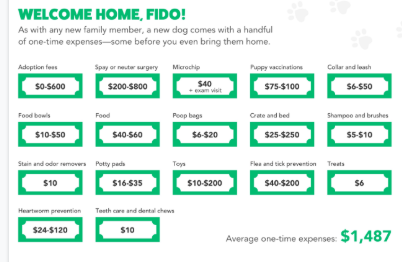
There are a lot of variables that go into how much dogs can cost. The breed of dog, the dog’s size, grooming and vet appointments, brand of food, etc. all factor in to how expensive a dog can be. It’s estimated that dog owners spend on average $1,400 to $3,000 the first year. And though this may seem overwhelming, many of the purchases made within the first year of adoption are one time purchases or things only needed for puppies. Adoption fees, spray or neuter surgery, puppy vaccinations, food bowls, a crate, and bed are considered one time purchases, but they all add up to being around $1,200. Continuous purchases like food, treats, toys, poop bags, and dental care can amount to $150 on average per month. Along with all the obvious purchases, it’s important to think ahead and be prepared for other possible expenses. Emergency vet bills, dog training, grooming, and a pet license could all add up to being over $1,000.

Adopting a dog comes with an enormous list of things to consider, but in the end it’s worth it. Dogs are known to help with both mental and physical issues and being around them helps us grow as people.


Works Cited
“21530 Dog Infograph FA0317-01.Jpg: Pets Plus Us.” Pet Insurance by Pets Plus Us, www.petsplusus.com/file/21530-dog-infograph-fa0317-01jpg.

“Ask a Vet Online for Free, 24/7.” PetCoach, www.petcoach.co/article/cost-of-owning-a-dog/.

Jaffe, Kate. “The True Cost of Getting a Dog.” The Dog People by Rover.com, 7 Oct. 2019, www.rover.com/blog/true-cost-of-getting-a-dog/.

Reisen, Jan. “Cost of Owning a Dog From Puppy to Senior Years.” American Kennel Club, American Kennel Club, 28 Jan. 2019, www.akc.org/expert-advice/lifestyle/how-much-spend-on-dog-in-lifetime/.

The Steep Costs of Healthcare in America

The Steep Costs of Healthcare in America
Sophia Castillo

According to the majority of Americans, healthcare in other countries around the world is better than healthcare in the United States (Djordjevic, Nikola). Although healthcare can be deemed as a necessity, the ever rising costs of healthcare in the US may deter Americans from receiving the resources that they need.

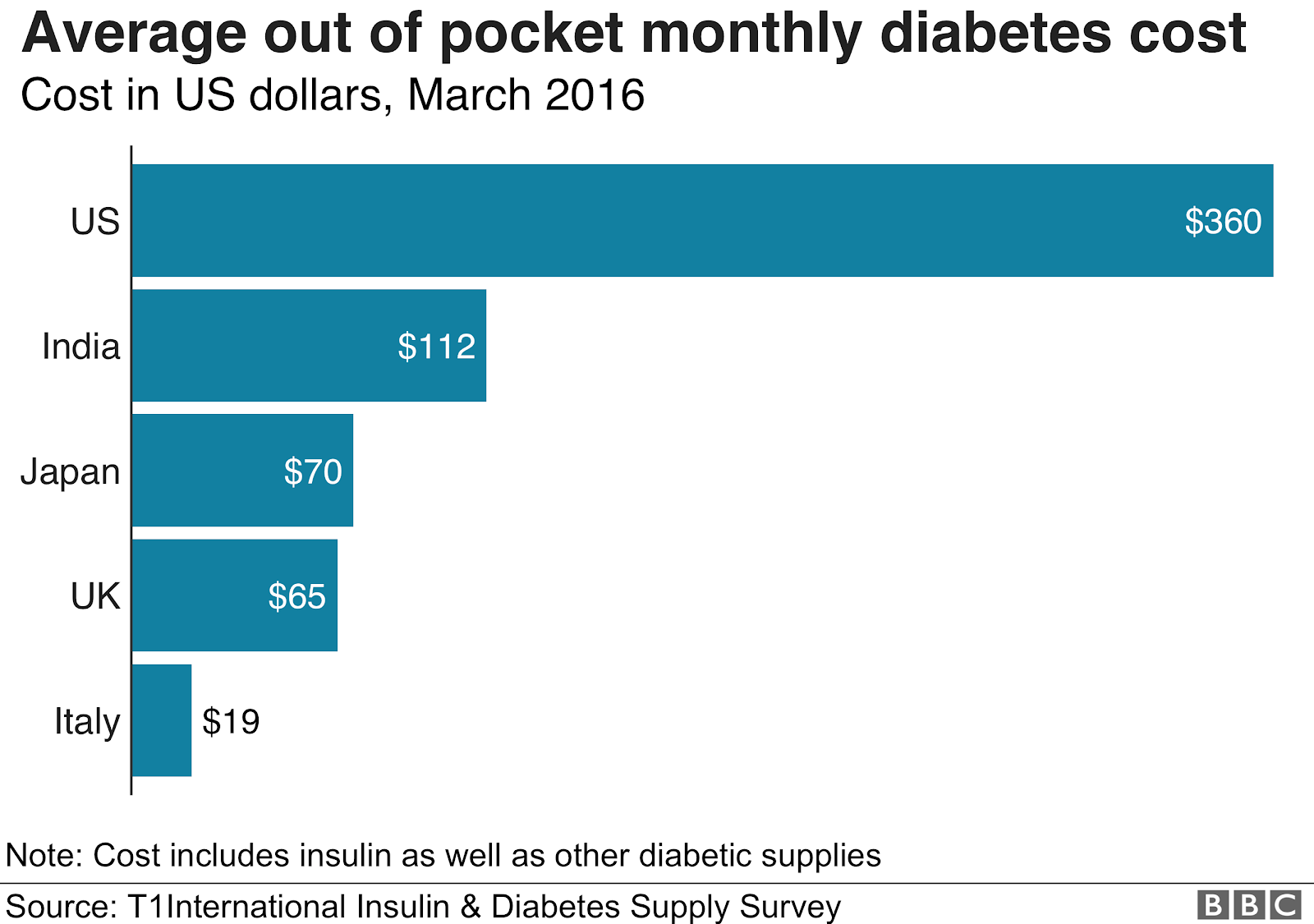
In fact, 27.5 million Americans did not have any form of health insurance coverage at any point of the year in 2018 (US Census Bureau). Without coverage, Americans have to pay for their health associated costs out of pocket. People may be uninsured if they lose their job, or do not qualify for insurance through their employer. This unfeasible way of living is the reality for many Americans, and detrimental effects can especially be seen in the lives of Americans living with diabetes. Some diabetics report paying upwards of $2,000 for a monthly supply of insulin — a non-negotiable cost to stay alive. (Prasad, Ritu). Even with insurance, insulin may not be covered until reaching a deductible, which can be as high as $10,000. The high costs of insulin in the United States are at the expense of one’s life.

In terms of prescription drugs in general, Americans spend more than anyone else in the world, at $1,200 per person per year (Langreth, Robert). In the United States, large pharmaceutical companies set high prices, as they often do not have many competitors, and maximize their profits. This is a result of the United States not directly regulating the prices of prescription drugs, unlike other nations. In Europe, with the next largest pharmaceutical market after the US, their governments directly negotiate with the drugmakers to place limits on what government funded health-systems will pay. However, leading pharmaceutical companies in the United States assert that they need such large profits to cover the costs of development of these medical advances, and that price restriction would disincentivize innovation. Advocates for stronger price regulation reason that at most large companies, the drugmakers tend to spend more on marketing than on research and development, anyway (Langreth, Robert). The cost of prescription medicine is on the rise, and medical professionals and health insurance executives fear that many drugs are becoming unaffordable at a rapid rate.

Essentially, prescription medicine costs have become rather unreasonable for Americans paying for their prescription medications out of pocket. Even for Americans with a form of health-insurance coverage, about 14% of prescription drug costs are still paid out of pocket (Langreth, Robert). Many Americans want change enacted at the national level to make prescription drugs more affordable. President Trump and other presidential candidates have made efforts to address this national concern. Time will tell how medication costs will shift as a result of potential government intervention or more drug competitors entering the marketplace.


Works Cited
Djordjevic, Nikola. “30 Staggering Healthcare Statistics to Know in 2020.” MedAlertHelp.org, MedAlertHelp, 17 Jan. 2020, medalerthelp.org/healthcare-statistics/.

Langreth, Robert. “Drug Prices.” Bloomberg.com, Bloomberg, 5 Feb. 2019, www.bloomberg.com/quicktake/drug-prices.

Prasad, Ritu. “The Human Cost of Insulin in America.” BBC News, BBC, 14 Mar. 2019, www.bbc.com/news/world-us-canada-47491964.

US Census Bureau. “Health Insurance Coverage in the United States: 2018.” The United States Census Bureau, 8 Nov. 2019, www.census.gov/library/publications/2019/demo/p60-267.html.

Can You Really Trust Online Tax Services?

Can You Really Trust Online Tax Services?
By: Tëa Goodmanson

With tax season in full swing, it’s time to start thinking about how you’re going to file them. In the past, many would hire a professional or just do them by hand. Now, there are endless amounts of online software that can help file your tax returns in minutes. But, are these do-it-yourself tax prep tools the best option? Completely trusting these online resources could harm your taxes, especially if you don’t review your finished tax returns.

One mistake tax services make deal with old law taxes. Because the database’s are so vast, tax services have difficulty completely updating their services. Some services like TaxAct refer to personal exemptions as if they were still in use. For example, services are “still telling customers they could deduct interests up to $1 million of mortgage debt” (Consumer Reports), when in actuality you can only deduct interest up to $750,000 for loans made after Dec. 15, 2017. That is a crazy difference that could totally mess up your tax returns! If you don’t catch a mistake like that or have prior knowledge about a change in tax laws, then it will be challenging to catch a mistake like that.

The major risk of filing your taxes online is the stake at which your personal data is at risk. Services will let you close out of their sites, saving your information without needing to physically press save and log out. Emails that look legitimate from the tax site where you finished your tax returns, can actually be fake. It’s a gold mine for identity theft. Picking the correct, most trustworthy site is an important factor in filing your taxes online. Luckily, the IRS has a list of authorized e-file tax services which will make your life easier. If you receive any type of email that is asking you for passwords, Social Security numbers, or credit card information, forward the email to the IRS at phishing@irs.gov. You need to always be aware of what information you are issuing out to tax services. Like always, be careful about what you share online!

Despite this, there are plenty of benefits from filing your taxes using online websites. There are thousands more success stories than horror stories. You are receiving accurate calculations because of the smart algorithms websites use. There is a smaller room for human error because websites know how to calculate everything properly. Plus, the website will walk you through the whole entire process and is walking you through possible tax credits and deductions you can receive. In addition, it is so nice that you can save your progress and return to filing your taxes at a different time. Preparing your taxes online through softwares actually makes it so you have control over your money and can physically see the whole entire process. It is easier to prepare and file your taxes at your own pace for a cheaper price.

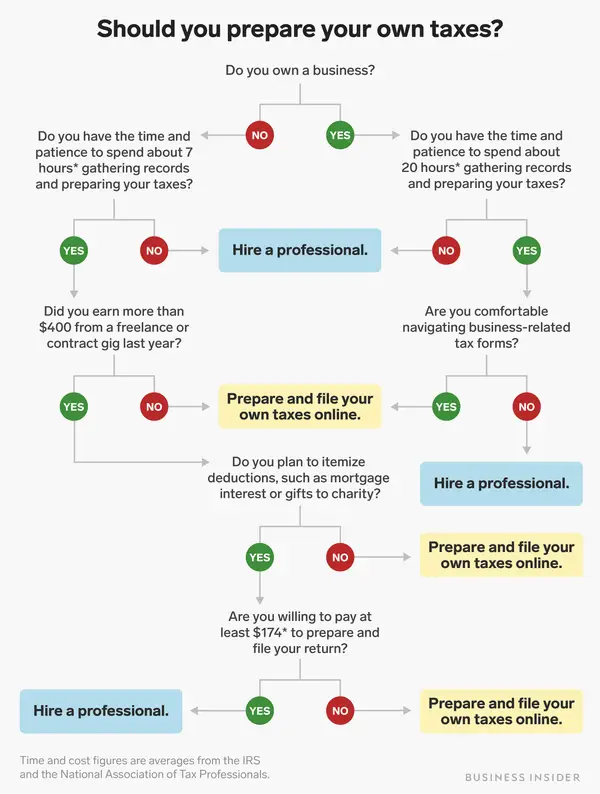
 If you are worried at all about filing your taxes online because you don’t feel comfortable sharing your personal data online, there is absolutely no shame in going to a professional! Using online softwares isn’t for everyone. There is a flow chart included in this article from Business Insider to help you decide which method is best for you. Either way, make sure your tax returns are done and completed in time before time runs out!


Works Cited
Elmblad, Shelley. “Is the IRS E-File Option Safe?” The Balance, The Balance, 22 Aug. 2019, www.thebalance.com/is-it-safe-to-e-file-your-tax-return-1293933.

Loudenback, Tanza. “Should I Do My Own Taxes or Hire a pro? Here's How to Decide.” Business Insider, Business Insider, 24 Jan. 2020, www.businessinsider.com/should-i-do-my-own-taxes-or-hire-accountant.

Neal, Brandi. “How To Keep Your Tax Return Safe This Year.” Bustle, Bustle, 16 Apr. 2017, www.bustle.com/p/is-it-safe-to-file-your-taxes-online-heres-how-to-keep-your-tax-return-safe-51524.

Perez, William. “Should You Pay Someone to Do Your Taxes?” The Balance, The Balance, 12 Dec. 2019, www.thebalance.com/should-i-pay-someone-to-do-my-taxes-3192866.

Stanger, Tobie. “Can You Trust Online Do-It-Yourself Tax Prep? CR's Evaluation Raises Questions.” Consumer Reports, www.consumerreports.org/taxes/can-you-trust-online-do-it-yourself-tax-prep-cr-evaluation-raises-questions/.

Wednesday, February 19, 2020

Teen Budgeting

Teen Budgeting
Written By: Spencer Fohr

Almost all teenagers can agree that creating room for college savings and personal spending is especially hard with very low pay, sometimes minimum wage. Not only is it hard to create room for savings and personal spending, but actually performing that task is extremely difficult. All of us have had that moment when we know that we should save the money that was supposed to be in savings, but we see a candy bar or a restaurant and can’t resist to only spend a couple bucks. Little did you know, is that those small purchases put you in a position in which it is almost impossible to save your money. This is why creating a budget is very important to us teens. Therefore, we are able to save for our future, while leaving some money for personal spending.

Firstly, we need to make the budget. This is a place where teenagers struggle. They don’t quite know how much of their paycheck they should delegate to each category. The 50/20/30 budget is a standard that a lot of teens go by. Do not assume that this is the exact way you should be splitting your paychecks, but it sure is a good guideline. Let’s use an example for this type of budgeting. Say that a student is making $200 per paycheck, in which they are paid every two weeks. Right off the bat, there is not much that a teen really needs, even though we think we need more than we do. We have free housing, food, and insurance that we don’t pay for. Therefore, I will be reducing the 50% from needs to 35% needs, and 35% savings. After splitting up the money from a $200 paycheck, $70 will go to both savings and needs, while wants gets $60. Even then, we have extra money from the needs category. One of the only things that teenagers really need is gas money and sometimes food or a driving ticket, but I wouldn’t count on it. At most, you will be spending about $35-40 on gas every two weeks. But, there could be other things that pop up, so having that extra $30-$35 is very important. Also, even if you happen to not spend that extra money, you could split that into the wants and savings category. Like I said before, there are some factors from person to person that could alter this base budget, but it is a very good starting place for teens who don’t know where to start.

After we create the budget, we need to put it into action. This is not only the hardest step for me, but also other people. Even though we have a virtual budget, not spending the money that is supposed to be saved for college or gas is difficult. For that reason, I have come up with a few tips. One tip that I find most effective is leaving cash or your debit card at home when you are going to school. One thing I personally find is that I like to get food on my way home from school, which is only a few bucks, but it definitely adds up. So, leaving extra money at home when you are going somewhere in which you won’t need money is very effective in maintaining your budget. Another quick tip to saving money and staying loyal to your budget is thinking about your spending often. So, if you are at the store looking for a specific item, don’t think about the other things you could be buying, but instead just the thing you came for. This is not to say that you should never spend any of your money, but it is ensuring that the money you want to save, is in fact being saved. Also, thinking if the item you are impulse buying at a store is truly beneficial to you and your future.

Lastly, keeping track of your spending is a great way to manage a budget and spending beyond that point. Making sure you aren’t going above your limit of wants money is a crucial part of that. Looking back at your spending on a weekly or monthly basis makes you aware of your ability to stay loyal to a budget. Also, it helps if your budget doesn’t completely fit you. Furthermore, you could change your budget to make it the most effective for saving money for you specifically.

Budgeting is a fairly easy thing to start, but a hard task to perform. Studies show that only 40% of teens actually have and maintain a budget. Those teens are surely looking out for their future. So, I advise you to join that group of people for the benefit of yourself and your future.

Thursday, February 13, 2020

Is the Increase in Cost of College Fair?

Is the Increase in Cost of College Fair?
Written By: Cooper Y.

Since the 1980’s, the average cost of college tuition has increased by around 300% including public and private universities. That equates to a school with a $15,000 tuition in the 80’s would have around a $45,000 tuition as of 2020. Families are now deeper in debt than they ever were. Even basic 4 year degrees are now becoming more unobtainable than they were 40 years ago. With this inflation in price, you would assume less students would enroll in a university. The opposite is true. An all time high of 72% of high school graduates, according to TheCollegeRoom.Org, attend a post high school university. With this higher enrollment you’d figure colleges would decrease tuition, as they’d still have sufficient funds with now a higher enrollment. However, as seen before that’s not the case. Confusing isn’t it? 

Another problem looms over tuition costs. Even though the cost of college has inflated by 300%, the wage rate and inflation rate has not been consistent with that increase. Since the 1980’s, the inflation rate has only been around 200 percent. By using analysis we learned this unit, we come to the conclusion that college tuition has increased by an unnecessary 100 percent. Now I understand public institutions have grown since the 80’s and thus they would require more funding. However, since the wage rate has only increased by an average 40% since the-once again-1980’s, again that means that college has only gotten that much more expensive. 

Students typically take out loans to pay for their post high school education. Only about 11% of university students can pay for their whole undergraduate education out of pocket. Such an increase in college costs has led to more students taking out student loans, and the amounts being even heftier than years before. Students, and soon to be adults, will then have to pay back that large sum over a large chunk of their career. I may not be the most gifted in math but lower college costs-I assume-would decrease the average loan taken out by students and therefore the span adults would have to pay back their loans. And who doesn’t want to not pay as much sooner? Loans come with lots of problems that I’m sure any adult that went to college can articulate, so I won’t get into that. But I’m sure we all can agree that lower college costs would be beneficial to nearly all included. 

Although the recent surge has been outrageous, there are some good reasons why tuition has increased. Since jobs have grown to require higher qualifications, the demand for college has increased. And as we know from our basic supply and demand model, price would increase in that relationship. Numerous colleges are also opening up international branches or expanding their campuses domestically. They need to get their funding from somewhere. These are valid reasons. But not reason enough to increase costs by 300%, or the 100% with inflation adjusting. College should be accessible for those that wish to attend. Our workforce is growing to require a minimum of a bachelor's degree. For those who can’t afford college, this is unacceptable. 


Works Cited
Emmiemartin. “Here's How Much More Expensive It Is for You to Go to College than It Was for Your Parents.” CNBC, CNBC, 29 Nov. 2017, www.cnbc.com/2017/11/29/how-much-college-tuition-has-increased-from-1988-to-2018.html.
“Inflation Rate between 1979-1980: Inflation Calculator.” Inflation Rate in 1980 | Inflation Calculator, www.in2013dollars.com/inflation-rate-in-1980.
Maldonado, Camilo. “Price Of College Increasing Almost 8 Times Faster Than Wages.” Forbes, Forbes Magazine, 25 July 2018, www.forbes.com/sites/camilomaldonado/2018/07/24/price-of-college-increasing-almost-8-times-faster-than-wages/#1fe83b8066c1.
Republiccountykansas. “Republic County Economic Development.” Republic County Economic Development, 4 Sept. 2014, www.republiccountykansas.com/studentdebt12timesmoreexpensive/.
Thompson, Van. “What Percentage of High School Students Attend College After Graduation?” The Classroom | Empowering Students in Their College Journey, 10 Jan. 2019, www.theclassroom.com/percentage-high-school-students-attend-college-after-graduation-1423.html.
Related Posts Plugin for WordPress, Blogger...