Wednesday, September 17, 2014

Tori Matkin
Mrs. Straub
Economics - B3
10 September 2014
Grab Your Guns, Ladies!
I personally have shot my dad’s 45 gauge handgun and have shot clays with a shotgun at the Milford Hills Hunt Club. Whenever I walk into the Milford Hills gun shop, I always see the little pink purse guns for girls. But women haven’t always been interested in guns. Back in the day, it was the stereotypical American white male who owned the guns because of the fact that it was thought of as a man’s sport and a “defense of the home” as a man’s responsibility. But the game has changed, and women are becoming more interested in gun ownership.

“Recent research by National Sporting Goods Association shows that number of women gun owners in the United States has jumped from 13 percent in 2003 to 23 percent [in 2011]” (Sukow). This increase in number is most likely due to women wanting a weapon to be able to defend themselves. And, of course, a gun is an optimal choice. Kirsten C. Tynan, who describes herself as a “pro-self defense feminist,” added in an email: Whether I am in a high crime area, car camping alone on a road trip, or hiking solo in bear country, carrying a firearm gives me another tool to ensure my own safety without having to depend on someone else. It opens up more opportunities for me because I don’t feel I have to have a partner by my side for my protection (Ritz). Protection is a self-interest for women. The women that enjoy the feeling they get knowing that they don’t need anyone there because they’re packing, gives them a sense of courage and they gain confidence.

But why now? It obviously makes sense that due to the increased number of independent women, that they are more interested in owning a gun, but the number of female shooters has significantly increased. And with that, more firearms are being produced.


All told, the firearms industry contributes more than $33 billion to the U.S. economy and supports about 220,000 jobs, according to the National Shooting Sports Foundation (Hall). The economy has grown with innovation trying to focus on the new female demographic: “gun manufacturers are trying to find the angle in their product line that will turn a predominantly male-focused industry toward females with options so far including smaller sizes, color options, and elements that reduce user fatigue” (Ritz). Gun manufacturers are thinking at the margin on this one, and it was the right move.
The economic value created by the firearms industry also is increasing steadily, from $19.2 billion in 2008 to $27.6 billion in 2010 and reaching a record $33 billion last year, according to NSSF calculations based on wages and salaries (Hall). All of this meaning that more firearms are being produced - especially in the United States. The 25-year survey estimated that 2,228 U.S. companies produced more than 106 million firearms from 1986-2010 (Hall).
So even though gun ownership will most likely always be a debate, it has become a significant benefit towards society: jobs have been created, the economy has grown with innovation, ...and self confidence in women is always a plus.


Works Cited

Hall, Glen. The ATF. The Blaze. Web. 10 Sept. 2014.

Hall, Glen. “The Gun Industry Employs Twice as Many Americans as GM.” The Blaze. Tactical Firearms Training Secrets, 26 Mar. 2013. Web. 10 Sept. 2014. <http://www.theblaze.com/stories/2013/03/26/nr-draft-how-important-are-guns-to-the-u-s-economy-for-starters-the-firearms-industry-employs-twice-as-many-americans-as-bailed-out-gm/>

Ritz, Erica. "Women and Guns: Why Female Gun Ownership Is Rising and Why Many Are Taking Notice." The Blaze. Tactical Firearms Training Secrets, 9 Apr. 2013. Web. 10 Sept. 2014. <http://www.theblaze.com/stories/2013/04/09/more-and-more-women-are-buying-guns-heres-why/>.

Sukow, Jill. “Ladies...Grab Your Guns!” Milford Hills Sept. 2014: n. pag. Print.

“Women Defying Gun Owner Stereotype.” Guns in America. NBCUniversal. MSNBC, New York City. 16 Feb. 2013. Web.

Behind the Scenes-2014 MLB Trade

Jessica Sklenar
Mrs. Straub
Economics A3
14 September 2014
Behind the Scenes-2014 MLB Trade
The 2014 Major League Baseball (MLB) trade is truly one that will go down in history. In the months prior to the 2014 trade officials decided to move the trade deadline up to July 31st, 2014. By doing so the MLB created the perfect economic conditions and a sufficient understanding of realistic trade based on the new two wild card format. The new two wild card format establishes a new one-game, wild card round in each league between non division winning teams with the best records, meaning a third place team could win the World Series . In the end the success of a team all comes down to the supply and demand of players
As the trade deadline grows nearer the representatives of teams begin to adjust to the possibility of trading players that could help them reach the playoffs. Upon reaching the trade deadline eight of the American and National League teams have a fifteen percent of reaching the playoffs; however nine teams have absolutely no chance of making the playoffs. Now due to the fact that there are nine teams with a zero percent chance of making the playoffs, supply of players will decrease while demand of players will increase as teams try to improve their chances of reaching the playoffs by investing in the trade. After all because the tension is rising with the addition of the two wild-card format teams need to make sure they have the best roster possible if said teams want to make it to the playoffs; let alone win the World Series.
The chart below shows how the supply (blue line) and demand (red line) for players eligible for trade as of July 2014. The equilibrium point represents where the price is set by the market with the supply of players meeting demand for the amount of players located at Quantity 1 and Price 1.
Based on the fact that the sixteen teams with a fifteen percent chance of reaching the playoffs would be less likely to participate in the trade than the nine teams with a zero percent chance of reaching the playoffs, the supply of players would typically decrease. Due to this decrease in supply of players and rising demand of trade, the price of trading players would in turn increase and profit margins would increase as well.
For example when the Oakland Athletics traded Addison Russel for Billy McKinney and Dan Starily for Jeff Samardzija and Jason Hammel, other teams began to take notice and look for ways to improve their chances of reaching the playoffs by participating in the trade. However in comparison to what can be inferred based on the graph above, as demand increased; supply decreased, the cost of trade increased as well; teams that were not at first considering trade are almost forced into the process.
Much like the invisible hand the MLB trade is affected by all surrounding factors: the performance of players, competing teams, supply, demand, profit margins and trade expenses. But in the end, if there are not enough players drafted to fill the demands of teams, the draft can be nearly impossible depending on the trades made by competing teams. Thus based on the evidence provided the statement rings true that the entire MLB draft is overall dependant on the supply and demand of drafted players.

Works Cited
"Why the 2014 MLB trade deadline was so crazy." Beyond the Box Score. N.p., n.d. Web. 15 Sept. 2014. <http://www.beyondtheboxscore.com/2014/8/1/5959053/2014-mlb-trade-deadline-crazy-lester-price-cespedes>.
services, ESPN.com. "MLB, union agree to expand playoffs." ESPN. ESPN Internet Ventures, 2 Mar. 2012. Web. 15 Sept. 2014. <http://espn.go.com/mlb/story/_/id/7638357/mlb-expand-playoffs-two-teams-10>.

Thursday, September 11, 2014

Paper or Plastic?

Paige Mertens
Mr. Reuter
Economics
September 7, 2014


Paper or Plastic?


I work at a local Pick N Save as a cashier. Each time a customer checks out, the bagger will ask, “Paper or plastic?”  In the “old days” customers had one choice for packing their groceries; a paper bag.  In the 70’s a new option became available in the form of a plastic bag.  Past or present, the choice at the grocery store is paper or plastic.
Plastic bags are a less expensive fixed cost to grocery stores.  These bags have less production costs over paper bags.  Additionally paper bag manufacturing uses many of our natural resources including trees, and water.  The process of making paper also emits a great deal of pollution.  All these factors increase the cost of the bag.
Initially the plastic bag was thought to be a great, cost savings option for grocery stores, and in turn shoppers.  Over time, concerns arose about plastic bags arose as well.  Plastic bags were also found not to be good for the enviromment.  Not only did people litter with them, but this littering was dangerous to animals. One of the biggest concerns with plastic bags is the inability to effectively recycle the bags.  A plastic bag can take at least 500 years to biodegrade, filling landfills.
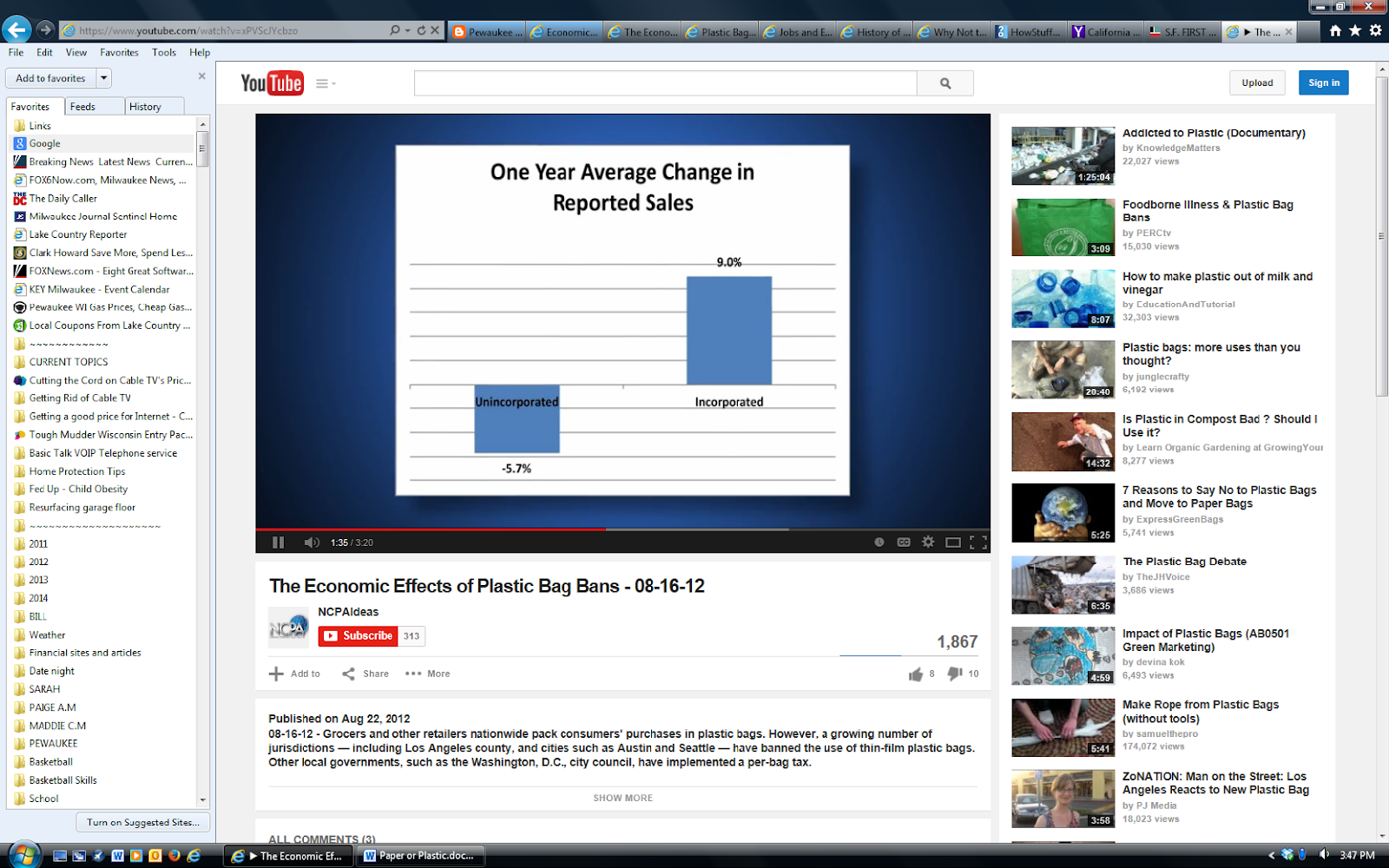
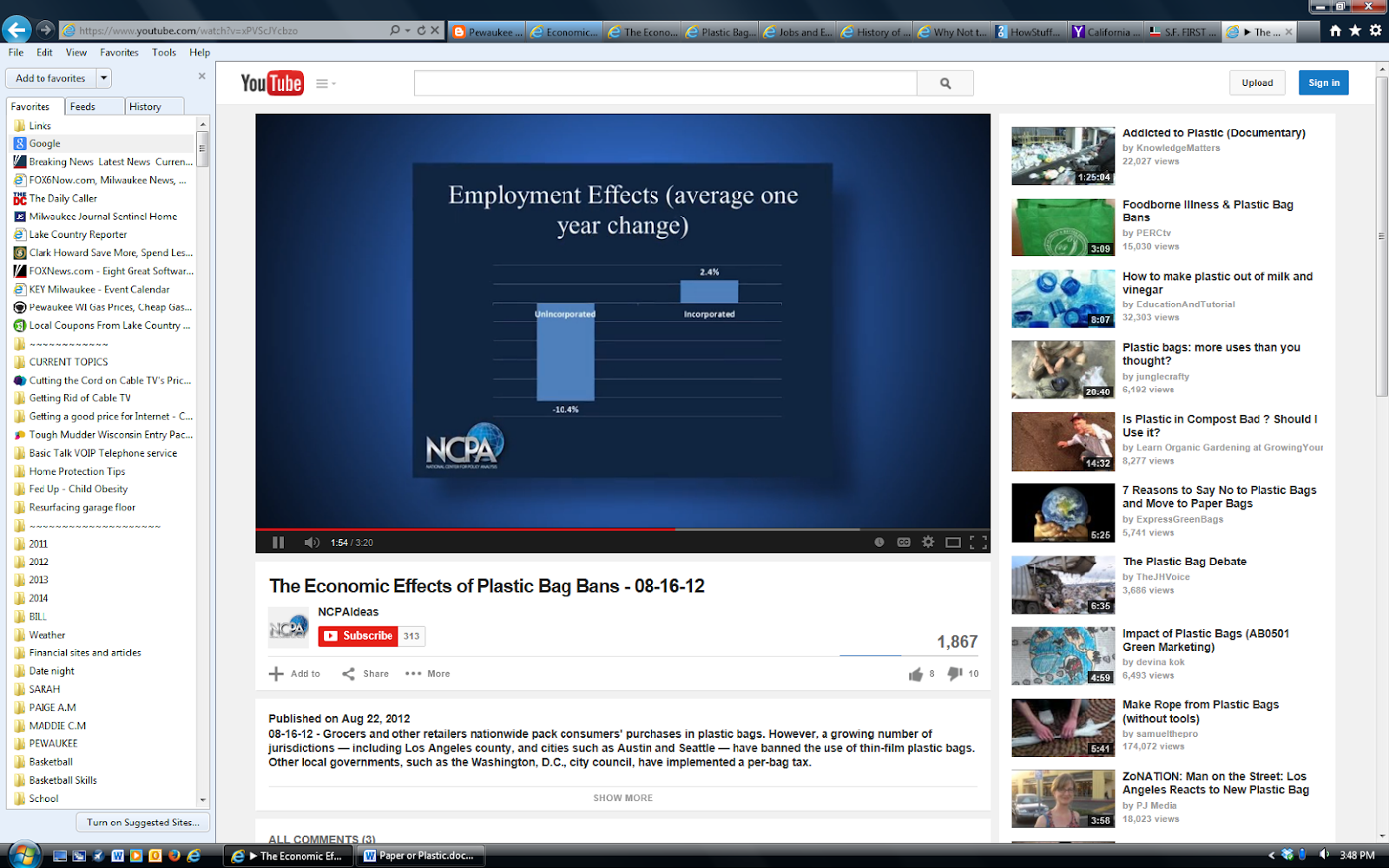
In July, 2011 Los Angeles County’s, “bag ban” went into effect.  Stores could not use plastic bags for groceries, but instead could sell the shopper a paper bag at a cost of 10 cents, sell the shopper a reusable bag, or the shopper could bring in their own bag.  A year later through a You Tube video, Pam Villareal from the National Center for Policy Analysis, outlined the economic impact of the ban.  The ban did not affect all stores within LA County. Therefore some shoppers choose to continue to go to stores where plastic bags were in use (incorprated), and paper bags were not a charge:


The analysis showed that stores with the plastic bag ban saw a drop in revenue of 5.7%, and staffing decrease/job loss of 10.4%.  In contrast the stores without the ban had increased sales/gains of 9%, and increase job growth of 2.5%.  Another unexpected cost to the stores was an increased number of lost and/or stolen carts and baskets.  Apparently shoppers “borrowed” these items to help get their groceries home.  Perhaps a positive aspect of the bag ban for stores in revenue generations to help cover the cost of the bags, and through selling reusable bags.  Despite economic concerns over the bag ban, this week the Governor of California announced his plans to sign a bill banning plastic bags throughout California.
Who would ever have thought the decision between paper or plastic would be such a difficult one?  As you consider the question, you must think about the environment as well as your personal beliefs.  Production of plastic and paper bags use several valuable environmental resources including trees, water, petrolium.  Each plastic bag we send to a landfill will stay in that land fill until our great, great, great, great, great, great grandchild is born.
As someone that values the environment, I personally feel that I can easily purchase and use reusable bags for all my shopping needs.  The choice is yours.  Next time you are asked, “Paper or plastic,” reflect on your personal beliefs and perhaps your answer will be, “Neither.  I brought my own bag.”


McGrath, Jane. howstuffworks. n.d. 7 9 2014 <http://science.howstuffworks.com/environmental/green-science/paper-plastic1.htm>.
Yahoo! News. 5 9 2014. 6 9 2014 <http://news.yahoo.com/california-first-us-state-ban-plastic-bags-064643573.html>.

You Tube. 22 8 2012. 6 9 2014 <https://www.youtube.com/watch?v=xPVScJYcbzo>.

Tuesday, September 9, 2014

The Great Crisis of 2014

Matt Thurman
Mrs. Sharon Straub
Advanced Placement Economics
07 September 2014
The Great Crisis of 2014
One of the great dilemmas of the current world is staring frequent flyers right in the face.  What once was a standard feature of comfort and satisfaction 35,000 feet above the earth has now become the epicenter of a horrendous calamity: reclining seats.  As passengers become more irritable and legroom becomes scarcer, the risk of reclining one’s seat on a commercial airplane appears to be one that only the bold are presently willing to take.  While one party has taken the initiative to petition the removal of reclining seats, another has considered a more cost-effective approach: “be nice to your neighbor” (Associated Press).  Although reproducing airplane seats that do not have reclining capabilities would surely eliminate aerial scuffles, airline companies can save large quantities of expenses by simply advising their passengers to think courteously while reclining on airplanes.

To fully understand the significance of this global issue, one must recognize the value of legroom on an airplane.  Perhaps the principle property of comfort on airplanes, leg space is a necessity for any length of flight and any length of person.  Unfortunately, airline companies have lessened the value of passengers’ legroom, as the below image illustrates the lessening of distance between plane seats since 2000.  (Picture Link)
seat distance.jpg
According to Dallas News, airlines believe passengers will not notice the decrease in leg space over time, largely because of new seat designs that create a sense of more space.  Relocating magazine pockets and reducing tray table sizes are just two methods via which these airlines endeavor to combat the diminishing seat separation.  On paper, they appear to be effective strategies.  On planes, they go unnoticed, as recently several fights have erupted solely because of the interference of legroom caused by seat recliners.  David Kerley of ABC News details the excitement of one fight on a Florida-bound flight.  (Watch 0:20- 0:47)  A knitting woman made a classic mistake, misjudging the marginal analysis of reclining her seat.  Supposing that reclining a few degrees would maximize her comfort or performance while knitting, she simply forgot to calculate the marginal cost of doing so, angering her fellow passenger.  The only thing she did consider was her utility, which apparently was great enough to disregard the marginal cost.  To the dismay of the other numerous passengers and the pilots, the plane was commanded to perform an emergency landing.  This episode revealed the major dilemma surrounding airplane seat recliners.

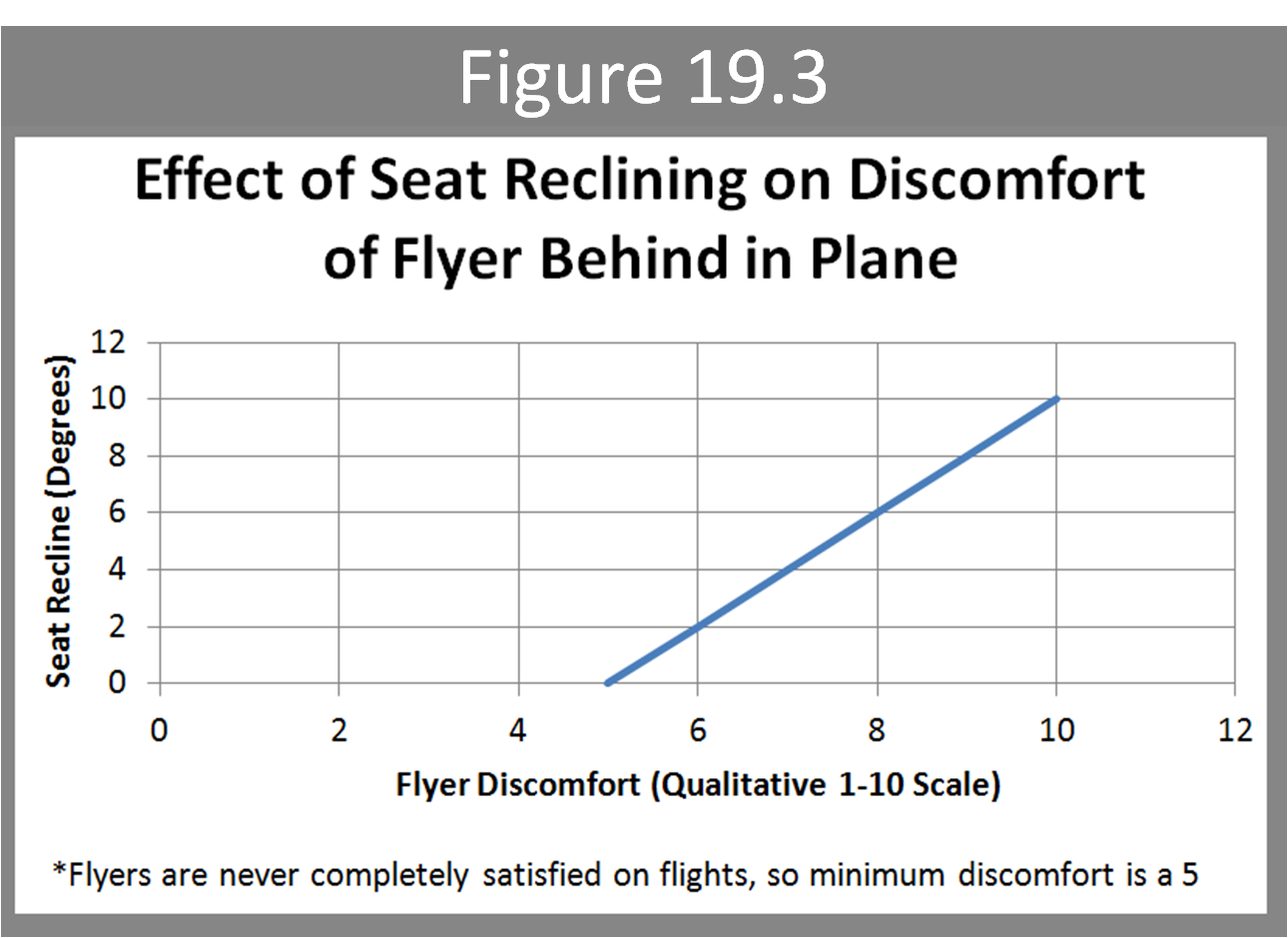
Economic analyst Dr. Thurman visits this quandary in a late chapter of his renowned Thurmanomics: A Study of the World Through the Lenses of Matt Thurman.  The notable question he poses is “is it worth reclining your seat an extra degree?”  While the mathematics behind the marginal analysis of reclining one’s seat and the ensuing discomfort and potential rage of the flyer behind that person seems rather pedestrian, the implications of this configuration are critical to controlling one’s behavior inside the pressurized cabin.  Figure 19.3 of his work details the hypothetical linear, positive relationship between the degree of seat reclination and the discomfort of the flyer behind due to limited legroom.  In creating this helpful visual, Dr. Thurman revives the age-old question, “what is the optimal degree to which one should recline his or her seat?”  Every flyer must realize that by reclining his or her seat to a comforting degree, he is endangering the knee health of the flyer behind.  Such health endangerment can be especially worrisome to frequent flyers; imagine the impact of a substantial amount of weight forced on one’s knees for two hundred two-hour flights in one year.  Yet – unsurprisingly – people often discount this notion, as the decision to recline an extra degree often does not produce a marginal cost that directly impacts that person negatively.
labeled graph.png
Such social insensitivity commonly appears to be acceptable.  That is, of course, until the water is thrown, the fists are flown, and the air marshals’ covers are blown.  As the flyer discomfort increases, the probability of retaliation also increases.  Already three situations since August 24th, 2014 have exhibited the extremes of this relationship, as two additional planes have made emergency landings due to altercations regarding the reclining of seats.  ABC’s David Kerley explains the other two striking events in an alarming video.  In one scenario, a passenger sought to avoid the problem of losing leg space by inserting devices that prevented the forward seat to recline.  Naturally, this incensed the frontward passenger, compelling her to throw a cup of water on him.  In a transatlantic flight, a passenger whose diabetes influenced a complaint regarding a reclining seat ended up thrown to the floor by three air marshals after he held a flight attendant who attempted to calm him.  Mayhem has reached all-time highs on airplanes.  What appears to several viewers as a trivial matter has become a startling predicament, as airlines are pressured now to quell the sudden unrest of passengers.  One thing is clear; turbulence is no longer only an external factor.  Therefore, airlines need to recognize the unruly behavior of passengers and solely need to instruct travelers to use courtesy while reclining on planes.
Works Cited
Associated Press. "It's No Longer Safe to Recline Your Airplane Seat." The Dallas Morning News. N.p., 02 Sept. 2014. Web. 08 Sept. 2014. <http://www.dallasnews.com/business/airline-industry/20140902-its-no-longer-safe-to-recline-your-airplane-seat.ece>.
CNN Wire Service. "Seat Recline Fight Diverts Another Flight, Woman "demanded" That Flight Land." FOX6Nowcom. N.p., -2 Sept. 2014. Web. 08 Sept. 2014. <http://fox6now.com/2014/09/02/seat-recline-fight-diverts-another-flight-woman-demanded-that-flight-land/>.
Murray, Rheana. "The Do's and Don'ts of Reclining Your Airplane Seat."ABC News. ABC News Network, 29 Aug. 2014. Web. 08 Sept. 2014. <http://abcnews.go.com/Travel/dos-donts-reclining-airplane-seat/story?id=25184467>.
Murray, Rheana. "Watch: Unruly Flyer Escorted Off Plane After Reclining Seat Fight." ABC News. ABC News Network, 03 Sept. 2014. Web. 08 Sept. 2014. <http://abcnews.go.com/US/video-unruly-flyer-escorted-off-plane-reclining-seat/story?id=25235578>.

The Return of College Football

Alexa Klotz
Mrs. Straub
Economics
7 September, 2014


The Return of College Football

Fall is the start of many changes here in the United States. Leaves change their color, the temperature drops, seasons change, and everyone anticipates one thing; the start of the college football season. Year after year people come together to celebrate their favorite college football teams. This means those die hard fans traveling all over the country to watch their team's progress throughout the year, and surrounding businesses bringing in lots of money. College football helps the economy out tremendously with bringing up the business of local hotels, restaurants, and shops, while also selling gear and tickets to fans.
These fans are constantly having to deal with opportunity cost when deciding to go to games. Students give up studying for exams in order to go to these games, while parents may be giving up the chance to either be working or spending quality time with their children. While they may be missing out on these other things, it is indeed a plus for the economy for them to be attending these games. According to economist.com, college football generated 2.4 billion dollars in the 2012-2013 season. Tickets to games are a huge resource that are scarce. People are always wanting seats to that big game, but that doesn’t mean they are always going to get them.
The Economics of College Football  A Look At The Top 25 Teams  Revenues And Expenses.png
Figure One: Expenses and revenue of college football teams

The most notable thing to take away from this chart is that Alabama spends the most on its football program for any university. But that investment has paid off with Alabama winning 3 championships in the past 5 years. Although the team spends the most on their program, they do not bring in the most revenue. The University of Texas made the most revenue with over $103 million dollars. Collegiate Licensing Company stated that Texas was the top selling institution for CLC licensed products for the eighth year in a row. Michigan also makes more revenue than Alabama, but sold less merchandise than Alabama. So what was it that put Michigan above the Roll Tide? Michigan receives royalties from the Big Ten Network. What’s most interesting though is that Boise State has been able to make a higher net income than larger schools such as Northwestern and Louisville, while investing a way smaller chunk of money into their program. This just shows that some teams earn economic success by spending large amounts of money, while other teams develop licensing contracts, and some spend reasonable amounts of money and still generate good feedback.
College football doesn’t just bring people together to cheer on their favorite teams, but it really does boost up the economy. These teams generate a lot of money that will not only help out their school, but also their surrounding community when traveling fan bases buy merchandise, food and book hotels. College football is more than just touchdowns and celebration dances; it’s about people with differences coming together to build a better economy.
tickets football.png
Figure Two: Breakdown of Revenue by Team


Works Cited

"The Economics of College Football: A Look At The Top-25 Teams' Revenues And Expenses." Forbes. Forbes Magazine, n.d. Web. 8 Sept. 2014. <http://www.forbes.com/sites/aliciajessop/2013/08/31/the-economics-of-college-football-a-look-at-the-top-25-teams-revenues-and-expenses/>.
"ncaa revenue." ESPN. ESPN Internet Ventures, n.d. Web. 7 Sept. 2014. <http://espn.go.com/>.

"Wildcat formation." The Economist. The Economist Newspaper, 8 Feb. 2014. Web. 8 Sept. 2014. <http://www.economist.com/news/united-states/21595967-why-college-football-players-want-unionise-wildcat-formation>.

Major Soccer Leagues Destroy the Economy

Major Soccer Leagues Destroy the Economy
By Ally Samuel


One of the most popular European soccer clubs, Real Madrid, is in tremendous amounts of debt and causing increasing possibilities of a complete economic collapse among all of the European soccer clubs.  Each year, soccer clubs offer players ridiculously large amounts of money solely to claim them on their team and to make more money for their club.  The most well-known soccer players that we know today make hundreds of thousands of dollars per week, which is one of the main reasons why the entire European soccer community may be at risk of falling under a never-ending pool of debt along with a destroyed economy.

The main ways that soccer clubs make their money is through three different sources -- television rights, ticket sales, and commercial income.  The English Premiership is one of the top broadcasters of European soccer, and it ensures that even the worst teams in the league still get millions of dollars per year, and then gives the top teams even more.  Clubs with bigger stadiums also make more money than the smaller ones, so the more fans that come to the games allows for more income for the club.  Selling merchandise -- shirts, scarves, flags, etc. -- seem to be the simplest, easiest, and most common way to make money for clubs.
 Either way, the soccer clubs have numerous ways to increase revenue, but it never seems to be enough.

Real Madrid made some of their top record amounts of money spent on trades in 2009 on Kaka for $86 million and Cristiano Ronaldo for $123 million.  In order to pay for these two players as well as a couple of others, the club had to sell their downtown training complex to the city of Madrid for $445 million.  With spending so much money on one or two players, the soccer clubs have given up opportunity costs to spend that money on maybe four or five equally distributed players instead of just one or two amazing players that are over-priced.  The people who manage those soccer clubs must believe that the benefits of having the players in the long run will outweigh the costs, which I find hard to believe.  The video linked here shows us just a glimpse of one example of what all goes into the process of trading players, as well as how much money is spent on certain players.

This debt never seems to stop the clubs from giving out more money though.  I’ve always wondered where the large amounts of money came from, and now that I know, I think that the whole trading and selling players situation is nonsense.  While many of the soccer-junkie boys here at Pewaukee High School would disagree with me, I strongly believe that there is no reason to be getting in half-billion dollars of debt to buy a few players off of another team when the money could be spent on much more useful things.  During the majority of the time, these clubs don’t have the money ready to be handled that they are offering many of these players but they commit to it anyways, which pushes their level of debt up that much higher.  The players on the teams have gotten so greedy to the point where they don’t care about the economy, they only care about their income.  Members of communities always wonder why their countries are in debt; maybe soccer clubs like these, and even the ones in the United States, are a big source of causing the country’s debt.


Works Cited

Karon, Tony. "Soccer's Billion-Dollar Players." Time. Time Inc., 3 Aug. 2008. Web. 9 Sept. 2014. <http://content.time.com/time/world/article/0,8599,1828967,00.html>.

"Real Madrid toys and merchandise - World of Sport ApS." World of Sport ApS. N.p., n.d. Web. 9 Sept. 2014. <http://worldofsport.biz/portfolio-view/real-madrid-toys-and-merchandise/>.

"Vizari Club Series Real Madrid Mini Soccer Ball - model 91684." -.... N.p., n.d. Web. 9 Sept. 2014. <http://www.soccergarage.com/Vizari-Club-Series-Real-Madrid-Mini-Soccer-Ball-model-91684.html>.

|, Leander. "Rolling out of control." ESPN. ESPN Internet Ventures, 22 Sept. 2010. Web. 9 Sept. 2014. <http://espn.go.com/sports/soccer/news/_/id/5580467/european-football-eating-itself>.
Related Posts Plugin for WordPress, Blogger...