Wednesday, March 11, 2020

What Are Some Strategies Self-made Millionaires Use?

What Are Some Strategies Self-made Millionaires Use?
Written By: Skylar Allen


Have you ever wondered how many people have been able to become millionaires by such young ages? For some, it may be that they got lucky and got it from their upbringing; it was handed down to them. Very few have won the huge jackpot in the lottery, and others have taken initiative to really work super hard in order to get where they are. Even though it may be
something challenging to build up to, here are some tips and tricks from self made millionaires to start building that up bank account, even if it’s not to millions.

One of the first things that they do is setting up a family budget and setting goals. Addison Jarman, a self made millionaire by 25 who is well known on the social media platform Tik Tok for giving out advice and tips on how to get to where she is, says “Have an intense goal-setting session where you create a strategic plan. Maybe you want to pay off all debt within five years. Maybe it’s owning your first home by the end of 2021. Set that goal and then break that down into a bunch of micro-goals.”. This is really important because you are creating a budget with what you have, and you are also making goals for the long run. When she mentioned breaking your larger and more long term goals into micro-goals, that's really important and it’s something not many people do. Setting micro-goals will allow you to see progress faster and throughout the time in which you wish to complete the big goal. Seeing this progress will give you the impression that you are making consistent progress, which results in you wanting to continue to do what you are doing.

Something many people struggle with isn’t understanding needs vs wants, but resisting to give in and buy those want items. Another quote from Jarman is “Just because you’re making this much, it doesn’t mean that you should be spending that much. I think so many people are just working paycheck to paycheck and just spend too much. You need to look very closely at what’s a need versus a want.”. This shows that people really need to take a look at what they are spending and what they can reduce from it to identify the “wants” that they have the strong desire to have. The sooner you are able to identify wants versus needs and really start to lessen the amount of “wants” you are spending money on, the sooner you will see those smaller results in your account. This could be an example of a micro-goal you could set for yourself.

Another interesting fact that many people may not know about self made millionaires is that many of them have more than one source of income. According to Tanza Loudenback’s article 17 habits of self made millionaires, from a man who spent 5 years studying rich people, "three seemed to be the magic number in my study," adding that 65% "had at least three streams of income that they created prior to making their first million dollars.". To expand on that, Jarman made a video on the social media platform, and she stated that she owns three businesses and works a corporate job, which was made before she quit her corporate job. Having a “side hustle” is extremely beneficial because it adds another source of income. These don’t have to be jobs you need to have a set schedule all the time for either, you can do some photography or videography and charge people per session, or become a realtor on the side! There are so many options; it's truly unbelievable.

Lastly, there are many more tips and tricks in order to start building up your bank accounts, but one of the overall most important things to keep in mind is that you need to be a motivated and determined person. All of these tips take time and a lot of effort. The sooner you start the sooner you will have the opportunity to see a difference and possibly set yourself up for success. Even though you may not see millions, seeing any growth is better than nothing.


Works Cited
Loudenback, Tanza. “17 Habits of Self-Made Millionaires, from a Man Who Spent 5 Years Studying

Rich People.” Business Insider, Business Insider, 3 Oct. 2019, www.businessinsider.com/good-habits-of-self-made-millionaires.

Parents Staff February 06, and Parents Staff. “How This Mom Became a Millionaire by 25.” PEOPLE.com, 6 Feb. 2020, people.com/human-interest/how-this-mom-became-a-millionaire-by-25/.

Coffee Spending

Coffee Spending
Written By: Grace T.

Coffee has become one of the most popular drinks in the world. From starbucks, to collectivo, to brewing your own at home, it all comes with a cost. Four to five dollars doesn’t seem like a lot, but how much are you really spending chasing that caffeine kick? To most millenials (41%), they are willing to spend more on coffee than their retirement fund.
According to Cliff & Pebble, the average american spends anywhere from $1,221-$1,577 per year at starbucks. Each visit seems harmless as we are “just spending $5”. But that turns into a habit. It consistently turns into no big deal and quite possibly a daily routine. Not only does the illusion of coffee prices entice us into buying a coffee, but the convenience as well. There are 15,144 locations across the nation and 31,256 worldwide. With that being said, odds are there is at least one starbucks on your way to school or work. Another part of convenience is online ordering. Being able to online order shortens wait times and takes the cost directly out of your bank account. This reduces the probability that one is consciously tracking spending and realizing the determinants of buying starbucks coffee every day.
Although those numbers seem scary, there are many solutions and alternatives. The cheapest alternative is to brew at home. Making a cup of coffee at home costs about $245 a year. Although that may take up more time, that is saving anywhere from $976-$1,332 a year-which is a big enough difference to be worth it. Another alternative is cheaper coffee shops. Places like Duncan Donuts, Panera, and Caribou Coffee all are a dollar or so less than starbucks per cup. That will save a small amount of money each time which accumulates to save more in the long run. The final solution is to limit the amount spent per week. Rather than going every day, limit it to a few times per month/week to lower the annual cost.

Coffee chains are never going away. With coffee being the leading beverage for adults above 18, coffee shops will continue to evolve. Knowing how to budget and the importance of tracking spending can help reduce how much is spent in a year and save money for the future.


Works Cited
Cliff & Pebble. “Here's How Much Your Starbucks Habit Costs You.” Cliff & Pebble, cliffandpebble.com/blogs/our-blog/heres-how-much-your-starbucks-habit-costs-you.

Editors of Publications International, Ltd. “Coffee Facts.” HowStuffWorks, HowStuffWorks, 29 May 2008, recipes.howstuffworks.com/coffee-facts.htm.

Herrera, Tim. “Here's Some Money Advice: Just Buy the Coffee.” The New York Times, The New York Times, 24 June 2019, www.nytimes.com/2019/06/23/smarter-living/personal-financial-advice-coffee.html.

Lock, S. “Starbucks: International and U.S. Stores 2019.” Statista, 19 Nov. 2019, www.statista.com/statistics/218366/number-of-international-and-us-starbucks-stores/.

Rella, Emily. “This Chain Restaurant Has the Cheapest Small Cup of Hot Coffee.” AOL.com, AOL, 15 July 2016, www.aol.com/article/2016/03/04/this-chain-resturaunt-has-the-cheapest-small-cup-of-hot-coffee/21323049/#.

VanderKnyff, Rick, et al. “Should I Be Spending $6 on a Coffee?” NerdWallet, 13 Dec. 2019, www.nerdwallet.com/blog/finance/should-i-be-spending-6-on-coffee/.

Friday, March 6, 2020

Economic Benefits of Air Transportation

Economic Benefits of Air Transportation
AP Economics
Brynn VandeZande

As one of the most popular methods of long distance travel and business, the air transportation industry contributes to the success of the global economy on a larger scale than most people might imagine. This industry has many different uses, including the common passenger travel, and global business through exporting/importing of goods. Over the years, demand within the airline industry has been rising steadily. This rapid growth was caused in part by rising GDP, disposable income, and living standards, since this creates an environment where people are more willing to travel for both leisure and business purposes.

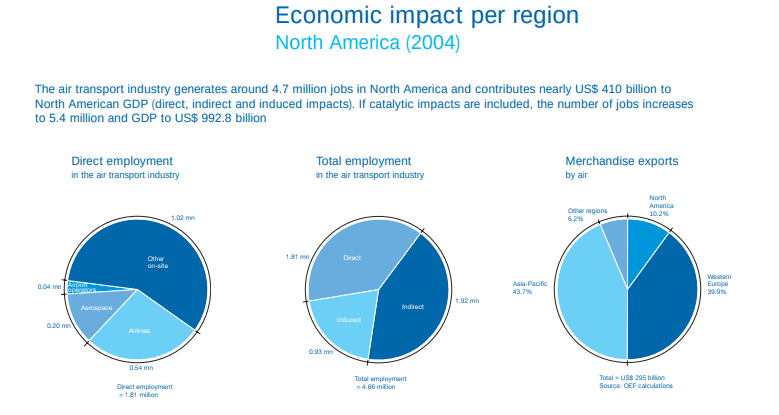
Overall, aviation in general supports an immense 65.5 million jobs worldwide and contributed $2.7 trillion to global GDP. In 2004, North America accounted for 37% of global employment in the aviation industry, but accounted for over 50% of the contribution of air transport to global GDP. This is clear evidence of how widespread the effects are, and on how large of a scale they act upon. Michael Gill, Executive Director of ATAG, states, “It’s a fascinating look at the scope of the aviation industry and our role in the world, when you realise that aviation, if it were a country, would be the 20th largest economy in the world, supporting 65.5 million jobs and nearly three trillion dollars in economic impact.”

Not only is the direct impact of aviation so substantial, but this industry is also an indirect source of economic growth in other aspects of economy, such as tourism and global business. Specifically, the tourism industry is directly linked to air transport, and the tourism industry in itself counts for 3.8% of world GDP and millions of jobs on top of this. By utilizing air transport to bring visitors, it is able to facilitate growth and create jobs in this large industry as well, thus creating a spin-off effect on these other industries and benefiting the world economy in more ways than one.

Additionally, ⅓ of international world trade occurs by air, and seeing that world trade is rising at almost double the rate of global GDP, economies around the world are going to be becoming increasingly reliant on air travel to facilitate this trade. By 2036, it is expected that 97.8 jobs are going to be supported by the air transport industry, contributing $5.7 trillion to the global economy.

It has been made clear of the vast economic benefits that the air transport industry has created, however, it should not be taken lightly the social benefits that arise from this as well. It is well known that this often can improve the quality of life through leisure and cultural experiences. Additionally, through tourism, air transport helps to reduce poverty and improve living standards. Overall, air transportation is not only able to connect our global economy, but also link the people of our world together.


Works Cited
“The Economic & Social Benefits of Air Transport.” Air Transport Action Group, www.icao.int/meetings/wrdss2011/documents/jointworkshop2005/atag_socialbenefitsairtransport.pdf.
“Enabling Trade.” Aviation Benefits Beyond Borders, aviationbenefits.org/economic-growth/enabling-trade/.

“The Future.” Aviation Benefits Beyond Borders, aviationbenefits.org/economic-growth/the-future/.
“Social and Economic Benefits of Aviation.” Air Transport Action Group, www.atag.org/our-activities/social-and-economic-benefits-of-aviation.html.

Should Running for President be Reliant on Money?

Should Running for President be Reliant on Money?
Trinh Vo

With the recent Democratic debates and the election heating up, there are only 5 candidates left for the democrats. There are many reasons for dropping out of the running for president, but there have been many candidates who’ve dropped out of the race partially due to a lack of funding. Many of us are getting close to the age where we can vote. Thus, it’s important to delve deeper into what it takes to even consider running for president; more specifically, how much it takes to run, such as self-funding or depending on donors, to show how funding should not determine who wins or loses.

In the 2004 election, George W. Bush spent around $345 million to win the election. Within the 2016 campaign, Hilary Clinton and Donald Trump spent a combined $1.16 billion. This trend of setting records for most money spent on campaigns is a poor reflection of how winning the presidency works. This begs the question should campaigning be so reliant on the money? And is there a disadvantage to those who are more reliant on donations rather than self-funding? Or is funding a reflection of the candidate’s progress and popularity?

While the majority of candidates are very reliant on donors, some are more than others. Within the 2016 election, Donald Trump self-funded the majority of his campaign meaning he used personal funds like portions of his income, trusts, or investment in stocks and more. This allowed him the ability to last a lot longer in the running than anyone expected of him and eventually led to his win as president. Similarly, in the current 2020 election, Michael Bloomberg is known to completely self fund his campaign and not accept contributions from outside donors which has helped him remain in the running despite not winning in various polls. In contrast, many candidates are more reliant on donors to fund their campaigns. For example, Kamala Harris was very reliant on donors but also dropped out of the election race due to a lack of funding despite her qualifications for presidency. Thus showing how dependent on money the electoral race is currently and how the money doesn’t accurately represent the candidate.

There are many pros and cons of self-funding verses donors for a campaign. For example, self-funding makes it easier to advertise more and stay ahead of other candidates, in terms of resources available to them, and stay in the running longer. The production possibility curve is greater on the side of self-funding because it gives the candidate more freedom in advertising and where the funding is allocated instead of being more focused on abiding by the ideas of big donors. But the opportunity cost of self-funding a campaign is that if the candidate does not win, it is a bigger loss for them due to the amount of personal resources invested in their campaign. Similarly, self-funding doesn’t accurately reflect the current polls for each candidate. For example, Bloomberg has the most funding, but has not led in any polls. Whereas, Amy Klobuchar, a candidate who is more dependent on donors, after doing well in the Iowa caucus, rose in polls and gained more funding from donors that reflected her rise. Thus showing that while funding may be what staying in the race relies on, it doesn’t represent the candidates to the best extent.

Thus, as more candidates drop out of the running and as many of us get closer to voting age, think about how much goes into running for president. While it may seem like one candidate is significantly better because of how long they’ve stayed in the race and how much money they have, that may not be the case. So as we debate who we will get to vote for, maybe let’s look a little deeper into how they’ve got to where they are.

Works Cited
“The 2019 Presidential Campaign Dropouts, Ranked.” POLITICO, www.politico.com/news/magazine/2019/12/26/2020-presidential-campaign-dropouts-ranked-089675.
“2020 Presidential Race.” OpenSecrets, www.opensecrets.org/2020-presidential-race.

“Democratic Drop-Outs Spent at Least $74M Pursuing Unsuccessful 2020 Bids.” OpenSecrets News, 20 Dec. 2019, www.opensecrets.org/news/2019/12/2020-democratic-drop-outs-spent-74m/.

Epstein, Reid J., and Trip Gabriel. “Pete Buttigieg to Quit Democratic Presidential Race.” The New York Times, The New York Times, 1 Mar. 2020, www.nytimes.com/2020/03/01/us/politics/pete-buttigieg-drops-out.html.

Graham, David A. “The 2020 U.S. Presidential Race: A Cheat Sheet.” The Atlantic, Atlantic Media Company, 12 Feb. 2020, www.theatlantic.com/politics/archive/2020/02/2020-candidates-president-guide/582598/.

Investopedia. “How Much Does It Cost to Become President?” Investopedia, Investopedia, 10 Feb. 2020, www.investopedia.com/insights/cost-of-becoming-president/.

McMinn, Sean, and Alyson Hurt. “Tracking The Money Race Behind The Presidential Campaign.” NPR, NPR, 21 Feb. 2020, www.npr.org/2019/04/16/711812314/tracking-the-money-race-behind-the-presidential-campaign.

Overby, Peter. “Every Position Donald Trump Has Taken On How He Is Funding His Campaign.” NPR, NPR, 14 July 2016, www.npr.org/2016/07/14/485699964/every-position-donald-trump-has-taken-on-how-he-is-funding-his-campaign.

Panetta, Grace. “Here's Everything We Know about the Net Worth and Personal Finances of Each 2020 Democratic Presidential Candidate.” Business Insider, Business Insider, 29 Feb. 2020, www.businessinsider.com/estimated-net-worth-wealth-2020-democratic-presidential-candidates-2019-4.

Summers, Juana. “Bloomberg Has Already Spent $450 Million On Ads Since Launching His Campaign.” NPR, NPR, 21 Feb. 2020, www.npr.org/2020/02/21/808163144/bloomberg-has-already-spent-450-million-on-ads-since-launching-his-campaign.

“Using the Personal Funds of the Candidate.” FEC.gov, www.fec.gov/help-candidates-and-committees/candidate-taking-receipts/using-personal-funds-candidate/.

Thursday, March 5, 2020

Paying for College

Written by: Logan Torres

Crunching numbers countless nights, my mind racing about what was to come. Many teenagers go through this. Once hitting senior year, the reality of financial aid set in. As for most families in Pewaukee, the support colleges give to students for demonstrated need is minimal...at best. To those who realize they will end up with a bill of $80,000 a year, I am here to tell you some steps you can take to become financially responsible for your future. It may seem as if you have no actions you can take now, but I can assure you there is much to do.

First and foremost is deciding whether you want to attend a four year university. Quite possibly a technical college or trade school might work better, instead of a four year university. On average, an elevator mechanic walks out of trade school with a starting salary of $41,323 dollars, making their way up to $116,150 with about five years of experience and further training (payscale.com). Comparatively, a salesperson, one of the most common jobs for a college graduate (CNBC), makes a total beginning salary of $31,100. It is also about the job you plan on going into. As learned in personal finance, about 27% of people go into a field they received their degree in (insighthighered.com). If you are not dead set on one career path it might be wise to go to WCTC or UW Waukesha for the first year. Then, transfer once you have a better idea.

If you are like me and have decided to go to a four year university, your next integral step is FAFSA(Free Application for Federal Student Aid). When you are applying for a school, the application almost one-hundred percent of the time gives you the option of sending in financial aid information. This section is where you select YES and they will ask you to submit your FAFSA, along with other information depending on what school you are applying to. Although you might not get any money outright from FAFSA or the school, it still does allow you to apply for an up to $5,500 student loan from the government. Now you might be thinking, why would I want to borrow money? Aren’t I still going to be in debt? The answer is quite frankly, yes. However, by borrowing from the government in lieu of a private agency or bank, the interest on the loan will be significantly less. A private loan is anywhere from 4.75% to 15.14% often with no grace period (period where there is no interest). Whereas, a student loan from FAFSA has a maximum of 7% with most being offered at around 4.45%, complete with a four year grace period (debt.org). Another important factor to note is how much money you will actually need. Never take more out for a loan than you need. You make think you need it but make sure you create a budget. Doing this will ensure your debt will be paid off faster. Taking this step will at least guarantee money you can borrow in your future.

Now, no one wants loans. So, here are some steps I took before and after applying for FAFSA that helped me. My junior year was when I began my scholarship search. Scholarships, although unlikely to win one, is an important factor in going to college. If you search hard enough there will be a scholarship where you fit the exact mold a scholarship committee is looking for. For a comprehensive list of all of the scholarships I have found, sorted by interest and type, you can go here (in the process of being built, but has lots of opportunities now!).

For other tips and tricks you can go here, because it is a culmination of many actions that makes college affordable. A lot of times we can get scared because everyone around us is yelling different problems. But with hard work and dedication, you can do it.

Works Cited
Federal Student Aid, studentaid.gov/h/apply-for-aid/fafsa.

“Alternative Ways to Pay for College (And How to Make It Cheaper).” SimpleTuition, www.simpletuition.com/managing-finances/alternative-ways-to-pay-for-college/.

“Average Elevator Mechanic Hourly Pay.” PayScale, www.payscale.com/research/US/Job=Elevator_Mechanic/Hourly_Rate.

Classically Court. “The Most Popular Job among Recent College Grads Pays $83,000 per Year-Here Are the Other 9.” CNBC, CNBC, 9 May 2019, www.cnbc.com/2019/05/08/linkedin-the-10-most-popular-jobs-among-recent-college-graduates.html.

Hamm, Trent. “Why You Should Consider Trade School Instead of College.” The Simple Dollar, 24 Jan. 2019, www.thesimpledollar.com/investing/college/why-you-should-consider-trade-school-instead-of-college/.

“New Data Track Graduates of Six Popular Majors through Their First Three Jobs.” New Data Track Graduates of Six Popular Majors through Their First Three Jobs, www.insidehighered.com/news/2019/08/02/new-data-track-graduates-six-popular-majors-through-their-first-three-jobs?utm_source=Inside+Higher+Ed&utm_campaign=9e78e93db6-DNU_2019_COPY_01&utm_medium=email&utm_term=0_1fcbc04421-9e78e93db6-199671765&mc_cid=9e78e93db6&mc_eid=eef5f6254c.

Max FayStaff. “Federal & Private Interest Rates on Student Loans.” Debt.org, www.debt.org/students/financial-aid-process/interest-rates/.

Wednesday, March 4, 2020

Is Travel Insurance Worth It?

Is Travel Insurance Worth It?
By: Megan Stoffield

With spring coming up soon, many of us are booking flights and reservations ready to go on vacation. Whether it be all the way across the world or just a few hours away it would still be a bummer if something came up causing the trip to be canceled. If your trip gets canceled due to injury, sickness, weather, etc., how much money will you lose? Can you get a refund? Is buying travel insurance worth it? Travel insurance can be a lifesaver in many cases, but at the same time be a waste of money and it’s important to know when to spend the extra dollars on it when booking a trip.

What is Travel Insurance?
Travel insurance is a purchased protection for losses or emergencies that can occur while you are traveling. Common things that travel insurance covers is a medical emergency that occurs right before a trip or during the trip, or even just a delayed or lost suitcase. In addition to being insured for certain circumstances on your trip, travel insurance commonly comes with assistance services. These assistant services can help replace lost luggage, passports, and even assistance in arrangement and monitoring of medical care in case of an emergency. There are different types of travel insurance for cruises, international trips, resorts, etc. Each type of travel insurance comes with its own fine print, so always read all details to ensure you will be fully protected in any type of emergency that could occur during your specific trip.

When is it worth it?
Travel insurance can be well worth the cost if you have to cancel your trip last minute or even during your trip. For example a close relative of mine had a two week trip to Scotland planned, but tore his achilles tendon a few weeks before the trip which came with a very long recovery. They were able to save all but $200 on the whole two week trip of reservations and flights. The main reasons that travel insurance is worth it is for international trips, for cruises, and medical reasons.

International trips tend to be much more expensive, planned out, and longer in length than domestic trips and this leads to much more money on the line if the trip needs to be canceled. There are many websites and resources such as insuremytrip.com that will give quotes for the whole trip and recommend the best insurance to cover your whole trip and reservations rather than just the flight or lodging that companies offer. With that said, those trips that are very planned out with upfront costs that add up, trip insurance is worth it.

Cruises are mostly all paid up front, have a high risk of problems that cause cancelations, and are many times international and those together are a recipe for disaster unless you have travel insurance. Additionally, with cruises it is reliable to get your insurance through the cruise line as long as it covers everything you need it for.

Lastly, medical emergencies can come up in many trips and if you are somewhere international or with little access to adequate medical care, travel insurance can help a lot. Based on the type of insurance, it can cover upfront initial costs of care and make sure your treatment is being monitored and arranged for you no matter where you are: but only specific insurance plans will cover these things.

When should you skip it?
There are some cases in which travel insurance can end up being a waste of money and hassle. These cases include domestic travel, for flights alone, and if your credit card already offers it.

Domestic travel tends to be much cheaper per person and less planned in advance than international trips are. Additionally, it tends to be much easier to cancel reservations or flights in the US over expensive international flights or plans. If a medical emergency arises and you have medical insurance, based on your plan it will be easier and more affordable to get care than if you were in another country, so travel insurance for that case isn’t necessary.

For flights alone, most simple travel insurance policies aren’t worth the cost of coverage for flights. With most flights if they are delayed or even canceled, the airline themselves will get you on the next open flight or provide compensation in terms of a refund or credit for another flight due to the cancelation. If you are to get insurance for a flight, make sure to research the plan closely to ensure that you will be covered and it is worth the cost.

Lastly, many credit card companies already offer travel protection as a perk of the card itself. Some companies offer mid-trip interruption insurance while others will cover lost baggage or trip cancelation coverage. As you sign up for a credit card it should be listed if any form of travel insurance is a perk of the card, but it is always worth it to ask and avoid the extra fees of separate travel insurance if your card already has it.

In summary, travel insurance can be a life saver financially or a waste of money. It is beneficial that you look into the trip you are booking and the coverage options that are available, and what the policies actually cover. Each trip is different and though it is never fun to have to use your travel insurance, in many cases it can save tons of money and stress.

Works Cited
Allianz. “Travel Insurance 101: How Travel Insurance Works.” Allianz Travel Insurance, www.allianztravelinsurance.com/travel/planning/how-travel-insurance-works.htm.

Leonhardt, Megan. “4 Times You Can Skip Travel Insurance-and 3 Times You Should Buy It.” CNBC, CNBC, 20 June 2018, www.cnbc.com/2018/06/15/when-you-can-skip-travel-insurance-and-when-you-should-buy-it.html.

Nikki, and Nikki. “Is Travel Insurance Worth It? Here's Your Guide to Decide.” She Saves She Travels, 3 Apr. 2019, shesavesshetravels.com/travel-tips/is-travel-insurance-worth-it/.

Weisbaum, Herb. “Is Travel Insurance Worth It?” NBCNews.com, NBCUniversal News Group, 6 Mar. 2019, www.nbcnews.com/better/lifestyle/travel-insurance-worth-it-ncna978911.

The Bachelor > Your Bachelor’s Degree

The Bachelor > Your Bachelor’s Degree
Manal Hasan

I’ve read enough blog posts about how I should save my money or how bachelor degrees are basically useless now because their value has been reduced to a high school degree. So let's talk about another type of bachelor. The Bachelor. (Also I should mention that the title is a little misleading, I don’t really talk about a bachelor’s degree any more than just that one pun, my bad, it was just funny in my head. Carry on). 

Reality television can be seen in one of two ways- either it’s completely trash to you, or it’s your only reason to wake up every Monday morning. No matter how you view it, the facts are irrefutable: reality television is a powerful economy-shaping tool that 68% of people ages 18 to 29 watch and love. One of the most tweeted about shows in reality TV history is also one of the most controversial shows of all time. The Bachelor. Some say the show encourages viewers to consume and engage with patriarchal views and adopt the ideology that women must cater to a man in order to live a fulfilled life. I am one of those people. But I also say it’s frickin’ funny! Victoria P is annoying and should have gone home WEEKS ago, Tammy is a word I can’t say without getting flagged, and Pilot Pete is probably the worst Bachelor of all time. I say all this because despite my distaste for the values of the show, it’s still fun to watch, and I’m not the only one who’s stuck in this love-hate relationship.

No matter what I say, people like me still consume the show for all it is. In fact, our consumption has caused the multi-show franchise to garner a stable $187.3 million for ABC in advertising alone. Clorox, a household producer, became a sponsor of the show in 2012 and in order to better connect with consumers. From when their campaign started, their social engagements doubled from 4% to 8% with more that 1.1 million likes on Facebook. People watch the show raptly and care and are willing to invest in the products the show supports. Another aspect to consider is that from 2012 to 2016, the audience has consistently remained devoted in finding out who will accept the next rose: 8 million viewers tune in every Monday night. You’d think teenage girls with nothing better to do would be their main demographic, but the median viewer age is actually 53 years old, so really, it’s just middle-aged women with nothing better to do. And Mr. Reuter.

The fact is though the show isn’t exactly the most accurate depiction of reality, reality isn’t as important as entertainment. Consumers can just look out their window if they’re looking for real life. Instead, reality TV provides a method of escape that allows people to turn their brain off and focus on what they would do if they were in the Bachelor’s shoes. In fact, casting is a main component of the show and makes or breaks whether or not the audience will continue to engage with the show. Picking the right contestants allows for consumers to connect emotionally with the people they see on screen and make viewers feel represented. If you can see yourself on the show, you’re likely to advocate for that contestant to make it through and watch until the final rose is given out. Of course, most contestants are white and social media influencers, but a little bit of representation goes a long way.

Creative industries led by Hollywood like The Bachelor account for 3.2% of US goods and services, or about $504 billion dollars. Though there is little way to measure the impact of culture and art on the economy, there is no way anyone can deny that consuming is a part of human nature. People talk about what they watched last night and though that can be a negative externality for some, the fact is, if you aren’t a part of the conversation, you’re on the outside of it. The only way to stay in the loop is to succumb to the societal pressures and give in and watch the dumb show anyways, which only forces the cycle to continue. To that I say, no matter how much I hate Pilot Pete, you can’t hate the player. Just hate the game.


Works Cited
"The Bachelor, " "The Bachelorette", et al. “The Business of 'The Bachelor' Franchise.” CNNMoney, Cable News Network, money.cnn.com/2017/06/15/media/bachelor-business/index.html.

Allan, Kate. “Reality TV Changed the Economics of Television, and Now It's Paying for It.” Business Insider Australia, Business Insider Australia, 4 Apr. 2018, www.businessinsider.com.au/reality-tv-changed-the-economics-of-television-and-now-its-paying-for-it-2018-4.

Poggi, Jeanine. “Coming Up Rosy: Inside the Business of 'The Bachelor'.” Ad Age, 12 Oct. 2015, adage.com/article/media/business-bachelor/300852.

“Reality Is America's Least Favorite TV Genre -- Yet People Are Still Watching.” Morning Consult, 27 Nov. 2018, morningconsult.com/2018/11/27/reality-is-americas-least-favorite-tv-genre-yet-people-are-still-watching/.

Tesler, Rachel. “Why It Pays to Be on 'The Bachelor'.” Fox Business, Fox Business, 14 Aug. 2019, www.foxbusiness.com/media/why-it-pays-to-be-on-the-bachelor.

Related Posts Plugin for WordPress, Blogger...