Wednesday, October 2, 2019

The Effect of Technology on the Job Market


The Effect of Technology on the Job Market 

By: Ava Landmeyer

It used to be that the not getting the job usually meant that there was simply a better applicant than yourself. Maybe they were more qualified, professional, or had a better interview than yourself. However, it is becoming more and more common that the more qualified “applicant” who was chosen over you for that position you were hoping for may have not even been a person, but rather, a computer. 


“The robots are taking our jobs”. This phrase is commonly heard in relation to the debate on the effect of technology on our job market. However, as shown in the graph above, there are two sides to this argument. As technology and artificial intelligence continue to advance, many jobs are facing a declining demand. Much of the fear that surrounds the idea of technological advancements taking over the workplace has came about due to the crippling debt, unemployment, and the cost of education that many are already facing. Technological advances have reduced the need for jobs that are centered around routine, mechanized work, such as data entry keyers, typists, and similar jobs shown to be declining in the graph above. In fact, an Oxford study predicted job losses of up to 47% within 50 years. Similarly, the McKinsey Global Institute reported that an estimated 375 million jobs will be eliminated due to technological advancements by 2030.  Even in the current times, 25% of jobs in the U.S. are being threatened by automation. According to a similar study as shown in the graph, the jobs most at risk for being replaced by artificial intelligence are telemarketers, computer support specialists, receptionists, and similar occupations. Advancements in technology have not yet revealed the effect that they are going to have on our economy, although many of these statistics point to the idea that many will be at risk for becoming unemployed. Unfortunately, those with the lowest incomes will be most affected by this shift, as the majority of the jobs with the ability to be replaced by technology will be those with the lowest.
 wages. 
However, there is another valid side to this argument: what about all the jobs being created by the new and exciting advancements in technology? As shown in the graph above, the occupations with the most estimated growth are jobs related to fields requiring high-skilled technical, analytical, and personal work. This shift is job growth is due to the fact that, while technology is proving to be advancing at an impressive rate, it has not yet reached the point of being able to replace jobs that involve emotional and personal aspects, such as home health aides, or highly-skilled analytical jobs, such as nurse practitioners or software developers. Additionally, the advancements of technology itself are posing the idea of many brand new jobs being made available. In fact, an estimate made by the World Economic Forum stated that while 75 million jobs may be lost in the next four years due to a shift towards more automation in the workplace, 133 million new jobs will also emerge as a result of this shift. 

So, what’s the correct answer? Is technology going to hurt or harm the job marker of the American citizen? Unfortunately, we haven’t quite reached that answer yet. Technology will without a doubt eliminate many of the jobs that offer employment during the current age, such as receptionists, data analysts, telemarketers, etc. However, technological advancements will certainly also provide for some brand new occupations and opportunities within the field of technology. Therefore, we cannot say with certainty that technological advancements and reliance on automation and artificial intelligence can either harm or help the economy or job market. However, the statistics and predictions for how this shift will impact our economy and the future of the job market allows us to make educated decisions as to how we employ ourselves and the future generation, as well as the value of a live, breathing employee over a generic computer. 


Works Cited
Bernazzani, Sophia. “10 Jobs Artificial Intelligence Will Replace (and 10 That Are Safe).” HubSpot Blog, blog.hubspot.com/marketing/jobs-artificial-intelligence-will-replace.
Brown, Steven, and Pamela J. Loprest. “How Is Technological Advancement Changing the Labor Market?” Urban Institute, 21 June 2019, www.urban.org/urban-wire/how-technological-advancement-changing-labor-market.
Shaban, Hamza. “Machines Will Create 58 Million More Jobs than They Displace by 2022, World Economic

Forum Says.” The Washington Post, WP Company, 18 Sept. 2018,

www.washingtonpost.com/technology/2018/09/18/machines-will-create-million-more-jobs-than-they-

displace-by-world-economic-forum-says/.

Why you should not invest in the stock market

By AlGene Caraulia

Some imagine the stock market investors and see a fat man in a suit with piles and piles of money. But the stock market isn't all the shine and glamor that it appears to be. This is because it’s basically gambling, no one is good at it, competition, and it’s time-intensive.

First, how does the stock market work? Basically you're a bank. You can invest in a company that you believe will grow over time. Over time the company will pay you back your money with interest and possibly growth interest. Which is interest time how much the company growth was. Possibly doubling or tripling your money? Or you can lose all your money and the company goes bankrupt. This brings us into our first problem it's basically gambling.

So with the stock market unless you know for a fact the company can do nothing but grow you can lose all your money and get none of it back. And there is no true way to tell if a company will always grow. Also, the stock market can crash at a moment's notice. In 2008 the stock market crashed. So basically inflation raised and no one bought things so no companies could grow and people loosed jobs. With no jobs there is no money and no money means you can’t buy things so the stock market cant recover. 


Since it’s stock market is so unpredictable, there is no way of telling if someone is good at it. People make their money basically through luck. No matter how much analyzing of companies they do and calculations it’s still up to luck. Now let’s talk about competition.

Part of the stock market is people can choose who they want to invest their company in. So say you put $100 into a company and they will agree to the investment. But then let's say Johnathan invest $101 since he is investing more the compony will drop your investment and take him instead. Over time he doubles his money and makes $202. Basically everyone is so greedy that they will want to slit your throats in an ally so they can guarantee to make money.

Finally, it’s very time-intensive. Some won’t be able to make a considerable change in interest until their investment hit’s two-year mark. So it’s a lot of looking at a screen every day hoping that something spikes. Then you can take your money out if you want or you can hold it out and hope for an even bigger spike. Going back to the gambling bit you can either earn and take out early and not earn as much as you could have. Or not take out any at all and lose more than you could have earned.

So never invest in the stock market or else you can become broke, your not good at it, waste years of your life, and make you worst enemies.


Works Cited
“10 Reasons You Should Never Own Stocks Again.” James Altucher, 28 Apr. 2011,

Amadeo, Kimberly. “When and Why Did the Stock Market Crash in 2008?” The Balance, The Balance, 22 Aug. 2019,

Tuesday, October 1, 2019

Why Rent Control Doesn’t Work

Why Rent Control Doesn’t Work
Eva Jöcker

In many of the United States’ largest cities, like New York and San Francisco, it is becoming increasingly difficult for individuals to find affordable rental housing. According to the Joint Center for Housing Studies of Harvard University, “nearly 39 million households live in housing they cannot afford.” Governments across the United States have made attempts at alleviating the monstrous costs by limiting the rent that can be charged by landlords. In theory, rent control seems like a good idea; however, in reality, there are very few benefits. Ideally, rent control protects low income tenants from becoming homeless due to expensive housing markets, when rent controls actually harm those who need it.

Rent controls cap the amount a landlord can charge their tenants in rent. So, if a landlord can’t charge market price, they will try very hard to do very little; they have no incentive to supply quality housing at such a low price. For the landlords, the units under rent regulation are less profitable, therefore they will attempt to eliminate as many costs as possible. Under rent regulations, the tenant is “protected” from rent prices that are too high, but they are exposed to improper maintenance and lack of repairs. In other words, as the monetary cost for the landlord may decrease, so does the quality of life of the tenants as they are forced to live in less-than-ideal conditions.

Unfortunately, there are some low-income individuals that don’t even have access to poorly maintained, rent-controlled apartments. In fact, many privileged, wealthy individuals are the ones seizing the cheaper rent designed for those who can’t afford it. These affluent renters, especially in Manhattan, have the upper-hand when it comes to the housing market as they have greater job stability, as well as connections and influence within the market itself.

With poorly maintained properties and often insufficient access to affordable options, rent control is not a sustainable, long-term solution to affordable housing. So, how should we go about fixing the flawed rental housing market? How can we provide rent-affordability alternatives to low-income renters? Getting rid of rent controls cold-turkey is not a viable solution, as allowing prices to follow the free market would completely price out low-income tenants. In the short term, some tenants could be grandfathered under rent control; at the same time, we should prevent negligent landlords from providing substandard living conditions. Government subsidies could be extended to landlords if they agree to maintain their properties. Such financial aid could be used to cover the costs of apartment upkeep, property taxes, utility bills, and more. Ultimately, this would provide an incentive for landlords to maintain their properties and subsequently provide suitable housing for low-income tenants. Over time, rent control could be phased out and replaced with government subsidies provided to renters to be able to afford the competitive free market pricing.

For additional information: www.youtube.com/watch?v=oJvTTGOHFkU


Works Cited
Block, Walter, et al. “Rent Control.” Econlib, www.econlib.org/library/Enc/RentControl.html.

Housing Challenges. Joint Center for Housing Studies of Harvard University, 2017, www.jchs.harvard.edu/sites/default/files/harvard_jchs_state_of_the_nations_housing_2017_chap6.pdf.

Large, At. “Rent Control in California: Seven Myths and Seven Solutions for Protecting Tenants.” San Diego Free Press, 7 Mar. 2018, sandiegofreepress.org/2018/03/rent-control-in-california-seven-myths-and-seven-solutions-for-protecting-tenants/#.XZKrepNKjBI.

PragerU. “Why Rent Control Hurts Renters.” YouTube, YouTube, 12 Jan. 2014, www.youtube.com/watch?v=oJvTTGOHFkU.

Salins, Peter D. “Does Rent Control Help the Poor?” City Journal, 26 Jan. 2016, www.city-journal.org/html/does-rent-control-help-poor-12772.html.

Images:
http://freedomandprosperity.org/2019/blog/big-government/the-folly-of-rent-control/
https://www.comstocksmag.com/commentary/counterpoint-rent-control-would-do-major-harm-sacramentos-future

Thursday, September 26, 2019

How Online Shopping Affects the Economy

Abigail Schmidtke

Thanks to the development of online shopping, the most basic of economic transactions— the buying and selling of goods—continues to undergo many positive and negative changes that have a profound impact on the way businesses reach their consumers. Online shopping has greatly affected brick and mortar stores in not only their sales but also even down to their employment.

First, we need to look at trends in online retail sales over the past few years. As you can see in the chart below, online sales have grown steadily and strongly, with their place in total retail sales increasing from 2.5% in the mid-90s to around 5% in the mid-2000s, then doubling again to exceed 10% today.

What we should look at next is  employment trends for physical store retailers and nonstore retailers. Since total retail employment includes job placements for gas stations, car dealers, and other establishments that are less vulnerable  to the e-commerce wave, the  focus should be on department store. This category includes employees that are incredibly susceptible to the competition from the online stores.  These department stores have also seen greater job losses than other types of retailers in recent years and seem to be among the most vulnerable to the rise of online retail. As the chart below explains, employment at both physical  stores and online retailers have fluctuated  up and down along with the economy until 2012. But at  that point,, there was an intense shift.  The two retailers began moving in opposite directions in that year. Department stores ended up firing over 200,000 people on physical jobs jobs, while online retail employment rose by a small fraction of that figure. Since early 2013, department stores have eliminated roughly 80,000 jobs, on average, while nonstore retailers have added roughly 100,000 jobs, and these trends seem to show no sign of stopping.

But why has online shopping become so lucrative and making such a HUGE impact? It is insanely convenient. Rather than taking time out of your busy day to drive on over to your local Target to pick up some socks and using gas to transport yourself to said local Target, you can keep your butt on the couch and order some off Amazon or even off Target’s own website. Although physical stores have a leg up over online retail due to the instant gratification of being able to hold your purchase in your hands the minute you pay for it, online shipping has improved so much that 2 day shipping is becoming very common. Fast online shopping has eroded the attraction of shopping offline, and it is one reason why more and more people are choosing to shop online. Along with speed and convenience, the prices are normally low and the selection is normally wider which adds more competition to the market which benefits the consumer even more!

The shift from brick and mortar stores to online sales doesn’t show any sort of signs of stopping and the economy will be impacted by the subsequent sales.  Online shopping boosts the overall US economy by increasing competition, and lowering prices. As E Commerce continues to grow, economic benefits are sure to follow.


Works Cited
Has Online Shopping Made Life Easier?, www.atechnologysociety.co.uk/has-online-shopping-made-life-easier.html.

“Economic & Environmental Benefits of Selling Online.” Miva Blog, 10 May 2019, www.miva.com/blog/economic-environmental-benefits-of-selling-online/.

“How Is Online Shopping Affecting Retail Employment?” Liberty Street Economics, libertystreeteconomics.newyorkfed.org/2017/10/how-is-online-shopping-affecting-retail-employment.html.

“Three Key Advantages of Online Shopping.” Rakuten SL, www.rakutensl.com/post/three-key-advantages-of-online-shopping.

An Economic Argument for your Education

Colby Pangerc

We’re reminded countless times about how important our education is, backed up with data sets that tell us the “consequences” of skimping out on our formative years. But with the drastic increase in college tuition, criticisms of standardized tests, and seemingly contradictory advice from countless public influencers telling us that college is not worth out time, the waters have become muddied and have made it difficult to make informed decisions about our futures.

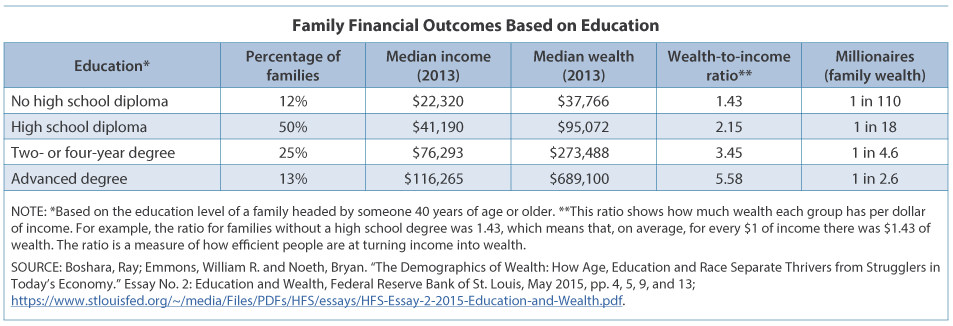
Perhaps education is best described as an investment, specifically in human capital. You are, after all, spending years of your life in school, even without advancing on to higher education, and assuming you attend college, the price of attendance can be its own beast. However, there are many sources that highlight the strong correlation between a higher education and income. Case in point,
“The higher income that results from a college degree is sometimes referred to as the ‘college wage premium.’ Research shows that this premium has grown over time. In addition, in general, the more skills people have, the more employable they are. As a result, workers with more education have a lower average unemployment rate than those with less education (Federal Reserve Bank of St. Louis).”


The Scandinavian Journal of Economics also wrote a paper concerning this question: How does education impact the economic growth of The United States? The paper explains that

“This increase in income is the key to understanding the link between investment in education and economic growth. People differ enormously in effectiveness on the job. Substituting more effective for less effective workers increases output per worker. More highly educated or better trained people are more productive than less educated or poorly trained people.”

The article concluded that,

“Our estimates of investment in education incorporate the impact of higher educational attainment on the value of nonmarket activities such as parenting or enjoyment of leisure, as well as the effect of increased education on earning power in the labor market. The time scale appropriate for measuring human capital formation is given by the lifespan of an educated individual.”

In other words, that means that the value of an investment in education are impactful over the full course of someone’s life. The benefits of a higher education also influence every aspect of one's life, not just their job or salary.

In addition to all of that, it’s not exactly a secret that Americans enjoy one of the highest living standards in the world. Of course, there are exceptions, but for the most part, Americans are enjoying more wealth than their foreign counterparts. According to the Foundation for Economic Education,
“A groundbreaking study has discovered that after accounting for all income, charity, and non-cash welfare benefits like subsidized housing and food stamps, the poorest 20 percent of Americans consume more goods and services than the national averages for all people in most affluent countries.”
And in the article’s unrelenting words, “if the US “[poorest]” were a nation, it would be one of the world’s richest (Foundation for Economic Education).”

That gives The U.S. the best of both worlds. A higher education is rewarded with a higher wage, on average; while, largely due to the success of the United States economy, there is a very large buffer between you and poverty. This makes pursuing higher education in The United States a very worthwhile investment because of the odds that your “investment” will pay for itself. However, you can also afford to take risks, invent, and explore new ideas, because you can be assured that failing is not a detrimental loss. Failing in The United States is a lot less dangerous than the same in Venezuela, Brazil, or one of the many developing African or Middle Eastern nations. You don’t want to end up broke in one of the Venezuelan favelas.

But what about the cost of college you might protest?

Well, there’s really no skirting around this one. Anyone that decides to pursue a college education will have to bite the bullet. There’s also no shortage of sources reminding us that a total of $1.53 trillion is owned in student debt, or that the average amount owed is $37,172 (NitroCollege.com). Not all is lost though.

 “Amid the alarming statistics, there is some good news as well. Higher education is a cornerstone of the American dream and, despite the rising cost, more than two-thirds of American high school students choose to go to college (NitroCollege.com)”

A national poll conducted by Morning Consult also found “61% of adults said that, even based on their “current financial situation,” taking out student loans was worth attending college.”

Forbes also reported that “Generation-Z, which the poll identified as 18-21 years old, said loans were worth it by a margin of 79% to 19%. Even among Millennials, ages 22-37 and the generation with the most student debt, 56% said the loans were worth it.”

College may be an expensive investment, but many of the people that attend and graduate with a degree say that their investment was worth it in the end.

Obviously the pursuit of higher education can be a nuanced and complex topic and every case should be taken individually. College is most certainly not for everyone, and if your career of interest does not require a 4 year degree or greater, why bother with the extra hassle? However, if you’re on the fence, consider taking on the challenge. Many of the people who graduate don’t regret their decision, and correlation between a greater education and salary is extremely strong. An “investment” in education suggests that the outcome will outweigh the costs.


Works Cited
Agresti, James D. “The Poorest 20% of Americans Are Richer on Average Than Most European Nations: James D. Agresti.” FEE Freeman Article, Foundation for Economic Education, 30 Aug. 2019, fee.org/articles/the-poorest-20-of-americans-are-richer-than-most-nations-of-europe/.

B2B, Clodagh. “What's the Importance of Higher Education on the Economy?” Digital Marketing Institute, Digital Marketing Institute, 10 Dec. 2018, digitalmarketinginstitute.com/blog/what-is-the-importance-of-higher-education-on-the-economy.

Günel, Sinem. “The Power of Education and Why It Is More Important than Ever Before.” Medium, The Ascent, 19 Feb. 2019, medium.com/the-ascent/the-power-of-education-and-why-it-is-more-important-than-ever-before-c0653b03b005.

Newton, Derek. “Even Borrowers Agree, Student Debt Is Worth It.” Forbes, Forbes Magazine, 19 Apr. 2019, www.forbes.com/sites/dereknewton/2019/04/19/even-borrowers-agree-student-debt-is-worth-it/#184a895416aa.

Nitro College. “Average Student Loan Debt in the U.S. - 2019 Statistics.” Nitro, www.nitrocollege.com/research/average-student-loan-debt.

“The Schools Aren't Broken, They're Outdated.” Teachers College - Columbia University, www.tc.columbia.edu/articles/2000/september/the-schools-arent-broken-theyre-outdated/.

“Why Education Matters for Economic Development.” World Bank Blogs, blogs.worldbank.org/education/why-education-matters-economic-development.

Wolla, Scott A., and Jessica Sullivan. “Education, Income, and Wealth.” Economic Research - Federal Reserve Bank of St. Louis, research.stlouisfed.org/publications/page1-econ/2017/01/03/education-income-and-wealth/.

Jorgenson, Dale W., and Barbara M. Fraumeni. “Investment in Education and U.S. Economic Growth.” , vol. 94, 1992, pp. S51–S70. , www.jstor.org/stable/3440246.

Investing -Joe & Brady

Wednesday, September 25, 2019

What’s the easiest way to stay out of Credit Card Debt?


By Quinn Berglin

Hundreds of thousands of Americans find themselves in a hole when it comes to their credit card debt, and they just can’t find their way out. How can you ensure you’re not in debt?

In short, don’t spend on stuff you don’t need, and can’t afford. According to Creditcards, they suggest that you use your credit card as a tool to avoid carrying paper cash, rather than using it as a debt tool. Essentially, they suggest that you think of your credit card as physical money. If you don’t have enough money in your hand, you shouldn’t, and can’t, pay for it.

But what if I’m already in debt?

That’s an issue. This is because credit companies charge compound interest on your payments, which means you’ll have to pay more and more as your debt keeps getting higher. Creditkarma makes it easy to understand. They say, “Compound interest is basically interest on the principal amount plus whatever interest has already accrued.”


However, there is hope. Once you are in debt, yes, it is hard to get out. But this is only for those who can’t control their impulsive or lavish spending. If you’re in debt, cut spending costs on stuff you don’t need. Don’t go out for dinner four times a week; cook at home. Don’t buy those new shoes that you really need; control yourself. Shut off the lights, or shorter your showers, or simply just don’t buy things you don’t need. Soon enough you’ll find yourself climbing out of debt.

Works Cited
“8 Things You Must Know about Credit Card Debt.” CreditCards.com,
www.creditcards.com/credit-card-news/help/8-things-to-know-about-credit-card-debt-6000.php.

Rosenberg, Eric, et al. “What Is Compound Interest & How Is It Calculated?” Credit Karma, 12 Aug. 2019, www.creditkarma.com/advice/i/compound-interest/.
Related Posts Plugin for WordPress, Blogger...