Friday, May 3, 2019

Tesla Announces Ride Sharing App

Tesla Announces Ride Sharing App
Nate Tollenaar


In character with their long history of announcing things that seem like dreams and likely won’t be accomplished as quickly as they say they will, Tesla has announced an opportunity to use your car as a pseudo-taxi service... when you aren’t using it. Much like Uber and Lyft that offer the ability to pay others to drive you places, this does something similar, enables you to get paid for moving someone from point A to point B. However, used in conjunction with their self-driving technology, you may not need to be in the car. Unlike Uber and Lyft, which require you to physically be driving a car, you could be making money while sitting at a desk at work or reading a book at home. Not only would this car provide a significantly better option for saving the environment (provided we actually start producing electricity in a greener manner) but it would literally pay for itself after a while. This could considerably shift the market and have a significant impact on the economy. With such a useful concept with a significant return to the buyer, this service could potentially drive the economy away from buying gasoline cars and provide significant competition for Uber and Lyft, especially since it removes one of the most complained about parts of both of those services, the driver. Tesla, being an american-based company, could potentially add millions or billions of dollars to the US economy should they complete this before other companies can create similar self-driving cars. Especially given the prevalence of foreign car companies like Honda, Toyota and Mercedez-Benz in the US economy, these cars could potentially corner the market for a short time. Not only would this change the imports of the US slightly, it would significantly increase exports as these cars would undoubtedly be sold all around the world. Furthermore, this service could prove to increase employment within the US as repairs unique to electric cars become more prevalent, the increased profits enable Tesla to fund more research and development, both on the mechanical and programming aspects of their vehicles and of course, we’ll need factory workers to at least make sure the cars are manufactured properly. All in all, this development could put the US at the top of the automobile food chain and provide a significant increase to the economy of the US.

Works Cited
Tesla, Inc, www.tesla.com/presskit#autopilot.

McFarland, Matt. “Elon Musk Says Tesla Will Have Robo-Taxis Operating next Year.” CNN, Cable News Network, 22 Apr. 2019, www.cnn.com/2019/04/22/tech/tesla-robotaxis/index.html.

Thursday, May 2, 2019

How does Immigration affect GDP?

How does Immigration affect GDP?
Aparna Mandapaka

Immigration is considered as one of the major and important topics in the United States. As Donald Trump got elected as the president of the United States the immigration became severe and terrifying. He nearly deported half a million people back to their homeland last year. Most people support President Donald Trump’s ideas because they believe that allowing more immigrants into the United States would put their jobs at risk and they think that as we hire high skilled and high experienced people from different countries the natives would lose job opportunities and lose demand in the market. But allowing more immigrants into the United States would have a huge benefit because they help in creating more workspace and also help in boosting up the economy. Immigrants contribute to the economy and GDP by paying taxes, immigrants pay more taxes than Americans. According to the National Immigration Forum, “Immigrants pay taxes and spend money in local economies. Without these important economic contributions from immigrants, the U.S. economy would be smaller, and government at all levels would see revenues decline without the taxes paid by immigrants.” Immigration brings benefits to the U.S. economy through the help of their taxes, immigrants taxes benefit retired people and other Americans like college students by the government providing them scholarships.

Immigrants also help in increasing the GDP by impacting on the labor market. As we hire more immigrants they work more hours, which means they worked more hours in the economy. Working more hours would help the economy because if you are in a job and working it means less unemployment when the government calculates the unemployment rate. When you are working for government doesn’t check if you are a citizen or immigrant(but you have to have legal working permit) they just want to know do you work or not and how many hours you worked because if there is less unemployment it means that the country is doing good and has a good economic condition. According to ProPublica, Adam Ozimek and Mark Zandi at Moody’s Analytics, “an independent economics firm, estimated that for every 1 percent increase in U.S. population made of immigrants, GDP rises 1.15 percent. So a simple way to get to Trump’s 4 percent GDP bump? Take in about 8 million net immigrants per year. To show you what that really looks like, we’ve charted the effect below. You can see for yourself what might happen to the economy if we increased immigration to the highest rates in history or dropped it to zero – and everything in between.” In recent interviews, President Donald Trump stated that he would increase GDP at least 3.5 - 4%, but he might not reach his goal if he stops legal immigrants from entering into the United States and deporting them. If there are fewer immigrants in the United States means that they are fewer taxes being paid, when there are fewer taxes being paid it means that the economic growth is decreasing


If we compare these two graphs, you can see that one million immigrants would maintain GDP at 2%, because as the immigrants come into America they pay local taxes which is 8% of their salary. If we compare the graph that has five million immigrants we can see that the GDP increased between 3 to 4 percent. They are receiving at least eight percent from each individuals salary, and more taxes are being paid so the GDP increases..

In conclusion, another way immigrants boost up GDP and economy by paying their kid's college fees. Most immigrant children are considered as international students in college, which means that they pay double amount than the out state fee. Since they are the international student they are not eligible or receive any type of government fundings like scholarships. Since they pay double amount this would go towards government spending, which is eventually used for boosting up the economy and would go as pension for retired people.


Works Cited
Groeger, Lena. “The Immigration Effect: There's a Way for President Trump to Boost the Economy by Four Percent, But He Probably Won't Like It.” ProPublica, 19 July 2017, projects.propublica.org/graphics/gdp.

“Immigrants as Economic Contributors: Immigrant Tax Contributions and Spending Power.” National Immigration Forum, immigrationforum.org/article/immigrants-as-economic-contributors-immigrant-tax-contributions-and-spending-power/.

“Immigrants as Economic Contributors: Immigrant Tax Contributions and Spending Power.” National Immigration Forum, immigrationforum.org/article/immigrants-as-economic-contributors-immigrant-tax-contributions-and-spending-power/.

Does Russell Wilson Deserve to be the highest paid Player in the NFL?

Does Russell Wilson Deserve to be the highest Player In the NFL?
Ryan Szewczyk

Quarterback is the most important position in the NFL. Therefore quarterbacks are the highest paid players in the NFL. Last week on April 19th former Wisconsin badger Russell Wilson signed the richest deal in NFL history. Adding another four seasons with Seattle and $140 million in new money. Wilson will be under contract through 2023 and he will be getting paid 35 million dollars per year starting this upcoming season. Not to mention the eye opening 65 million dollar signing bonus. Wilson’s signing bonus was 9 million dollars more than Aaron Rodgers. Which most people think Arron is the better of the two. So does he deserve to be the highest paid player in the NFL


When you think of top quarterbacks in the NFL you think of names like Brees, Brady and Rodgers, not Russell Wilson. Don’t get me wrong he is an above average quarterback but he doesn’t deserve to be the highest paid. Wilson has won one super bowl in 2013 and has not been back to the Conference championship since 2014. Last season the Seahawks went 10-6 and lost to the Cowboys in the wildcard. According to Footballrefernece.com Wilson was 20th in the league in total pass completions, 18th in total yards and 19th in completion percentage. He was3rd in touchdowns thrown but that still isn’t the numbers you want for the highest paid quarterback in the NFL. Wilson’s greatest asset as a quarterback is his ability to extend plays with his feet. No quarterback has rushed for more yards since 2012 than he has, but those playmaking instincts often get him into trouble. Despite dropping back the fewest times among regular quarterbacks over the last three seasons, Wilson has taken the second-most sacks in the NFL.

Granted, Wilson’s interception percentage has been 2.5 percent or lower but he hasn’t been expected to throw it much either. In 56 career games, he has attempted 30 or more passes just 15 times.Wilson has been assisted by a superior and bludgeoning defense for his entire career. It also helps that he’s got Marshawn Lynch in his backfield. When the Seahawks won the superbowl in 2013 Seattle had the best defense in the NFL and he only threw for 206 yards.

To conclude on one hand, it’s hard to argue against Wilson’s value as a winner, and he certainly has all the intangibles  like  leadership, character, poise to give out an elite quarterback contract. The numbers, however, tell the story of a good but not great quarterback, who probably shouldn’t get the top-of-the-market money that is reserved for the absolute best players in the league.

Augmented Realty, the Next Revolutionary Technology?

Augmented Reality, the Next Revolutionary Technology?
Author: Dominic Leonard

What’s the first thing that comes to mind when you think of the future? Flying cars that automatically drive, virtual reality, robots, do any of these ideas pop up? Most likely yes. While some of these technologies are just a figment of the imagination, some of them are real, and very well could be used by the public today, or in the upcoming years. We are in an era of rapid technological evolution, and while the public’s opinion may be controversial at best when discussing the future of technology, all these modern technologies are well known. All except one: Augmented reality.

Augmented reality (AR) is when a device takes the existing surroundings around the user, and adds computer generated images to it. This is not to be confused with virtual reality (VR), where a device is used experience an entirely original world with computer generated images. The most popular example of augmented reality is Pokémon Go, which superimposes images on to your surroundings with a phone, but augmented reality can also count as 3D holograms, and some QR codes, as long as it follows the definition. Compared to VR, AR is cheaper at the expense of an immersive experience, but virtual reality’s immersive experience will be exactly what holds it back from being used outside of the video game market, and for specific medical therapies. AR doesn’t limit the user as much as VR because the user can still see their actual surroundings, and the user doesn’t have to use wires and a high quality graphics processing unit to render millions of polygons on screen. Augmented reality is simply more practical than virtual reality.

 Augmented reality can be used for a large variety of purposes to boost the economy. The site eonreality.com suggests that with the lower attention spans today, education could be improved by transitioning from an auditory, lecture based learning style, to a more visual based learning style. (Wouldn’t you agree? School would be a lot more interesting if that was the case.) The site lifewire.com goes even further and suggests many other uses such as military pilots using AR to display necessary information, surgeons using AR to display an overlay, and information when doing a precise surgery to reduce risk of failure. There’s also more conventional uses for AR such as navigation, sightseeing, maintenance and repairs, gaming, and businesses would also benefit with AR advertisements. All of these applications of AR can increase production and efficiency for many different markets, providing certain services also would become a lot easier. The economy’s GDP would grow and the quality of life for most consumers would also improve as a result.
Augmented reality is a useful technology that is overlooked for its simplicity. This technology already works fairly well, and it’s been around for many years at this point. All that really needs to happen is to polish up the technology a little bit more, make sure it’s 100% reliable, and to spread the word. Augmented reality is a great technological step forward just waiting to happen.

Works Cited
Admin. “What Is Augmented Reality (AR)? Ultimate Guide to Augmented Reality (AR) Technology.” Reality Technologies, Reality Technologies, 4 Oct. 2018, www.realitytechnologies.com/augmented-reality/.

“Augmented Reality – The Past, The Present and The Future.” The Interaction Design Foundation, www.interaction-design.org/literature/article/augmented-reality-the-past-the-present-and-the-future.
“How AR and VR Change the Global Economics Conversation.” EON Reality, 12 Sept. 2018, www.eonreality.com/how-ar-and-vr-change-the-global-economics-conversation/.

Perdue, Tim. “All You Wanted to Know About Augmented Reality.” Lifewire, Lifewire, 2 Apr. 2019, www.lifewire.com/applications-of-augmented-reality-2495561.

Ronzio, Jonathan, and Brent Turner. “What Is the Difference Between AR and VR? A Lesson in Altered Realities.” Cramer, Cramer, 24 Feb. 2019, www.cramer.com/story/the-difference-between-ar-and-vr/.

The War on Drugs and Legalizing Pot

The War on Drugs and Legalizing Pot
Marissa Ziolkowski

If you closely followed the 2018 midterm election in Wisconsin, it will come as to no shock that 59% of voters, 70% of voters, 77% of voters respectively in Racine, Milwaukee, and Waukesha Counties said they would support the legalization of recreational marijuana in Wisconsin (“Wisconsin”). And, as someone myself who acknowledges that people are going to use marijuana recreationally regardless of the legality of it, I am left to wonder: if so many people support the legalization of pot in Wisconsin, why haven’t we done so yet? Ultimately, from an economic and social standpoint, the legalization of recreational marijuana just makes sense.


As seen by this graphic, public approval of legalizing recreational marijuana is not endemic to Wisconsin.

As previously mentioned, we have marijuana users in our state as we speak because, despite it being illegal in Wisconsin, people continue to use the drug. Seeing as it is a drug that is near impossible to overdose on and is not as dangerous as alcohol (Villa)--a drug we in Wisconsin near condone the over-serving of--marijuana should be a good we tax in Wisconsin. Our state (and hopefully, one day, our country) can take a good that is being used regularly by its citizens and make a profit off of it while introducing regulation on the drug to limit the lacing of marijuana with more harmful, addictive substances. By legalizing marijuana, small businesses related to dispensaries or pot paraphernalia can begin to thrive, and justice more easily served to those who sell tainted products. For example, in August of 2018, Colorado was ranked first when comparing states’ economies (“States”). This ranking came after Colorado’s legalization of pot in 2014--and while it is unfair to attribute their entire thriving economy on their marijuana sales, I would be remiss to say it didn’t help.

Additionally, the war on drugs has not been cheap for the American people. An estimate has put the federal government of the United States at $1 trillion spent on the incarceration of illegal drug possession or use since 1971. Not only would the legalization bring in money to our governments, with tax revenue raking in anywhere from $2.4 billion to $6 billion annually, depending on how it is taxed--but also, would save the federal government about $7.7 billion annually, as by legalizing pot, you reduce the number of people who are committing a crime (Edwards).  Taxpayers are paying for the incarceration of nonviolent “criminals” currently, which is quite honestly, a waste of money.

The legalization of marijuana would also improve the social health of our nation, as unfortunately, racism is present in our legal system. This is no question, as from the excess of police brutality shown towards minorities to the sentences received for the same exact crime between minorities and whites, the racism present in our system has been proved time and time again. “[D]espite accounting for only 12.5 percent of all substance users, black Americans make up nearly 30 percent of all drug-related arrests” (Pearl). Justice is not being fairly served, as marijuana arrests appear to be just another vehicle for delivering unjust sentences to minorities.

All in all, while change can be scary, it is the key to progression--as a nation and as an economy. Legalizing recreational marijuana is heavily supported in Wisconsin, and after seeing the benefits of the legalization, I believe it is time to listen to the people.

Works Cited
Edwards, Ezekiel, and Rebecca McCray. “Hundreds of Economists: Marijuana Prohibition Costs Billions, Legalization Would Earn Billions.” American Civil Liberties Union, American Civil Liberties Union, 9 July 2018, www.aclu.org/blog/smart-justice/sentencing-reform/hundreds-economists-marijuana-prohibition-costs-billions?redirect=blog%2Fmass-incarceration%2Fhundreds-economists-marijuana-prohibition-costs-billions-legalization-would.

Hartig, Hannah, and Abigail Geiger. “62% Of Americans Favor Legalizing Marijuana.” Pew Research Center, Pew Research Center, 8 Oct. 2018, www.pewresearch.org/fact-tank/2018/10/08/americans-support-marijuana-legalization/.

Pearl, Betsy. “Ending the War on Drugs: By the Numbers.” Center for American Progress, 27 June 2018, www.americanprogress.org/issues/criminal-justice/reports/2018/06/27/452819/ending-war-drugs-numbers/.

“States with the Best and Worst Economies.” USA Today, Gannett Satellite Information Network, 27 Aug. 2018, www.usatoday.com/picture-gallery/money/economy/2018/08/23/states-with-the-best-and-worst-economies/37490719/.

Villa, Lauren. “Marijuana vs Alcohol | Is Marijuana Safer Than Alcohol?” DrugAbuse.com, American Addiction Centers, 21 Dec. 2016, drugabuse.com/marijuana-vs-alcohol/.

“Wisconsin Election Results: Governor, Senate and Other Seats up for Grabs.” Wisconsin Election Results: 2018 Midterm Live Results | Journal Sentinel, Journal Sentinel Online, 7 Nov. 2018, projects.jsonline.com/topics/election/2018/11/6/november-2018-wisconsin-general-election-results.html.

Wednesday, May 1, 2019

Why Protectionism Is Toxic

Why Protectionism Is Toxic
Written By: Miriam John

The one rebuttal to this argument that I know everyone has is, “But we want to protect American jobs!” and I absolutely agree, but trading with other countries should not be equated to outsourcing. When you look at countries like England, which is an isolated island (resourcefully speaking) located towards the northern hemisphere, their entire economy and country would collapse if they tried to depend on themselves for produce, oil and other resources and goods their land cannot provide to the quantity that they need. In 2017, England earned about $395 billion in exports, but juxtaposed by the whopping $617 billion that they spent on imports you can clearly see they have a great trade imbalance. Yet, their unemployment rate as of 2018 was 4.2% which is around the natural rate of unemployment. Compare that to our export earnings of $1.25 trillion and import spending of $2.16 trillion, it’s easy to see that the trend is that well functioning, first world countries naturally import about double what they export (in dollars) considering our unemployment rate was at 4.0% as of June 2018. But limiting free trade and enticing trade wars can only destroy that.

In my opinion, the real reason protectionism has gotten so popular lately is not because it would actually strengthen our economy, but because of xenophobia. It’s easy to blame any of our economic problems on another country instead of making internal changes to our system because creating fear is easier than instilling hope. It’s easy to blame China, with whom we trade extremely often for goods that are far too expensive to make here, for the fact in 2017, our poverty rate was about 12.3%. That meant about 39.7 million Americans lived below the poverty line. Nothing about this statistic is good and I do believe we need to take measures to improve this situation, but putting higher tariffs on foreign goods that we depend on is not the answer.

Of course I realize there are downsides to excessive trading. Perhaps it is more humane to purchase products domestically if you are worried about sweatshop labor, but the reality is that we have laws in place to prohibit illegally made goods and/or products produced of child labor from being imported into our country to be sold. The only way that you would be supporting inhumane labor is if you yourself bought from the individual company/country that utilizes these methods. But the government will not currently stop you from buying cheap clothes from that online Chinese website because those goods are not being imported by the government in bulk. Another downside is that we may become too dependent on other countries, but there is always a happy medium. We obviously cannot rely on ourselves to produce certain goods at an effective price and quantity, but if we rely on other countries, we will be at their mercy if they decide to withhold those goods from us. But if we approach it as we are currently approaching oil, we can buy cheaper oil from the Middle East but build our oil reserves domestically and slowly work it into our economy so as not to overwhelm gas prices but to also be less dependent on the OPEC countries. But were we to raise tariffs on imported oil, prices in the U.S for gas would soar and we would not be able to afford OPEC oil but we would not have the resources to provide the entire country with oil. You can actually see in these pictures that we export a lot of the same things we import, which contributes to the trade balance in a positive way. Other countries are just as dependent for our cars as we are for their cars etc. thus we can make the products that are more efficient for us to make and we can buy similar products based on tastes and preferences that may not be as efficient for us to make.


All in all, extreme protectionism is truly bad for our economy and will actually reduce our GDP, if you consider recent news about the many factories in various industries that shut down/laid off workers because the price of steel is currently too high with the tariffs the Trump administration currently has in place. Ultimately, workers will pay the price for the costs that corporations have to shoulder and that will damage our economy more than restore it, thus we should shift our focus to more free trade and perfecting our trade balance to a healthier level.

Works Cited

Ikenson, Daniel J. “Protectionism and Trade Barriers Aren't Just Bad Economics – They're Also Immoral.” Cato Institute, 10 May 2018, www.cato.org/publications/commentary/protectionism-trade-barriers-arent-just-bad-economics-theyre-also-immoral.

Pensions, Department for Work and. “Employment Rate Remains at Record High.” GOV.UK, GOV.UK, 12 June 2018, www.gov.uk/government/news/employment-rate-remains-at-record-high.

Petersen, Thieß. “US Protectionism Is Bad for Everyone, Especially for America Itself.” Euractiv.com, EURACTIV.com, 14 Sept. 2017, www.euractiv.com/section/economy-jobs/opinion/us-protectionism-is-bad-for-everyone-especially-for-america-itself/.

“United Kingdom.” OEC - United Kingdom (GBR) Exports, Imports, and Trade Partners, atlas.media.mit.edu/en/profile/country/gbr/.

“United States.” OEC - United States (USA) Exports, Imports, and Trade Partners, atlas.media.mit.edu/en/profile/country/usa/.

“United States Unemployment Rate.” United States Unemployment Rate | 2019 | Data | Chart | Calendar | Forecast, tradingeconomics.com/united-states/unemployment-rate.

US Census Bureau. “Income and Poverty in the United States: 2017.” Income and Poverty in the United States: 2017, 16 Apr. 2019, www.census.gov/library/publications/2018/demo/p60-263.html.

The Potential of the AfCFTA

The Potential of the AfCFTA
Benjamin Bucheger

AP Econ A4


In March of 2018 the leaders from 44 African nations met in Kigali, Rwanda, committing to launching a common market for Africa. The African Continental Free Trade Agreement (or AfCFTA or CFTA for short) is not something that average American thinks about or maybe even knows about. But this agreement that would create the largest continental trade-bloc for goods and services in the world is arguably the biggest story in international economics to date. In order to stay informed let’s get into the finer details of what the CFTA is and what it plans to do.

The CFTA intends to bring together the markets of all 55 AU member states covering a population of 1.2 billion people with a collective GDP of $3.4 trillion. Further it seeks to boost intra-African trade through trade liberalization allowing the free movement of local businesses, investment and people. Better coordination between governments and businesses through this international economic forum will also resolve disputes that arise from membership in multiple smaller trade unions (such as the Economic Community of Central African States or the EC of West African States). The hope is these goals will enhance competitiveness, market interaction, and effectively deal with a century old problem caused by colonialism - impediment to trade and economic development due to an overemphasis on raw materials. Despite the potential of growth for the African economy there are still some points of disagreement amongst African nations mainly dealing with execution.

The goals will be accomplished through several measures. The CFTA consolidated text itself is split into two phases. The first (currently underway) deals with the trades in goods & services and dispute settlements. The second phase (to be concluded in 2020) will cover investment, intellectual property rights, and competition policy. The part I’m going to focus on - included in phase 1 - is the progressive reduction of tariff and non-tariff barriers.

According to the United Nations Conference on Trade and Development a Full Trade Agreement (that is, eliminating all tariffs) could generate welfare gains of $16.1 billion at the cost of $4.1 billion in tariff revenue loss. At the same time GDP and employment are projected to grow 0.97% and 1.17% respectively. Intra-African trade is estimated to grow by 33% and the trade deficit across the continent would decrease by 50.9%.

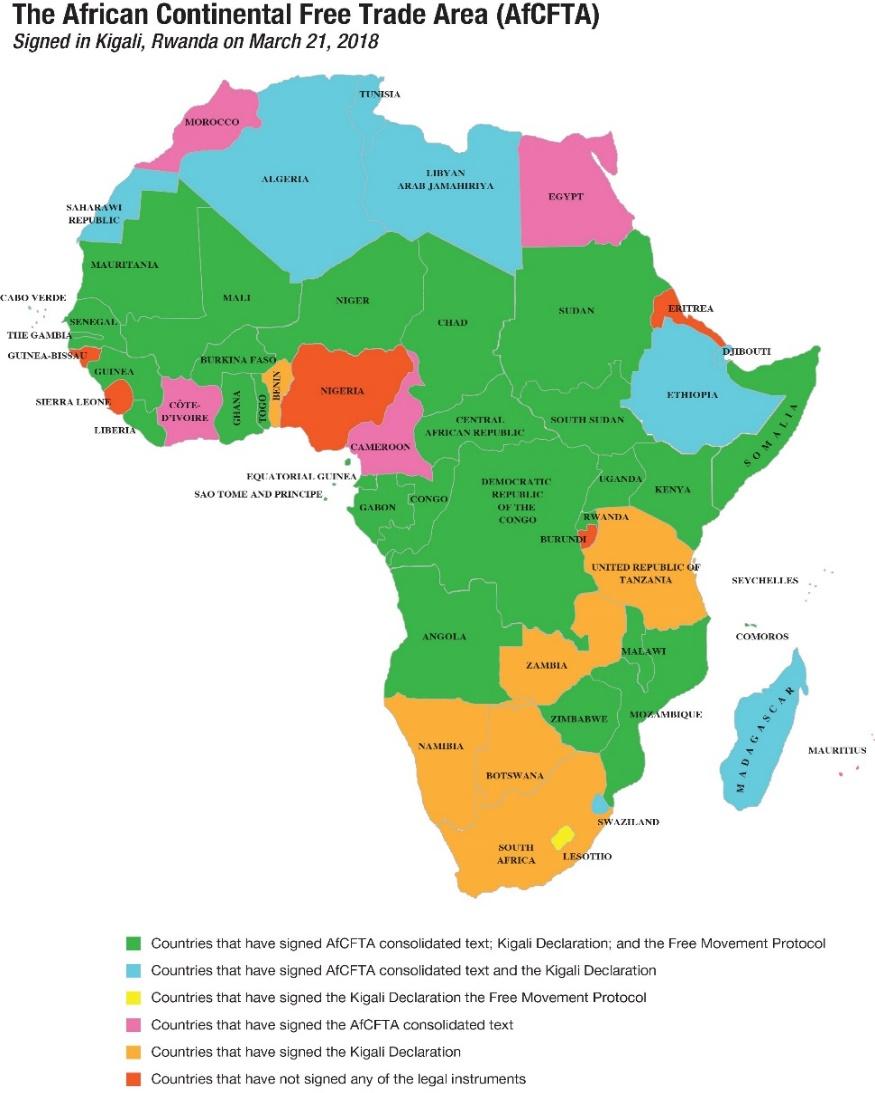
On the other hand if African nations instead go to a Special Product Categorization model (exempting sensitive products from trade liberalization) in order to appease nation-states with concerns towards a FTA, more on that later, welfare gain would decrease to $10.7 billion in the long term. Tariff revenue loss would also decrease to $3.2 billion. Meanwhile GDP and employment are expected to grow by 0.66% and 0.82% respectively. Intra-African trade would still grow, but only by 24% and the trade deficit would only decrease by 3.8%. Though the SPC option seems worse on the surface the draw to such a model for nations at odds with the CFTA, such as Nigeria or Burundi, is that it appears to address concerns over a lack of protection for local industry in a completely liberalized market. There is also concern that the agreement favors larger nations that already have a somewhat industrialized economy while leaving smaller nations behind without proper incentives to invest in them. However, nations who refuse to sign the CFTA are outliers and as of this month 52 nations have signed the agreement. The more contentious part of the agreement, which only 29 nations have signed, is the Free Movement Protocol.

As the name suggests, the protocol allows the free movement of people, right to live and establish businesses anywhere in Africa. Despite its less than ideal support the FMP is the backbone of the CFTA as free movement improves the interconnectivity between African businesses by lessening the cost of and time it takes to cross borders. The reason certain nations don’t support the protocol, such as Tanzania, is due to concerns over potential mass immigration to more wealthy nations with an inability to properly manage these immigrants. This mainly applies to fears over job loss of citizens due to overcrowding in the job market. Francis Mangeni, director for Trade, Customs, and Monetary Affairs for the Common Market for Eastern and Southern Africa, puts it best why these fears are unwarranted stating, “Many African states still believe in overblown myths that when they open up to other nationals, it will cause insecurity and jobs will be fewer for their citizens. But they have to look at countries that have successfully done it. Rwanda, Kenya, Seychelles and others opened up their borders and they have not collapsed,” In any case the signing of this protocol by all nations involved will be crucial to the success of the CFTA.

Wrapping up, the AfCFTA will undoubtedly take a lot of work to implement. Participating nations will have to implement minor and major economic reforms to be better responsive to a more liberalized trading system and economy while at the same time putting in place the infrastructure required to fully take advantage of the potential benefits of the CFTA. Furthermore trade agreements between African nations and nations outside of the African continent such as China and the US will have to be renegotiated with the greater African Union. So far 22 countries have ratified the agreement meeting the minimum requirement to bring it into full force. More who have signed are expected to ratify the agreement as phase 1 negotiations continue and more specifics are made available. As you watch the news be sure to keep an ear out for word on the AfCFTA, an agreement that will change the course of African economics for generations to come.

Map of whose signed the AFTCA in March, 2018: 


Works Cited
“Africa Continental Free Trade Area: Benefits, Costs and Implications.” Infomineo, 20 Apr. 2018, infomineo.com/africa-continental-free-trade-area/.

“Africa Wary of Free Movement as Single Market Opens.” The East African, 22 Mar. 2018, www.theeastafrican.co.ke/business/Africa-wary-of-free-movement-as-single-market-opens/2560-4352792-cv2rmfz/index.html.

“African Continental Free Trade Area: What Do We Expect in 2019.” Daily Monitor, 29 Apr. 2019, www.monitor.co.ug/OpEd/Commentary/African-Continental-Free-Trade-Area-What-expect-beyond/689364-5091612-adta3t/index.html.

“Kigali Declaration, 2003.” ACHPR, www.achpr.org/instruments/kigali/.
“THE AFRICA CONTINENTAL FREE TRADE AGREEMENT AND CROSS-BORDER DATA TRANSFER: MAXIMISING THE TRADE DEAL IN THE AGE OF DIGITAL ECONOMY.”

AANoIP, 20 Mar. 2019, aanoip.org/the-africa-continental-free-trade-agreement-and-cross-border-data-transfer-maximising-the-trade-deal-in-the-age-of-digital-economy/.

Related Posts Plugin for WordPress, Blogger...