Wednesday, October 24, 2018

LeBron James Leaving Cleveland

LeBron James Leaving Cleveland
BJ Wallace

LeBron James left Cleveland just over 3 months ago and his absence doesn’t just hurt the team’s success but the city as a whole economically. If his move causes the same economic downfall as his first move in 2010, the city would lose an estimated $300 million as a whole.

Why would one player leaving an NBA team cause such a loss in a cities economy? While I know this would require a response more well-versed in macroeconomics, there are several microeconomic components through the reasoning.


First, the merchandise sold by the Cleveland Cavaliers was 25% accounted for by LeBron James jerseys and other products. Imagine you are selling any one product such as a type of crop, and there is a storm that rids of 25% of your field. This is a very significant decrease in supply. This leftward shift of the supply curve would cause the new quantity demanded to decrease.

The biggest reason for a decrease in economic value when LeBron leaves is that going to a Cleveland Cavaliers game is a complementary product to many of the local businesses such as many well known restaurants. When the demand for the cavaliers tickets go down, which will inevitably happen when the best basketball player in the world leaves, the demand for the compliments will also go down. Just being in the city and experiencing the downtown area is also a compliment and when all of these businesses are getting less customers, the economy will be in decline. Even the owner of the Cavaliers, Dan Gilbert, will experience this decline because he has invested in a well-known casino named Jack Casino. This casino has had a total revenue of of $1.26 billion in the last 6 years. Below is the number of restaurants within one mile of the stadium in the years that LeBron was in Cleveland and in Miami. As you can see, there are more restaurants when he is present. With these restaurants brings jobs which greatly benefit the economy.


Finally, a more in depth proof of the drop in price of the game tickets (the main source of profit for the team) can be shown through the marginal utility of the consumer. We know that most consumers will buy a product up until the point where marginal utility is equal to the marginal revenue or the price. Without the electrifying presence of LeBron James, the marginal utility for each game you go to will decrease. This will create one of three outcomes. Either the prices of tickets will stay the same so less people would attend the games, the prices of tickets will decrease significantly and the same number of people will attend the games, or somewhere in the middle. In each scenario, the total revenue of the organization is lower than what it was in 2017 because either the price decreases while quantity sold stays the same, price stays the same and the quantity sold decreases, or both.

It is amazing that one person can have such a large effect on the economy of a city by just being there playing a game. Not only does it affect the team’s revenue through merchandise and ticket sales, but also it affects the surrounding businesses. We will have to wait a few more months to see the final effect of his move.


Works Cited
Banks, Alec. “The LeBron James Effect: An Economy Built on One Man.” Highsnobiety, Highsnobiety, 14 July 2018, www.highsnobiety.com/p/lebron-james-effect-econony/.

Rooney, Kate, and Leslie Josephs. “How LeBron's Move West Could Tip Parts of Cleveland's Economy South.” CNBC, CNBC, 10 July 2018, www.cnbc.com/2018/07/02/lebron-james-move-will-hurt-clevelands-winning-record--but-its-econ.html.

Rovell, Darren. “LeBron James Is Worth Hundreds of Millions to the Cavs and Cleveland.” ESPN, ESPN Internet Ventures, 13 June 2018, www.espn.com/nba/story/_/id/23769496/lebron-james-worth-millions-economy-cleveland.

Scott, Dylan. “LeBron James Means a Lot to Cleveland - and Its Economy.” Vox, Vox, 1 June 2017, www.vox.com/2017/6/1/15724252/lebron-james-economic-impact-cleveland-miami.

The Rise of American-Made Clothing

The Rise of American-Made Clothing
Written by: Nik D.

On June 1st, 2017, the United States imposed 10% tariffs on aluminum and 25% on steel being exported to Europe, and as a retaliatory response, the European Union placed 25% tariffs on European-made clothing being exported to the United States. Recently, the Trump Administration set out to try and “force” companies to produce goods within the United States in hope of a more self-sustaining economy. In order to do this, they placed large tariffs on an aluminum and steel being imported to the United States. In a retaliatory response, the European Union slapped 25% tariffs on jeans, shorts, t-shirts, and synthetic woven trousers being exported to the United States ( a tariff is an extra tax added to a good being exported or imported). Some of these clothing goods are shown on the right. A common output from tariffs is that they change the number of goods being imported or exported). According to Rick Helfenbein, the chief executive/president of the American Apparel and Footwear Association, “‘Made in USA’ apparel... will suffer as a direct result of this action by the Trump administration”. I believe that Helfenbein is on point with the outcome effects of these tariffs, and believe that they are not beneficial for our economy and greatly hurt individual clothing companies.

When looking on a smaller scale, these clothing tariffs can be devastating to clothing companies; in specific they affect implicit/explicit costs, profit, as well as the marginal cost/revenue of the companies. The production of the clothing being produced within the United States rather than overseas leads to greater explicit costs. A majority of the increased explicit costs are due to higher wages needed to pay to the workers in the United States. Yes, it is good that the businesses are producing product within our country, but then again they are doing so less efficiently than they would if the product was produced overseas. The increase in wages outweighs the costs of producing within the United States (such as less transportation cost due to no international transportation), so these tariffs are not beneficial whatsoever. The production of the clothing, as well as the material costs, are close to the exact same as they are overseas, so it is the increase in worker wages that is responsible for the greater explicit costs. There will also be an increase in implicit costs because the opportunity cost is larger for producing the items inside the United States (the items would be produced more efficiently overseas and for less of an opportunity cost). Overall, these costs lessen the profits from the clothing companies and hurt the economy in the clothing and textile sector (which has to do more macroeconomics).

These changes in explicit and implicit costs affect the overall profit of the company. Accounting profit (Total revenue - explicit costs) is much less after the tariffs are imposed because, provided that the total revenue stays constant or less than before, there are greater explicit costs, so the money earned (after paying off all of the costs) is less than it would be if it were produced overseas. The same goes for economic profit, however, the difference in economic profit would be greater than the difference in accounting profit for before and after the tariffs were imposed. This is because the implicit and explicit costs are both greater, so when calculating for the economic profit (Total revenue - explicit and implicit costs), there would be more subtracted from the total revenue, in turn making the economic profit much smaller. Furthermore, the profit of the companies will be closer to normal profit due to the difference in the total revenue and the total implicit and explicit costs being close to zero after the tariffs were put into place. When analyzing profit, the further away from the normal profit a company is (when the revenue is greater than costs), the better off the company is doing. Therefore, the companies producing clothing within the United States are less efficient when doing so, proving that the tariffs are not beneficial to the economy.

Marginal costs and revenues also vary when substantial tariffs are placed on a good. The marginal costs are greater after the tariffs are imposed because the cost added by producing one additional piece of clothing is larger (due to larger explicit costs). Also, provided that the total revenue would stay constant and the total quantity of goods would decrease, the marginal revenue would increase. Therefore, the quantity would be greater at the optimal output due to the fact that the marginal revenue and marginal cost are greater than before the tariffs were in place. In the end, even though the tariffs sound good at first, they end up hurting the clothing companies within the United States. The goal of imposing them is to try and get the clothing companies to produce clothing within our country, and it does so, only at the price of increased explicit/implicit costs, less overall revenue, and in turn less profit.


The table above represents countries in the European Union that the United States imported the most clothing from after the tariffs were imposed. Table from https://wits.worldbank.org

Wednesday, October 17, 2018

Hurricane Michael

Hurricane Michael:
Caleb Nordquist
Hurricane Michael destroyed the east coast this past month, where the death toll reached 18 people and several homes and stores were ravaged. The total cost of damages hasn’t concluded yet however currently they are between $1.5 billion and $3 billion however they could possibly reach around $4.5 billion of deficits. Another 500,000 policyholders in Florida were impacted by the savage storm and power was eliminated in the states from Florida all the way to West Virginia. Although the disaster destroyed several million lives, people believe that insurance companies are benefiting from the hurricane because of the sole fact that they are making money based off of destructed buildings and homes. The southeast corner of the USA was the targeted and afflicted states and the damages resemble that.


As far as most people know, the hurricane isn’t officially concluded. There are still high wind speeds and massive flooding that is ensuring that whatever was there before the hurricane isn’t there afterwards. According to Brock Long, administor of the FEMA, “We're still in life-safety mode. We're not even close to having discussions on rebuilding yet." (CBS News). So according to Brock, most people are still bracing for the wind and water while they see their houses and towns all around them being ravaged. While the hurricane is still occurring, the president has sent out search-and-rescue teams to all the states that were hit by the hurricane. Hurricane Michael also caused destruction to Mexico, when over 250 people were evacuated from their homes and cities because of how serious the threat was. Due to the damages and deaths, the hurricane has seriously hurt the poverty rating in the states. Now that recovery will occur, most buildings and companies are in bits and pieces, causing the jobs to go under and people to live without their careers. With only $4.5 billion dollars in damage, compared to last year’s deadly hurricanes (Irma and Harvey) which crippled the US economy with $180 billion of damages, Hurricane Michael didn’t take as much of an economic decline as past hurricanes have. That doesn’t separate the fact that millions of people are still out of the job for the time being.

Considering all of the damages and all of the hazards that are present in the environment, the damages are fatal and brutal. However, the country as a whole won’t be as affected economically speaking. The destruction is horrific and the damages are in the billions, however compared to prior natural disasters, Hurricane Michael hasn’t costed as much. So, from an economic standpoint, the hurricane caused severe damage and massive payments, however it’s a penny to pay compared to how much Hurricane Harvey and Katrina costed in the past.


Works Cited

CBS/AP. “Michael's Death Toll Jumps as Crews Search for Survivors - Live Updates.” CBS News, CBS Interactive, 12 Oct. 2018, www.cbsnews.com/live-news/hurricane-michael-damage-florida-flooding-georgia-power-outage-weather-deaths-today-live-updates/.

“Hurricane Michael Death Toll Climbs to 18; Trump to Visit Florida, Georgia.” The Weather Channel, weather.com/storms/hurricane/news/2018-10-15-hurricane-michael-latest-impacts-florida-georgia.

“The Damage Costs From Hurricane Michael Could Top $4.5 Billion.” Fortune, fortune.com/2018/10/11/hurricane-michael-damages/.

Why Did Vine Die?

Why Did Vine Die?
Chloe Brossman
You all know the beloved vines that gave you hours of laughter. They created social norms and creative greetings that took over the world. Instead of saying hello to someone between classes, “hi welcome to Chili’s” was screamed across the hall. If vine was such an iconic app, why was it announced that it was going to shut down December 16th, 2016 and fully changed January 17th, 2017?

Initially, the goal for vine was supposed to be little 6 second clips about people’s daily life, snippets into a private world to then share with others. But even after the small test group, it became apparent that it wouldn’t stay like that. Users took a more creative approach, using it to create legendary videos that are viewed more than a billion times. Twitter had been running fine for some time before buying vine, they wanted to continue it and push it further but they didn’t take over their business, instead, left it to the original marketing team. The problem with that came about when Instagram released their 15-second video options. Some stars from Vine began to move to Instagram instead for the longer loop time. From there, Instagram then began to start promoting stars Instagrams by creating an “explore” tab which boosted people’s views. Vine fell behind, remaining under the 6-second barrier.

From there, stars began to demand that Vine compensate them for their videos like Instagram or other platforms do. Without much effort, Vine began tapping into their limited resources to pay people such as Logan Paul $200,000 for Vines. While people loved Vine, they were unable to keep up with the changing competitive social media sources. Facebook, Instagram, and Snapchat all began to create a brand around them and advertise not only to people but on their site to gain money from companies. Together, these large social media’s took over the market with their increasingly unique add-ons and their celebrity base. Vine fell behind, unable to keep up in the highly competitive market.
Soon enough it was left to the core members and creators of Vines who stayed without much money from Vine. As the platform lost its money, Twitter took action, announcing that it will be shutting down the platform and instead it will be something that is attached to Twitter to create the videos.
The Vine fanbase was large, but as it went on, it shrunk, along with their influence in the market. Leaving no economic impact despite its social popularity. Now, you only are able to see existing relics of a past icon.
Works Cited
Newton, Casey. “Why Vine Died.” The Verge, The Verge, 28 Oct. 2016, www.theverge.com/2016/10/28/13456208/why-vine-died-twitter-shutdown.

Ng, Alfred. “Why Twitter Killed off Vine after a Short-Lived Run.” CNET, CNET, 27 Oct. 2016, www.cnet.com/news/twitter-kills-off-vine/.

Twitter (TWTR) will officially phase out its beloved six-second video service on Tuesday, and replace it with a "pared-down" camera application instead. “Twitter Officially Shuts down Vine.” CNNMoney, Cable News Network, money.cnn.com/2017/01/17/technology/vine-shuts-down/index.html.

Hurricane Michael

10/13/18
Ryan Novak
Economics A1
Mr. Reuter
Hurricane Michael

On October 10th, Hurricane Michael touched down on “Florida’s Panhandle”. This hurricane is a category 4 with wind speeds up to 155 mph. This hurricane has killed at least 8 in Florida and another 9 in other states like North Carolina, Virginia, and Georgia. This hurricane also completely massacred Mexico Beach, hitting it the hardest. People did not think the hurricane would be that devastating, the governor had required a mandatory evacuation and yet some did not leave. They definitely took a hit too from the pictures and information behind it saying how the houses had been completely ripped apart. Then the Staff Sgt. Andrew Pliscofsky said, “It was like a monster came through and kicked it all down. This all just shocked us.”. This was his fourth rescue mission and had never seen anything like it.


This photo is from Mexico Beach
Now, looking at the economics side of this, this hurricane had cost an estimated $25 billion. Around $3 million will be placed on the federal flood insurance program and then for the private insurances, they will be hit with around $9-10 billion. Money is not the only thing that was lost here, but also the power is obviously gone, no fuel, and sewage lines are also down. People have lost the homes that they have had for their entire life possible and if it is not gone, it is damaged severely.
Then, you must think about, “Where do these people go now or live?”. Well, there are many other states but they already have a lot of people and don’t another few thousand coming in all at once. If they go back to Florida, how are they supposed to live with no food, water, and home? The only way they’ll live is being on the side of the road or help from everybody or moving to a different state and getting a new job. But what about those with large families? As you can see there are many unanswered questions. First, flood insurance will help families get a couple thousand dollars to get back up. Secondly, helping shelters will have water for them most likely and not all of Florida was completely destroyed so they still have some food places/stores. Thirdly, the city hall is accepting people to live there and people have been living in there cars. Luckily this really only hit Mexico beach which is just a little community, so not many were affected.
After reading through many people’s stories from The New York Times. The average cost for evacuating was around $700 after like 3 days from out of pocket/credit card. Then they’ll have to go back and hope they still have a home and most likely be living off a generator if there is one. Then there is also a shortage in gas majorly. Florida took a devastating hit and will need all the help they can get to start living again and rebuilding. The estimated time to rebuild is around 1-2 years, so this will be awhile until they get better. Many of the people affected by this have never had anything like this, if you’ve seen on the TV how they ask for only $10, that goes a long way to giving food and water to those who need it and running generators for hospitals and living shelters. Just donate $10 and that’s all that’s asked of you.


Works Cited
Bloomberg.com, Bloomberg, www.bloomberg.com/news/articles/2018-10-11/hurricane-michael-s-price-tag-could-reach-25-billion.
“'It's All Gone': Tiny Florida Beach Town Nearly Swept Away by Hurricane Michael.” The Washington Post, WP Company, 12 Oct. 2018, www.washingtonpost.com/national/its-all-gone-tiny-florida-beach-town-nearly-swept-away-by-hurricane-michael/2018/10/12/f1a110c0-ce56-11e8-a3e6-44daa3d35ede_story.html?noredirect=on&utm_term=.37294a922736.
Associated Press. “Hurricane Michael: Breaking down the Devastation Left in Florida, Elsewhere.” OrlandoSentinel.com, 12 Oct. 2018, www.orlandosentinel.com/weather/hurricane/os-ne-hurricane-michael-devastation-by-numbers-1012-story.html.
Chavez, Nicole. “Michael's Death Toll Rises to 17, Including 8 in Florida.” CNN, Cable News Network, 13 Oct. 2018, www.cnn.com/2018/10/12/us/hurricane-michael-wxc/index.html.
“Hurricane Michael May Have Disrupted Florida's Red Tide.” NBCNews.com, NBCUniversal News Group, www.nbcnews.com/news/us-news/hurricane-michael-may-have-disrupted-florida-s-red-tide-n919826.
Moore, Lela. “The Price of Fleeing Hurricane Michael: 'We Are Going to Be Financially Devastated'.” The New York Times, The New York Times, 13 Oct. 2018, www.nytimes.com/2018/10/13/reader-center/evacuation-hurricane-michael.html.

Wisconsin Pride


Wisconsin Pride
By:Jenna Brandl

To all the Badger fans out there, and yes that’s probably most of you reading this, but did you know that this last year or so for the 2017-2018 budget of Wisconsin Athletics was at a profound $132.4 million? I know, it’s shocking! At first I didn’t believe it either, but after reading an article on the Wisconsin State Journal webpage I found out where all of this money has gone too. It’s a mix of things really, $5.8 million of that $41.5 million in media rights revenue from the conference in the coming year will be going towards things such as sports medicine, psychology and academic services. The rest of that 97 percent will be going towards the growing student athletic programs. Though with all the new students and outstanding athletes coming into the school, they’ll need a place to stay that will be growing with these athletes throughout the coming years; that’s why about $10.9 million is being set aside for the campus.
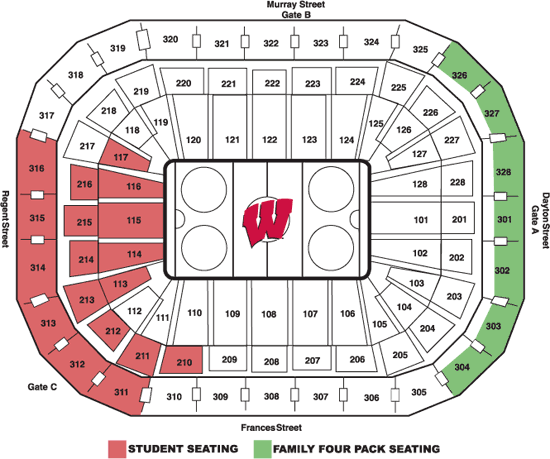
Recently, I got the chance to go to the first UW Wisconsin Men’s Hockey game of the season this past Saturday (October 13th).  After going I started to wonder just how much it would be for certain tickets for this one game not including the money from the 2017-2018 budget and if it was worth the amount of money for tickets. To start I found on the the UWBadgers website each of the tickets worth for each section and the amount of games provided. Here is what I found down below.
kohlCenter-hockey2009.gif (550×459)
Group Ticket Levels (Single game)
Cost
15-39 tickets in the Reserved sections (100, 200, & 300 level)
$18.00
15-39 tickets in the Upper Reserved sections (row D and above in the 300 level)
$15.00
40 tickets in the Reserved sections (100, 200, & 300 level)
$13.00
40 tickets in the Upper Reserved sections (row D and above in the 300 level)
$11.00


Season Pass:
Face Off package→ $215, includes nine regular season home games, B1G quarterfinal 1, and the B1G semifinal.
Slap-Shot package →  $230 Includes nine regular season home games, B1G quarterfinal 2 and 3, and the B1G Championship.

Contributions
Sections
$50 per seat sections
107, 108, 109, 121, 122, & 123
207, 209, 221, 222, & 223
$25 per seat sections
106, 110, 120, 124

Student Tickets:
Season Pass→ $115 + $20 Processing Fee
Sections: 113, 114, 115, 116, 117, 211, 212, 213, 214, 215, 216, 311, 312, 313, 314, 315, & 316


After looking at these ticket prices a lot changed my thinking about how much these games actually cost. Are these ticket prices worth the games? For example what if you buy tickets and the team has a horrible game or gets crushed by their opponent. According to some ticket purchasers they don’t mind paying to watch the sport,for some students who have to pay alongside their college fees it may not sound like the best idea. This would be an example of an oppertunity cost for a student. They either get to go to the games and live the college life or they save that money for other goods and services like food, student funds, etc.  If I was a student going to UW Madison there would be a very high chance of me paying for the season passes to really get to feel like a student at that school. Though I cannot say that about everyone’s decision on these tickets. According to another article on the Wisconsin Sate Journal the price of the UW Women’s Hockey team just got approved to increase the price of tickets, though many people think it won’t be worth the income in the long run. "Women's hockey already has the smallest sign board. It almost never has the band. We do get Bucky," said Viney, a law school professor. "But, otherwise, you're asking people to pay 30 or 60 percent more for their tickets, and they're all going to be asking me, 'What are we getting for that?'"(Wisconsin State Journal). In the end, it all depends on how committed of a Badger fan you are and how much you enjoy seeing them play by watching their games in person, which I certainly love to do.

Works Cited
“Men's Hockey - Ticket Information.” Men's Hockey - Ticket Information - Wisconsin Athletics, uwbadgers.com/sports/2015/8/21/GEN_20140101137.aspx.
Milewski, Todd D. “Badgers Sports: Committee Approves $132.4 Million Wisconsin Athletics Budget for 2017-18.” Madison.com, 9 Feb. 2017, madison.com/wsj/sports/college/badgers-sports-committee-approves-million-wisconsin-athletics-budget-for/article_985308d4-1752-5796-85a6-b4fcc28b087c.html.
Milewski, Todd D. “Committee Approves Wisconsin Badgers Women's Hockey Ticket Price Hike, OKs Wrestling Season Ticket Sales.” Madison.com, 17 May 2018, madison.com/wsj/sports/college/hockey/committee-approves-wisconsin-badgers-women-s-hockey-ticket-price-hike/article_585bedb2-df8a-5789-9add-069d5265683a.html.


 Links:
https://madison.com/wsj/sports/college/badgers-sports-committee-approves-million-wisconsin-athletics-budget-for/article_985308d4-1752-5796-85a6-b4fcc28b087c.html

https://uwbadgers.com/sports/2015/8/21/GEN_20140101137.aspx

https://madison.com/wsj/sports/college/hockey/committee-approves-wisconsin-badgers-women-s-hockey-ticket-price-hike/article_585bedb2-df8a-5789-9add-069d5265683a.html

Image #1

Image #2

Companies are Working Against You

Elise Picard
Companies are working against you. No one reading this is a millionaire, no one reading this is a ceo, it’s safe to say you’re a worker or consumer in modern america, and I can tell you with a great deal of confidence that major businesses are working against you. Whether you’re middle class, lower class, or not sure of your place in the economy at the end of the day, we are being targeted in a variety of ways by corporations.

In america right now we live in late-stage capitalism. And in late-stage capitalism, gaining capital is the only thing that matters. From major businesses like Walmart for instance. In June of 2000 when meat workers decided to unionize in certain braches, unionize with no demands yet, Walmart ended the deli part of the store in six states, following with twenty states after that. The current CEO of walmart makes 22.8 million a year. Another example is ever popular Jeff Bezos. In a recent announcement Bezos claimed that he would be boosting the minimum wage of amazon workers to 15 dollars an hour. What he didn’t mention was the significant cuts to bonuses, forfeit of to a number of medical and dental plans, and commissions for white-collar workers. Jeff Bezos meanwhile has a net worth of 165 billion.

There’s a reason why companies are scared of unions, because their demands will ultimately draw capital away from the ceos and top managing class of workers. Their goal is not a safe or secure working environment, nor is it to pay workers a living wage. It’s too pay workers as little as possible for the maximum amount of gain. This is why, although you legally must offer breaks after working for a certain number of hours, many companies will schedule you for just under that requirement. Or companies will often berate and threaten workers, keeping them on the edge of passive exhaustion.

Companies aren’t just harming workers, they’re harming consumers too. Apple’s been a notorious perpetrator of rigging their products so that they can make the maximum amount of profit. When an apple product breaks, newer models now have a system that can detect if they’re being repaired. And the repairs, even if using official apple products, will lock the user out of the phone unless an official Apple code is entered certifying the repair is by the Apple company. Small tech repair businesses are suffering because a major corporation like Apple has put in place a firewall to ensure you have to pay a bigger price for a repair that could be completed by a local business. It harms small businesses, and it harms you the consumer.

And you may say ‘Then I’ll take my business elsewhere, I’ll buy my phone from a different company’. While that option is still available with phones, many other facets of business such as Internet provision is handled by only one or two providers. That’s why in many locations you don’t see competition. Businesses are no longer managed by small groups or local parties, many major brands are all owned by the same parent company.

These factors are obvious in our government as well. Many politicians, republican or democrat, have strong ties to corporations that manipulate their decisions. Corporate lobbyists have overtaken the government since the 70s, and their influence is unprecedented. One famous and recent example being chairperson of the FCC Ajit Pai who was noted to have ties to Sinclair Broadcasting. He then proposed and voted on changed Internet from Title II to Title I. This choice benefitting Sinclair Broadcasting. The writing was pretty on the wall or this one, but there are more subtle tactics of collusion with companies. Major tax cuts is one way, decreasing workplace regulation another, allowing companies to be treated like citizens is a hugely alarming one.

Corporations don’t just manipulate the government for their own benefit but manipulate the populus. A social media craze a few months ago was the Wendys twitter account, drawing on popular jokes and comedy to make you feel an attachment for the company. We don’t personify that company by it’s food or service, but rather by a faux persona created as a marketing tool to relate and manipulate young people. Corporations pretending to be people seems like an innocent marketing tactic, but is a subtly harmful as it makes corporations feel more human. A massive company should not be treated as a person, should not be treated with religious or personal rights. These social manipulation tactics make companies seem harmless and relatable, yet they are anything but.

Social manipulation is a tool that has been used by the government and corporations for years. In the case of corporations that often comes as punishing all workers for any union involvement, which often makes other workers dislike those who attempt to unionize, and perceive the union workers as the source of the misery, not the punishing company. This was evident in the meat handling union in Walmart. Now Walmart workers are too scared to unionize or else lose their job and get others fired. With the government this is another common manipulation. Often in the event of a disaster it’s the upper class appealing to the middle class to get them to donate to the lower class in disaster. Upper class members could just as easily donate, if not use their resources more effectively but often pull on the heartstrings of the middle class. Guilt tripping them into paying to help the lower class. Or in the instance of the most recent presidential election, instead of confronting the corerations and barriers keeping many people in poverty, the Trump campaign pitted one group of poor people against another group of poor people. Pitting lower class americans against immigrating mexican workers. Claiming the immigrants would steal their jobs and use up economic resources.

In America corporations have gotten out of hand, and similar to the industrial era are becoming more and more manipulative, more and more involved in the government, and more and more powerful. We talk about the degree of corruption in the industrial era and that corruption is a mirror image of what’s to come in American society. We need to regulate corporations, redistribute the wealth, and unionize. Politicians, Ceos, and Millionaires are working to preserve their wealth.


Works Cited
Ann ZimmermanStaff Reporter of The Wall Street Journal. “Pro-Union Butchers at Wal-Mart Win a Battle, but Lose the War.” The Wall Street Journal, Dow Jones & Company, 11 Apr. 2000, www.wsj.com/articles/SB955407680495911513.
CBS.MarketWatch.com. “Wal-Mart to Shut down Meat-Cutting Operations.” MarketWatch, MarketWatch, 4 Mar. 2000, www.marketwatch.com/story/wal-mart-to-shut-down-meat-cutting-operations.
“Corporate Personhood.” Wikipedia, Wikimedia Foundation, 20 July 2018, en.wikipedia.org/wiki/Corporate_personhood.
Feingold, Danny. “Walmart's War Against Unions -- and the U.S. Laws That Make It Possible.” The Huffington Post, TheHuffingtonPost.com, 5 Aug. 2013, www.huffingtonpost.com/julie-b-gutman/walmart-labor-laws_b_3390994.html.
Greenhouse, Steven. “How America's Largest Employer Persuades Its Workers Not to Unionize.” The Atlantic, Atlantic Media Company, 9 June 2015, www.theatlantic.com/business/archive/2015/06/how-walmart-convinces-its-employees-not-to-unionize/395051/.
Harris, Ainsley. “Jeff Bezos Made 1.2 Million Times the Median Amazon Employee in 2017.” Fast Company, Fast Company, 23 Apr. 2018, www.fastcompany.com/40561786/jeff-bezos-made-1-2-million-times-the-median-amazon-employee-in-2017.
Norman, Al. “Wal-Mart's ‘Meat Wars’ With Union Sizzles On.” The Huffington Post, TheHuffingtonPost.com, 25 May 2011, www.huffingtonpost.com/al-norman/walmarts-meat-wars-with-u_b_91757.html.
Totenberg, Nina. “When Did Companies Become People? Excavating The Legal Evolution.” NPR, NPR, 28 July 2014, www.npr.org/2014/07/28/335288388/when-did-companies-become-people-excavating-the-legal-evolution.
Tuttle, Brad. “Jeff Bezos Net Worth 2018: Amazon CEO Has Made $40 Billion | Money.” Time, Time, 5 June 2018, time.com/money/5301812/jeff-bezos-net-worth-2018-amazon-worker-salary.
Winkler, Adam. “Corporations Are People, And They Have More Rights Than You.” The Huffington Post, TheHuffingtonPost.com, 30 Aug. 2014, www.huffingtonpost.com/adam-winkler/corporations-are-people-a_b_5543833.html.
facebook.com/jefferson.graham. “FCC Chair Ajit Pai Investigated for Sinclair Ties, Lawmakers Say.” USA Today, Gannett Satellite Information Network, 16 Feb. 2018, www.usatoday.com/story/tech/2018/02/15/fcc-chair-ajit-pai-investigated-sinclair-ties-lawmakers-say/342893002/.
Related Posts Plugin for WordPress, Blogger...