Friday, May 5, 2017

Summerfest

Danielle Koepp
Economics
Mr. Reuter
4/30/2017
41_summerfest_16x9.jpg
Events such as Summerfest are what is keeping the Milwaukee area in a good economic state, with a gaining number of tourists, and an increasing income. Wisconsin holds the largest music festival, known as Summerfest. Summerfest consists of an eleven day long event that holds multiple concerts, and presents multiple restaurants and services throughout Wisconsin. The concerts are that of many genres from all around the United States. People from all around attend this event because of the large crowds, and famous music groups. In the past performers such as  Zac Brown Band, Lady Gaga, Aerosmith, Bruno Mars, and many others have attended. In 2017 there are scheduled performances from artists such as, Flume, Ziggy Marley, The Chainsmokers, Shinedown, Future, and many more. People are already saving up and planning on seeing these performers. These acts have put on amazing shows that have attracted people from all across the US, bringing in a massive revenue for the Milwaukee area. The Milwaukee World Festive states that, “Summerfest 2013 generated $187 million in positive economic impact for the City of Milwaukee; $226 million for the state of Wisconsin” (MWF). The profit that is made from the festival doesn’t only come from bought tickets, it comes from locally run beer tents, shops, food stands, and games. These places all gain recognition for the Milwaukee area. All of the restaurants and bars that are open to the Summerfest grounds, are in the Milwaukee area, and give people places to come to the next time they’re in Milwaukee.
Oasis_courtesysummerfest-1.jpg

With all of these different things offered a lot of tourists are attracted giving Milwaukee the chance to self promote the city.Summerfest 2016 had brought in, “a total of 804,116 people through the Henry Maier Festival Park gates. That number was a 4.1 percent increase over the 2015 attendance” (OnMilwaukee). As shown its popularity continues to increase, and the income from this festival will continue to strive. People will not think twice about the cost of tickets or food and drink, because they go for the overall experience, and with all that Summerfest provides it is well worth the consumer’s money. As the festival gains popularity the demand increases as well, resulting in bigger crowds, larger bands, and more restaurants. Clearly Summerfest is a positive externality for Milwaukee, and Wisconsin as a whole. It brings in tourists, creates jobs, and is a place for all ages to come in and enjoy music as well as summer life.

"Summerfest 2016 Attendance up from Last Year, plus Other Festival Figures."OnMilwaukee.com. N.p., 14 July 2016. Web. 30 Apr. 2017.
Cary, Docter. "Summerfest Generated $187 Million in Positive Economic Impact."FOX6Now.com. N.p., 05 Dec. 2013. Web. 30 Apr. 2017.

Digitalization Revolution: Spotify

Digitalization Revolution
Alec Ripp

The music industry has gone through some major changes economically in the past two decades due to the increased use of computers and the internet. Illegal downloads and digitalization of music on platforms like iTunes kicked off the  rapid decrease in purchased music. In 2013-2014 CD sales dropped by 15%. We have been moving on from a physical copy of albums for over a decade now, but in the past few years, there has been a 13% decrease in Digital track purchases. Illegal downloads have also caused a major decrease in profit for artists and labels. In 2008 more than half of the music downloaded was pirated and in 2009 30 billion songs were illegally downloaded. During this same time frame pirating music became more popular because of it’s simplicity. Google has done a good job of eliminating the most used illegal downloading websites in the past decade, which has helped push music listeners to use music streaming platforms such as Youtube, Soundcloud, and Spotify.

It’s hard to imagine how artists can make so much money still, when such a small percentage of people pay for albums. These music listening platforms have given artists like Drake the  opportunity to reach billions of streams. Drake’s was streamed more than 4.7bn times on Spotify last year, and every hour, his songs are streamed more than 500,000 times on the app.  So despite the decrease in actual purchases of the album, Drake is still brings in the cash from music streaming. Spotify stated they pay their artists royalties on average about $0.05 per stream, therefore with 4.7 billion streams in 2016, Drake has received an estimated $33,840,000.  

Streaming revenues are expected to double in the next few years. Artists are getting more recognition than ever before because of the simplicity of online music streaming. The most used streaming app Spotify gives consumers the option of free use, or a monthly subscription at a cost of $15 monthly. The incentives for consumers subscriptions are no advertisements, exclusive tracks, and having the option to stream music without using data.
Spotify executive Troy Carter revealed that Spotify had passed 39 million paying subscribers.That more than doubles Apple Music’s estimated 17 million.

Artists are getting more recognition than ever before due to the ease of streaming music. There's never been a better time for artists to get their music heard. With the help of social media, artists have been able to connect with fans on a much larger level. Competition in the industry has risen greatly because of the publicity given to artists on twitter. Subsequently,  demand has increased and will continue to grow exponentially with social media.
Screen Shot 2017-04-26 at 8.28.48 AM.pngScreen Shot 2017-04-26 at 7.20.41 AM.png


Works Cited

Camp, Gregory. "Spotify. https://www.spotify.com/. Retrieved 21 January 2015." Journal of the Society for American Music 9.03 (2015): 375-78. Web. 26 Apr. 2017.

"Financial Times.". N.p., n.d. Web. 26 Apr. 2017.

Adejobi, Alicia. "How much has Drake earned from Spotify with 4.7 billion streams?" International Business Times UK. N.p., 01 Dec. 2016. Web. 26 Apr. 2017.


Print Books vs. Digital

Lauren Orheim
Mr. Reuter
Economics B1
2 May 2017
As technology develops and becomes more popular, people are starting to worry about the fate of traditional print books. Will too many prefer the easily accessible ebooks that books no longer have to be printed? Although books use paper, which could be harmful for the environment, reading physical copies rather than on a phone or tablet has good effects for both the economy and your brain.
Teachers aren’t crazy when they say that reading is good for you. Books of all kinds stimulate your brain, except printed and ebooks weren’t created equal. According to an article by Maddie Crum about why print books are better, a 2012 study “gave half its participants a story on paper, and the other half the same story on screen. The result? iPad readers didn’t feel that the story was as immersive, and therefore weren’t able to connect with it on an emotional level. Further, those who read on paper were much more capable of placing the story’s events in chronological order.” Connecting to characters on an emotional level is practice for working well with others: an important part of improving the economy and life skills in general. Additionally, by immersing oneself in a book, it is easier to enjoy reading and can spark creativity with both writing and other art forms. Creativity and literacy are both important for the economy because without a literate workforce, it would be harder to get work done, and without a creative workforce, we would be without innovation.
This graph accurately depicts the pros and cons to each book type. However, the pros that come along with ebooks books don’t seem to be as important. Most people are able to get a book quickly just by checking it out from the local library or purchasing it from a bookstore, while reading with a child and sharing books with others is much more beneficial. Reading at a young age promotes a greater imagination and yearning for learning. Investing in a child’s future sets them up for success, and a better economy.  
Overall, printed books have more benefits for the economy than ebooks. The next time you read, go to a bookstore and pick up a new book, or go to the library and check one out. The economy and your brain will thank you.


Works Cited
Crum, Maddie. "Sorry, Ebooks. These 9 Studies Show Why Print Is Better." The Huffington
Post. TheHuffingtonPost.com, 27 Feb. 2015. Web. 29 Apr. 2017.
"Top 5 Advantages Print Books Have Over E-Books." The Clarion Ledger. N.p., 23 Sept. 2015.
Web. 29 Apr. 2017.
Yarow, Jay. "CHART OF THE DAY: The Death Of Printed Books." Business Insider. Business
Insider, 05 Apr. 2012. Web. 29 Apr. 2017.
<http://www.businessinsider.com/chart-of-the-day-e-books-versus-print-books-2012-4>.

Nintendo and Deliberate Shortages

Nintendo and Deliberate Shortages

Simon Kirchoff
In late 2016, Nintendo needed to make up for the lack of a big boom for the holiday season. As their new console-handheld hybrid system, the Nintendo Switch, wouldn’t release until the Spring, Nintendo released the “NES Classic” system, a plug-in-play miniature version of their famed home console from the 1983. While not supporting additional games to be bought on cartridges like the original, it came built in with 30 classic games to play, and fans were excited if only for the novelty of owning such a neat item. Unfortunately upon launch, the system was ludicrously hard to obtain. Fans drove from store to store in the unlikely hope that one could be in stock. The most of the few that managed to buy them often bought them in large quantities and sold them online for higher prices, making it incredibly difficult to obtain one for a reasonable price. It wouldn’t be a first time a situation like this has happened. In recent years, Nintendo has had a history of under supplying their products, an event known to economists as a shortage.

Some people speculate that the practice might be done on purpose, as the word of mouth about the rarity of a new product can help generate interest and make it seem like the device is in high demand, hopefully causing a bandwagon effect. It would seem that this trend of under supplying for hype first started with the release of the Wii in 2006. After receiving less and less financial success with each generation since the Nintendo 64 in 1996 and facing their worst selling home console at the time, the Gamecube, the Wii was an extreme success for the company as the third best selling video game home console of all time with over a hundred million consoles sold (VGChartz). The system is famous for its incredibly high demand and rarity during its launch, in which people weren’t able to find one for months. Nintendo might have thought that part of the Wii’s major success was due to this phenomenon, and have tried to imitate it with each major launch since.  

In 2012, Nintendo’s Wii U home console, the under-advertized successor to the Wii, was also relatively hard to find at launch, despite the fact that just a month or two later, sales plummeted drastically (Byford). It’s not so much that the system was in high demand with the general public, but the low supply made it hard for even the demographic of loyal Nintendo fans to acquire the system at launch. Only a few months later near the end of 2013, the system received a price drop, from a price of $350 for the 32GB “Deluxe” edition, to a standardized $300 price while ending production of the $300 8GB “Basic” Edition.


Just a few years after the Wii U’s launch, Nintendo launched an entirely new line of products: collectable figures that work with games called “Amiibo.” Riding the wave of success from similar technology used in games such as Skylanders or Disney Infinity, Amiibo were a perfect fit for Nintendo. The toy and functionality aspect could appeal to their younger audience, while the collectable aspect could appeal to their older, loyal fans. Unfortunately, upon the first wave of amiibo for Super Smash Bros, the chances of younger kids getting their favorite Nintendo character amiibo were rather slim. Similar to the NES classic, the figures quickly experienced a shortage and blew up on the second hand market with insanely high prices.

Those who purchase new products to sell for higher prices are known as “scalpers.” Not only do these people annoy consumers, their practice means that Nintendo could be missing sales of their own. While Nintendo does get the initial profit from the scalpers that buy the items in large quantities, the rapid fast shortage leaves little room for consistent profit overtime. With the high rarity of the product, consumers feel forced to buy it on the second hand market if they want it, or alternatively, not buy it at all. This causes Nintendo to miss out on a boat load of potential sales, and fans to be disappointed and unsatisfied.  

Bizarrely enough, it seems like Nintendo has already seized production of the highly scalped NES classic only a few months after its release, a baffling decision to many (Orland). The device has still been in such high demand, meaning they could still make profit from it, yet instead of restocking they just dropped everything before most even had a chance to purchase one. Rumors speculate this is to focus production on a successor, the SNES classic, to release at the end of this year, but it still seems like a hugely missed opportunity when most that want the system still don’t have one.


Besides this, the newly released Nintendo Switch came out and is also relatively hard to obtain, but this actually seems to be the result of genuine interest as Nintendo has reportedly tried to keep it in stock and the system happens to be one of the fastest selling successes they’ve had since the Wii. But in the same statement Nintendo claimed they would try to prevent Switch shortages, they also said they’d restock the NES classic...and we see how that turned out (Carter). Hopefully from here on out, obtaining Nintendo products can be a lot easier, but recent decisions still make it seem unlikely for Nintendo to change their bizarre business practices anytime soon.

Works Cited

Byford, Sam. “Wii U Sales Collapse with 'Well under' 100,000 Sold in January.” The Verge, The Verge, 15 Feb. 2013, www.theverge.com/2013/2/15/3990934/npd-january-2013-sales-figures-wii-u. Accessed 3 May 2017.
Orland, Kyle - Apr 13, 2017 7:31 pm UTC. “Nintendo Hates Money, Discontinues the NES Classic.” Ars Technica, 13 Apr. 2017, arstechnica.com/gaming/2017/04/nintendo-hates-money-discontinues-the-nes-classic/. Accessed 3 May 2017.

Carter, Chris. “Reggie: Nintendo Switch Won't Have Shortages, NES Classic Getting 'Continued' Stock in the US.” Destructoid, www.destructoid.com/reggie-nintendo-switch-won-t-have-shortages-nes-classic-getting-continued-stock-in-the-us-412425.phtml. Accessed 3 May 2017.

“Game Platforms.” VGChartz, www.vgchartz.com/platforms/. Accessed 3 May 2017.

Tuesday, May 2, 2017

The Economics of Birthdays

Lizzy Strange
Mrs. Straub
AP Economics Insight
2 May 2017

The Economics of Birthdays

When it comes to birthdays, different countries use different traditions to celebrate the lives of their people. For some countries, birthdays are all about ceremonies and celebratory events that are revolved around the cultural of their country. For other countries including America, there is less importance on tradition and ceremonies, but more importance on gifts and ‘Happy Birthday’ cards. Having the opportunity to write this blog post on my own birthday—May 2nd—has lead me to believe that I would enjoy celebrating with another country’s birthday tradition because it would be a lot cheaper than having a normal, American birthday party.
In other countries, there are more traditions associated with birthdays and these traditions are usually more cost-friendly than having an expensive party with presents and activities. In the Philippines, “...birthday cakes are baked in various sizes and shapes. The celebration also includes noodles representing a long life” (“Birthday Traditions from Around the World”). In this culture, the Filipino people celebrate with food and they enjoy one of their culture’s most necessary food items, noodles. This food is so common in the Philippines that it wouldn’t be hard to fix and shouldn’t be too much of an expense or hassle for the family of the birthday person. A company from the Philippines, Joey Prats, sells cake mixes at 175 Philippine pesos, which is $3.49 US dollars, (“Joey”), and grocery stores in the Philippines sell noodles anywhere from 90 Philippine pesos to 30 Philippine pesos which is $1.79 to $0.60 US dollars (“Pasta”). Just adding these prices alone makes the cost of Philippine birthday traditions anywhere from $4.09 to $5.28 in US dollars. There is wiggle room for other expenses in this total, but still, the cost of a Philippine birthday is fairly reasonable and affordable.
Egyptian families also enjoy a simple celebration that is attainable yet celebratory. In Egypt, “Lots of flowers and fruit are used to decorate the party as symbols of life and growth” (“Birthday Traditions from Around the World”). The flowers and fruit set off a happy and bright vibe for the occasion, bringing color and freshness to the Egyptian family table. The symbolism of life and growth also create a happy and celebratory mood for the celebration, and bring in Egyptian culture to the birthday party. An Egyptian florist sells flowers from 53.20 Egyptian Pounds to 79.60 EGP which is $2.94 to $4.39 USD (“Egypt”), and a gourmet produce center in Egypt sells 1kg of apples for 36.00 EGP—Egyptian Pounds—and a 1.2kg pineapple for 60.00 EGP which would be $1.99 USD and $3.31 USD (“Fresh”). This adds to a total of $8.24 and $9.69 in US dollars, which is again very affordable while there is still room for other expenses.
In Europe, German families celebrate with cake which is more like a traditional American birthday, and they also have another interesting tradition for younger, single men. In Germany, “....a member of the birthday person’s family wakes up at sunrise and lights the birthday cake to be lit all day long” (“Birthday Traditions from Around the World”). The lasting candles carry on the celebration of an entire day dedicated to someone’s birth, and as Americans, we can relate to the tradition of having a cake to symbolize our birthday celebration. A store in Germany entitled Real sells a pack of birthday candles at 1.93 euros which is $2.11 USD (“13tlg.”) and a company in Germany called Kaufland sells a box of mix for a Feine Speisestärke cake for 0.55 euros which is $0.60 USD. (“K-Classic”). This German tradition costs $2.71 in USD, which is again a very cost friendly tradition to uphold. An odd tradition that Germans also have for their birthdays is that when a man is still single at age 30 in Germany, he will sweep the steps at the city hall while his friends throw garbage at him—this indicates to the rest of the community that the man does not have a girlfriend (“Birthday Traditions from Around the World”). You can see this tradition demonstrated in the image below.
Lastly, after learning about traditions and expenses in other countries, we get to the familiar American birthday traditions that we have all grown up participating in. In America, people buy gifts for each other when it is their birthday. An American family will also normally have a birthday cake or birthday treat including ice cream, brownies, etc., and they will light the treat with as many candles as there are years that the birthday person is celebrating. Americans tend to lean more towards material things when it comes to events and birthday parties, and stray from cultural celebrations unlike the rest of the world. Proof that the American birthday tradition is to spend more on gifts and birthday activities was discovered on CBS local news when “A new study found the average parents today spend $450 on each birthday party for each one of their kids, every single year. And that’s BEFORE they spend $250 on presents.” (“The Cost Of A Child’s Birthday Party”).
Compared with the prices of traditions around the world, Americans spend a lot more on birthdays than anyone else. Of course there are other factors other than cake mix prices and fruit prices to be taken into consideration when determining which country spends the most on birthday festivities. One of these factors would be if families in Germany had lower income in comparison to American families; if that were the case, American families would be able to afford more than German families. Another factor would be if Egypt’s economy had higher price levels, increasing their real gross domestic product, prices, and demand for money, which would eventually drive up the real interest rate and increase every German consumers’ want to save. If consumers are saving more, they’re spending less. And if they’re spending less, they will want the most affordable birthday party and birthday tradition. From an economist's standpoint, choosing a cheaper, more affordable way to celebrate your birthday would be the best option, and if that option were from another culture, there would also be a positive externality of having a new experience and fun opportunity to embrace other cultures and countries. Overall, birthdays would be more fun and affordable in the United States if once in awhile we decided to try a different culture’s birthday tradition and see if our families and our wallets liked that option better.


Works Cited
“Birthday Traditions from Around the World.” Coolest Kid Birthday Parties, Briff Me, Inc., http://www.coolest-kid-birthday-parties.com/birthday-traditions/.

“Egypt Gifts and Flowers.” Egypt Florist, Egyptflorist.com, 2017, http://www.egyptflorist.com/.

“Fresh Fruit.” Gourmet Egypt, Gourmet Egypt Food Stores, 2016, http://www.gourmetegypt.com/fresh-fruits-vegetables/fresh-fruits-vegetables/fresh-fruit.

“Joey Prats Ultra Mixes: Home.” Joey Prats Ultra Mixes, Joey Prats Ultra Mixes, 2014, http://www.joeypratsultramixes.com/.

“K-Classic Feine Speisestärke 400g.” Kaufland, Kaufland Stiftung & Co. KG [DE], https://www.kaufland.de/sortiment/das-sortiment/sortimentsdetailseite.article_id=3602794.html.

“Pasta and Noodles.” Walter Mart Supermarket, Walter Mart Supermarket, Inc., 2017, http://www.grocerydelivery.com.ph/cooking-baking/pasta-noodles.html.

Ray, Margaret and Anderson, David. “Module 20 and Module 29.” Krugman’s Economics for AP, Second Edition, Worth Publishers, 2015, pgs. 201-208 and pgs. 276-285.

“The Cost Of A Child’s Birthday Party.” Y98, CBS Radio Inc., 21 Jan. 2016, http://y98.cbslocal.com/2016/01/21/the-cost-of-a-childs-birthday-party/.

“13tlg. Kerzen Set ‘Happy Birthday’ Deko Geburtstagskerzen.” Real, https://www.real.de/product/301388527/?sl=IEdlYnVydHN0YWdza2VyemVu25bZt7eHtOvbjhpcyZDQUpdxYg-1vvgyksVdqjh-IJc.

Should We Increase Minimum Wage?

Jess Fonte
Should We Increase Minimum Wage?
Most people who have a job would gladly accept an increase in their hourly wage; specifically people who are only making minimum wage. Although this increase in wage sounds ideal for the employees, it might not be as ideal for people that typically buy goods and services from the business, as well as the business itself. In the end however, an increase in minimum wage will bring forward more benefits than it does negatives, therefore it should be increased.
Above is a graph that shows the correlation between restaurants’ average star rating and how likely they are to close down. It also shows restaurants that pay their workers minimum wage, and restaurants that pay 20% more than minimum wage. This graph shows that at any given star rating, restaurants that pay minimum wage are less likely to close than those who pay more. Although this may seem like a bad thing, it brings many positives as well. Since restuarants with high ratings aren’t the ones that are closing, this increase in restaurants shutting down would cause the overall quality of restaurants to increase. The reason why higher paid employees’ establishments are more likely to close is due to the fact that the demand for these restaurants are relatively elastic since they tend to cater towards less wealthy individuals. Since in increase in wages would also increase the price, it would cause an overall decrease in demand. This then causes the consumers to think of other alternatives instead of eating out such as cooking at home.
Another benefit from the increase in minimum wage would be less reliance on government aid such as food stamps, medicaid, and energy subsidies. Since the relative minimum wage is not high enough due to inflation, many people rely on government aid in order to scrape by. Using the Bureau of Labor Statistics longest-running measure of inflation, the minimum wage should be $10.95 today. Since it is well below this, it demonstrates how people making this hourly wage are struggling to survive in today’s economy. If the minimum wage were to increase, they could provide more for themselves, and become less reliant on government aid. This is a benefit for our economy, therefore helping to prove the point that minimum wage should be raised.
In conclusion, an increase in minimum wage will improve the overall quality of restaurants as lower quality restaurants will be forced to close down due to the inability to maintain customers with an increase in menu prices. Along with this, it will provides individuals with better living opportunities, as even if they are laid off from their job, it is not structural unemployment, so they will be able to find work otherwise.

"Higher minimum wages may make bad restaurants close." The Economist. The Economist Newspaper, 29 Apr. 2017. Web. 01 May 2017.
"The impact of raising the federal minimum wage to $12 by 2020 on workers, businesses, and the economy: Testimony before the U.S. House Committee on Education and the Workforce Member Forum." Economic Policy Institute. N.p., n.d. Web. 01 May 2017.

Economic Impact of NBA Playoff Basketball

Economic Impact of NBA Playoff Basketball
By: Jack Gohlke

In the NBA, each team gets 41 home games every year. This allows for their arena to generate ticket, concessions, and merchandise sales at each one of these home games. It also allows the surrounding restaurants and venues additional opportunities to host fans and generate revenue, especially with the much higher demand on the premium brand of basketball that's played in the playoffs. That’s just one of the many positive externalities of a city's franchise getting to play more basketball in the spring.
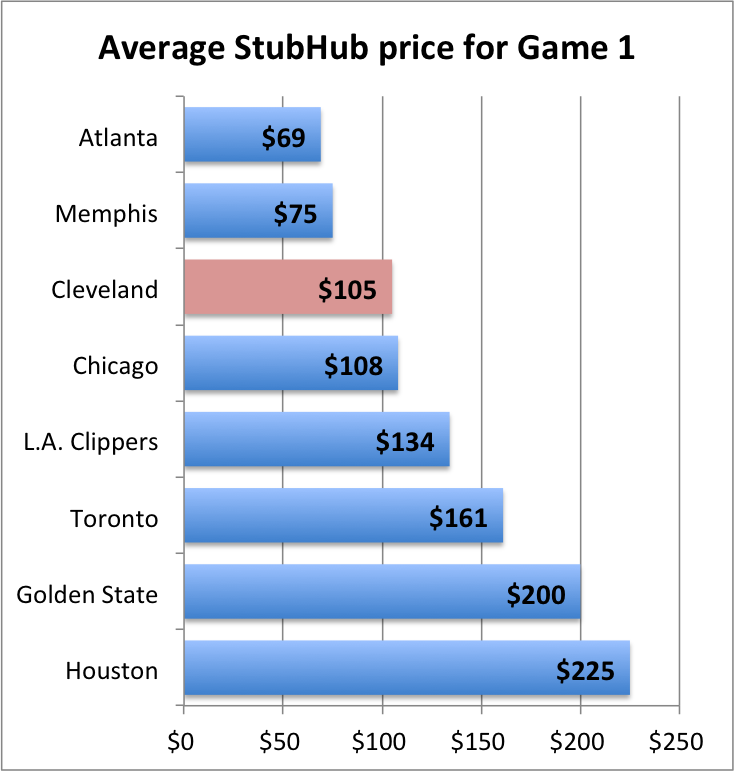
The stadiums themselves bring in a large amount of extra revenue for teams since it’s the playoffs. Almost every game is a sellout, and teams hike up ticket prices due to the higher demand. In just the first round, average ticket prices hover right around $220. With the second round, it’s important to note that ticket prices for the second round typically range from $129 to $379. The conference finals is ratcheted up another notch with prices falling somewhere between $194 and $786. These numbers stand alone to prove how having a playoff basketball team allows that much more opportunity for a franchise to make revenue.
Some teams however, that aren’t in the big markets like New York City or Los Angeles don’t benefit quite as much from these rises in playoff ticket prices. These prices represent the league as a whole, and getting into games in Atlanta or Memphis is much cheaper than one would expect. A seat in the nosebleeds would only run you $30 which seems like an anomaly due to the demand for playoff basketball. However, in reality it makes sense because those teams have large arenas, Memphis’ seating over 18,000, and filling those seats that are perceived to be a mile from the floor can be tough. As you can see in the graph, prices for the bigger cities are much higher on average than those of smaller markets creating a disparity in the market. The main reason that selling these nosebleed seats is tough on small market franchises has to do with how they’ve developed their fanbase. The fans are so into their team and want to not just watch the product from afar but experience it up close and personal while being a part of the action.
Overall, the impact on these NBA cities is a great one as there truly isn't much of an opportunity cost to opening up the arena for additional opportunities to generate revenue besides extra traffic in the city. The amount of new ticket and merchandise sales for each franchise and the league as a whole is a win for everyone.


Works Cited

"The Cheapest and Most Expensive NBA Playoff Tickets." ClutchPoints. N.p., 15 Apr. 2017. Web. 02 May 2017.

Hill, Adreine. "Ratings, Ad Revenue for the NBA Playoffs." Marketplace. N.p., 02 June 2016. Web. 2 May 2017.

"NBA ticket price first round playoffs 2014 | Statistic." Statista. Statista Inc., n.d. Web. 02 May 2017.

"2017 NBA Playoffs Tickets." SeatGeek. N.p., n.d. Web. 02 May 2017.

Related Posts Plugin for WordPress, Blogger...